






Ensconced on my godparents’ bed—a surface comprised of more books than actual bed, my godmother Gayle petted my head. “When you were little, we’d make you say ‘I’m the bad one,’ over and over.” She erupted into laughter. “You’d get soooooo mad.”
I laughed too, though the story—which I’d been hearing all of my fourteen years—always touched a tender spot in me.
My godfather Jeff, sprawled on the floor, sucked on the joint in his hand and made a low sound in his throat. “Such a bad baby,” he crooned in his Arkansas accent.
The bad one. The bad baby. These were teasing words, ones that return to me when, twenty-five years removed from that scene, I check voicemail, and my mother’s voice is a bellows of grief-stricken breath, “Please call me back, I have some very sad news. Gayle died back in September. She’s just gone!”
Sobs catch in my lungs in sticky strands of disbelief while my mother’s tears come easily. Do I have any right to tears after all? I who ceased contact? The bad one.
I tumble into memory: age thirteen, sobbing my heart out on Gayle’s couch over some stupid boy who was unimpressed by my flat chest and bookish ways, while Sinead O’Connor sang “Nothing Compares 2 U” on repeat; white knuckling the grip of her car as she slalomed the streets and freeways of San Diego with her New Yorker’s spirit and style, having only learned to drive in her forties.
Back in the horrible present, my mother reveals: Gayle died six months ago, and none of us knew. Or was that knowledge a mangy stray dog on the porch we didn’t want to let in? Maybe I did not want to interpret the silence, the sudden thoughts of her like the stabbing pains of moving a stiff muscle, putting her out of mind so much easier than stepping through a thicket of apologies and explanations.
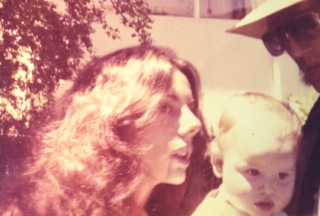
Later in the week, when I tell my friends “There has been a death in the family,” an oil slick of guilt washes through me. The loss is real, and Gayle was family—she’s a dark-haired beauty in my parents’ wedding photos, then cradling my plump face to her high model cheekbone a year later—and then again in my own wedding decades later, but I can’t claim to have behaved as family behaves. There was no round-the-bedside vigil for her, as with my Oma, or a last goodbye, as with my Opa. I hadn’t seen Gayle in the flesh in nearly six years. I hadn’t spoken with her, either, other than to send Christmas cards with my young son’s face. I told myself: Life gets busy. There’s always time. Or was the truth closer to: look away from what you can’t handle?
Grief settles in my shoulders, lumps of pain that produce tears when I turn into them in the grocery store, facing off with the frozen pizzas so that strangers passing by won’t know I’m losing it. We deserved to know. At the very least, my mother—her oldest friend—deserved a chance to say goodbye.
The journey to uncover Gayle’s silence began when my mother’s husband, Paul, had a dream that that Gayle was “nowhere” and her husband, Jeff, was “far away.” And this dream scratched an itch already building. Only due to my mother’s determined sleuthing, phone calls to Gayle’s doctor and eventually, to the county records office, can we confirm: Gayle is dead. Has been for months, her body buried in an unmarked grave near her father’s in Mill Valley, California. Their house is empty, the phone line leads nowhere.
But the worst part is the rusty blade between my shoulders I can’t pull out no matter how logic tries to intervene, the voice that says: It’s my fault. I’m the bad one. I told the truth about my experience with my godfather, Jeff, and I told it hard in an essay published in The St. Petersburg Times in 2005 (he’s called “Jack”). Its opening line is a poison dart: “This year my family and I placed bets on the death date of my godfather, Jack.
The essay I never meant for him to read, he read. The last words we exchanged were vitriolic, spiteful. He called me a liar in words so big I had to look them up. “Don’t flatter yourself,” he’d said of my suggestions that he’d leered at me in my first bikini. Nor humor myself that I had any clue about his actual feelings or intentions. As if you’d remember, I wanted to say, you were drunk so much of the time. The published essay is a carefully carved skeleton of the larger truth, omitting his romantic pursuit of my 20-something friend “Karen” and his artistic stage of painting larger-than-life canvas vaginas. I had skirted the edges of his eccentricities and darkness.
Yet what I never said to her is an acid burn to the heart: I never thanked her for years of surrogate parenting, anchoring my mother through her addiction; for all the books and magazines I could desire to read in private room in their San Diego condo with the ocean view; for those stories, raw honey in the hive of my childhood, of me as a toddler with tuna fish in my hair stomping about dictatorially demanding sweets.
After all, life gets busy—what’s a few months, five, a couple years?
There’s always time.
And then there isn’t.
Cancer had carved out a slice of Gayle’s torso in her childhood. I never thought twice about this half-moon indentation in her side, though it gave her a limp, but my mother told me it had always eaten into her sense of worth and beauty. I always saw her as beautiful—under a head of glossy soft waves, with sharp, knowing eyes and a room-filling laugh—and so had many men, my mom recalls, when they were young.
Warned that cancer could return in her adulthood, we were still raw with shock when Gayle found a lump in her breast in her fifties which led to a mastectomy.
“I’m tough,” she said of beating it. “I’ll be fine!”
Sure enough, she beat the second cancer into remission, but several years later she had to retire on permanent disability from her high-powered TV advertising sales job. She was losing weight and feeling “off.” One little known side effect of chemotherapy is a form of diabetes that steals nutrients from the person’s body. Never more than one hundred pounds in her life, she began steadily losing weight. Once, my mother and her husband, Paul, rushed down to visit, alarmed by a phone call where Gayle sounded unintelligible.
“When I saw her, I gasped.” My mother’s hands shook as she later recalled Gayle’s image, carved down to bones at fifty-nine pounds. “She was thin as an Auschwitz survivor. I couldn’t look directly at her when I talked.”
At my mother’s insistence, as though he had simply not noticed her emaciated state, Jeff made a doctor’s appointment, and Gayle was rushed directly into the Emergency room. The doctor—whom my mother also saw—later told my mother the entire office was horrified at the sight of Gayle’s weakened and withered form.
The last time I saw Gayle, she had been home several months after that same hospitalization, rescued from the edge of death quite literally. Her legs so swollen and weak that she couldn’t walk.
She was cheerful, patted the seat beside her where I was hesitant to plunk my five-months pregnant self, my protruding belly like an affront and in such stark contrast to the reduced woman I saw before me. “The doctors took such good care of me,” she said cheerfully.
It took a physical effort to look at her without a horrified hand to my mouth. Gaunt in the face, and leached of color and moisture, her already tiny frame shrunk even further, her skin clung on in patchy flakes, like a human version of mange. “You look like an angel,” she sing-songed.
Guilt bloomed through my healthy, gravid body.
I was there because I thought it might be the last time I ever saw her. I went, I suppose, to say goodbye, though she would, in fact, live seven more years. She asked about my writing and called me “baaaaaby,” as she always did, drawing out the word like a sentence all its own. She didn’t accuse me of silence. She didn’t ask why it had been so long. I longed to reach back through time and have never abandoned her. But Jeff darted past us, an ellipsis of unspoken things between us, unable to sit still. He and I played the part of two people pretending that we had not said terrible things to each other.
Jeff, like many addicts who struggle with sobriety, had tried and retried the patience of those who loved him, including Gayle. Attempts to get sober in which a humbler, gentler, more open man appeared to us for the first time in years, eventually failed. It got so bad that once Gayle even spoke of divorce. And yet, with a child’s ability to see the best in people, I looked up to him—loved his southern lilt as he droned on about Jazz and Shakespeare. Through him I came to understand there was something valuable, almost divine about writers and great books. I revered his literary knowledge, at the same time as my hackles often rose in inexplicable shivers around him after he doctored his coffee with vodka.
I wanted to believe he was good and trustworthy. To accept otherwise was to question the entire framework of my world and all the people in it.
The child of an alcoholic myself, Jeff had once defended himself against me by saying, “I think it’s just easier to be mad at me,” suggesting that my anger at him was a stand-in for my mother; that he was a safer target. There was some truth in that. But still, I ached for an apology, a defense, an “It’s not the way you think it was.” Or, more than anything: “I loved you too much to treat you that way.”
Death is supposed to be the great leveler, and not just for the dead. Before my mother called that day, I had long since stopped imagining Jeff’s funeral, and instead, envisioned the more likely reality of Gayle’s. I imagined that Jeff would look hangdog and dark around the eyes, but in our mutual sorrow, we’d hug and taut band of anger inside me would snap and release. Forgiveness would wash over me in memory of the elation that had lifted me when I arrived each April to their house, with its heady sweet-acid scent of coffee and pot, books rising in literal stacks like the ruins of great monuments. In my imagining, I’d put my hands on Jeff’s shoulders and tell him that none of it mattered so much anymore, not the things we said or the ways we failed each other, not really, because we’d been part of the making of each other’s lives, and before we knew it, we, too would be gone.
But that’s not how the story went. The only place I can speak to Jeff now is in angry dreams where we spit accusations at each other.
And then, the other night, I dreamt about Gayle for the first time since I learned of her death. I’d gone to her apartment in search of answers, and there, instead, I found her, very much alive, though frail and small as a child, not far from death, but cheerful, sitting in that bed perpetually surrounded by books and magazines.
“Oh baby,” she said, reaching for me. “Such a good girl. I was here all along.”

Jordan E. Rosenfeld is the author of the novels Forged in Grace, Night Oracle, and the forthcoming guide, A Writer’s Guide to Persistence. Her essays & articles have been published in Brain, Child, Bustle, Full Grown People, Medium, Purple Clover, The Rumpus, Roe/Reboot, New York Times, Washington Post and more. www.jordanrosenfeld.net.
–Art by Rona Keller