Jason Mashak

September 14th, 2011 § 1 comment § permalink

On Somewhere Never Traveled, Gladly Beyond
Postscript to “Places”

(for Karolina Majkowska and her students)

Imagine a small boy lying
on the deep-shag carpet of his living
or rather his parents’ living or rather
the bank’s living room floor.

He is looking at, studying, a map,
thinking what it must be like to live
someplace else. After hearing
his grandpa say a Danish prayer,
his great-grandmother coughing out German,
his other Bohunk and Polack elders,
he realizes, young, he is of the world
and not of a country or race.

The boy soon tires of pronouncing
his name for Anglophiles — he knows it
doesn’t fit the language he was born to master.

Later, he gets a spinning globe
to accentuate his maps, plays a game
holding his finger on it as it spins
and wherever it stops is where he’ll go someday.
Cartography is therapy, he thinks, and so he begins
to listen — to really listen — to from
where came who and what and why.

In time, he’ll write a poem titled “Places.”

Author Biography

Jason Mashak (b.1973) lived in Michigan, Georgia, Tennessee, and Oregon before moving in 2006 to Prague, Czech Republic. He has two mostly Slovak daughters with whom he derives much inspiration. His first book of poems, Salty as a Lip, was anointed Most Poetic Book for Haters of Poetry in 2010 by Black Heart Magazine. An expanded, 2nd edition of the book is forthcoming by Haggard & Halloo (Austin, TX) sometime in 2011. Mashak’s writing can be found in numerous journals and anthologies, including a few in Czech translation.


Jason Lasky – HALiterature – on America

September 14th, 2011 § 2 comments § permalink

My America, I am to trust. Why, what’s all the fuss?

My homeland security, my land of absurdity,
My streets paved with gold and blood.
My soaring, smoking towers, my transmogrified presidential powers,
My incendiary, far-reaching, democratic brotherhood.

My America I am to trust. Why, what’s all the fuss?
Whatever happened to that bright dream and promise?

My white neighbors strengthen, my blue families weaken,
My red suburban wasteland continually replicates.
My fingertips of expedience, my web-savvy convenience,
My fire-breathing, flag-waving, war-mongering state.

My America I am to trust. Why, what’s all the fuss?
Whatever happened to that bright dream and promise?

My media’s leftist agenda, my media’s rightist agenda,
My middle men and women all but confused.
My elected (un-)officials, my power-seekers in scandals,
My blazing words hurling all sorts of scathing abuse.

My America I am to trust. Why, what’s all the fuss?
Whatever happened to that bright dream and promise?

My lame ducks in rows, my (reality?-based) nightmarish shows,
My consumerist, conventional, guaranteed trash.
My starving fellows on the street, my land of plenty to eat,
My ever-burning, faith-valued, green-backed cash.

My America I am to trust. Why, what’s all the fuss?
Whatever happened to that bright dream and promise?

My eyes are heavy, but my fingers are mighty,
My repugnant, reviled, “un”patriotic reproof all but done.
My country shakily stands as, through the neck, slip the sands,
My words, my tools, are my only truthfully American weapons.

My America I do trust. But that’s not the fuss.
Whatever happened to that bright dream and promise?

Author Biography

Jason is an actor, playwright and poet currently living in Shanghai.  His original work has been performed in England (Nottingham University’s New Theatre), New York (Coffee Bean Productions) and Shanghai (Shanghai Repertory Theatre and HALiterature).  Currently, he is a patriot who is wondering what’s gone wrong. More of Jason’s work can be found at www.haliterature.com. 

Kira Clark

September 14th, 2011 § 0 comments § permalink

Poet Kira Clark on the theme of “Red Shoes.”


These Red Hard Things

You and I moved to a small room for a brief time.
Our family dead stepped over our flattened and sleepy bodies.
In that room my dreams were alive and
took the shape of moths too distracted by the
light shooting off your face to do anything but hover around you.

I took my high heeled white shoes,
the pointed toes like an accusation,
the rounded heel an apology,
and covered them with tiny red heart stickers.
These covered shoes-these red hard things,
I danced on your face with them at night
and reminded myself, like a ritual
that the heart in you was just an eggshell,
the bursting and running yolk of you was something else entirely.
In the mornings I tried to be a blossom
in the center of your chest, tearing itself open to the soft milky light.
These days
you still have to rip yourself open
to the unbearable things in this world
and to the unbearable things nesting in you.
I know it is hard.

I told you
It is not good to live among so many beached whales!

You told me
“You don’t understand.
I am a beached whale and
you have crawled inside of me and died,
a dead thing inside of a dead thing
inside of a world that will sigh in our faces
like spidery little earthquakes,”
and so when we opened our mouths,
flies spilled out and
we were a gray, hushed tone.

Author Biography

Kira Clark hails from Oklahoma City, moved to Austin and has settled in Portland where she is happy with the rain and melancholy. She runs a poetry open mic, competed in the Portland Poetry Slam finals this year as well as contributes and edits to an experimental flash fiction press, Housefire. Her writing also appears in the recently published book, Heartbeats.

Chris Leja

September 14th, 2011 § 0 comments § permalink

Portland poet Chris Leja on the topic of rapture.

After The Rapture Had Passed

we drank like beaches
trying to swallow the ocean,
our voices, trapped in bottles
rising with the tide
(there was a message
behind the shouting.)
We made a bonfire in the front yard,
with papers and notebooks for kindling,

left a history of the people we had tried to be
smoldering in a birdbath,
a stone urn collecting the
chronology of unfortunate mentors
and indelicate lessons that had
made us so calloused.
We called it cremation,
and meant rebirth.

When the embers of old promises
suffocated the flames,
we breathed for them, sending
clouds of cinders swirling through the air—
with each exhale, we watched the ashes hover,
before they succumbed to slow descent,
a picturesque blizzard
surrounding some kind of Eden.

When the rain started, it was nothing like a baptism.
It was something holier. We stood like
the lungs of bonfires, reading aloud
whatever the flames left legible
(the words, coarse shadows
on newly golden pages).

We joked about apocalypse,
left the taste of rapture wrapped
around our tongues, as we drank
like saviors and laughed like thunder.

This is what I know of scripture—
sacred is just a word for that which rebirths us
into our bodies. It is not found in bibles,
just the remnants of bonfires
forming a galaxy around us.
When the fire swallowed everything
we’d once called holy,
we started breathing for ourselves again.

I was surprised at how much
it felt like prayer.

Author Biography

Chris Leja is a senior at Lewis & Clark College in Portland, Oregon. He has represented LC three times nationally at the College Union Poetry Slam Invitational, is a founding member of the Sparrow Ghost Collective in Portland, and just released his first chapbook, A Chronology of Quiet Thefts. He also has an impressive collection of snakeskin shoes and a peculiar affinity for the word “vernacular”. You can contact him at cleja@lclark.edu.

Jillian Brall of Unshod Quills on America

September 14th, 2011 § 2 comments § permalink

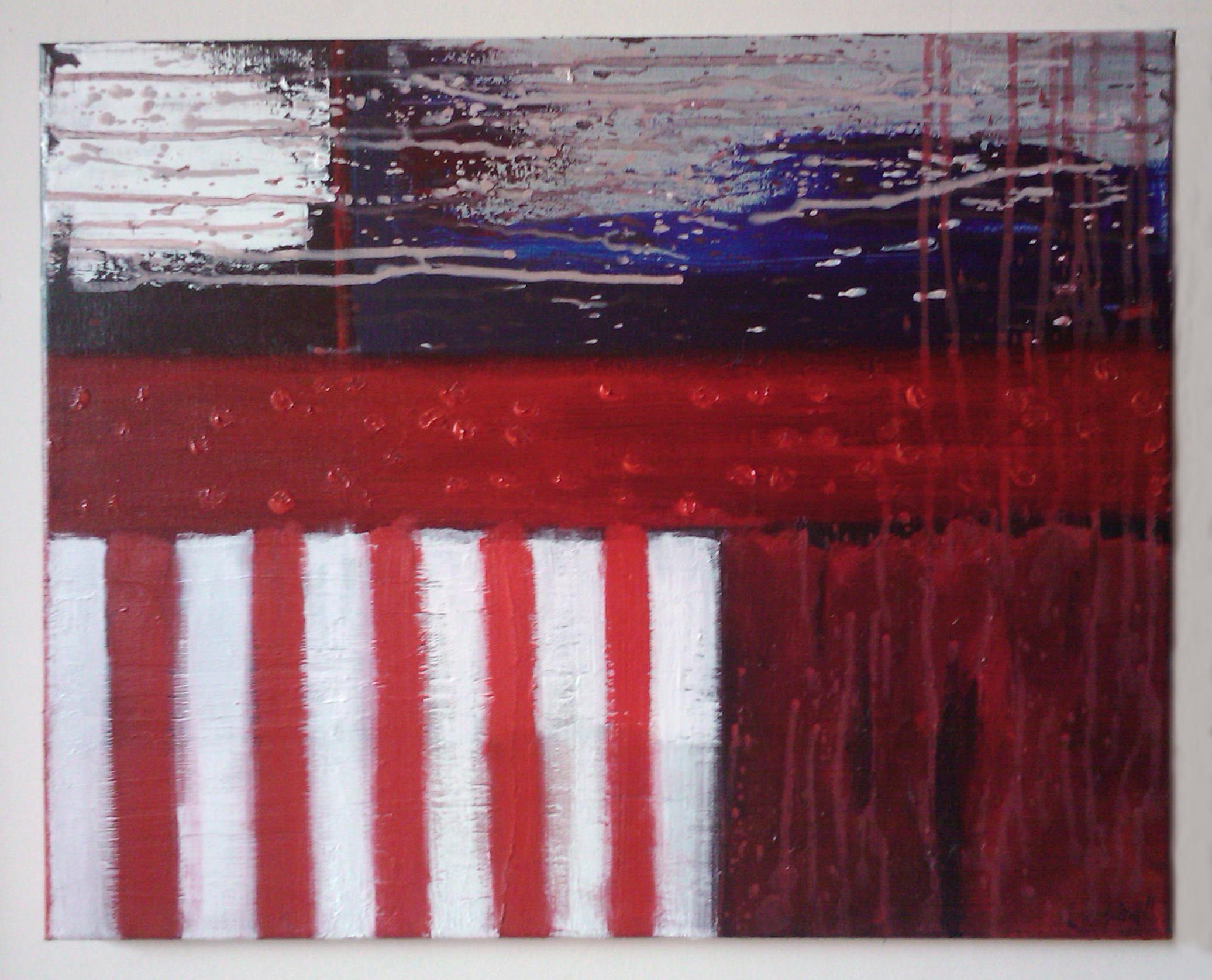
America the Beautiful - original painting, Jillian Brall

Out Of This World

Stop whatever you’re doing and come inside.
Skeletal structure has no use in a weightless environment.
There are some writers who don’t seem to have any necessity to travel at all.
It’s all inside.

Postcards saying Greetings from the U.S. of A! never feature photographs of winkled faces.
I pointed this out to you and then said something about plastic surgery.
Then a couple minutes later inside a bookstore
a girl walked in and said something about plastic surgery.
I pointed this out to you and you sang Synnchronicccityyyy.

Over someone’s shoulder I read, “Should have been the happiest”.
A couple minutes later over the same shoulder I read, “Democracy”.
But I knew the real ending to the sentence was “girl”.

Someone added a Hitler mustache to the graffiti monster on my block.
The character in the violent game said, “I’ve never seen it so quiet”.
The kid said, “Yo yo yo turn it up.
This is the best part.”
This is the part you recognized from a world away.

Author Biography:

Jillian Brall is a writer, musician and visual artist living in Brooklyn, NY. She co-edits the journal Lyre Lyre. 

Dena Rash Guzman of Unshod Quills on America

September 14th, 2011 § 0 comments § permalink

salt box house

I’m wood-clad, weathered
gray by snow and sun. The lights
inside my stories flicker as the moon
calls and departs, full or waning –
phases little matter, matter little
to hours creeping through
the rooms which define and redefine
by fashion and function my trusses,
my mortise-and-tenon joints.

The architecture of nothing nailed,
of metal shanks not present, solid
and creaking all at once; simple
and stoic, I populate
my space in time as only something
purely necessary will. Leaning near
a copse of trees, I cover and nurture
my humans, my spanning generations.
They creep from cradle to rocking chair
here beneath my hand hewn beams,
crafted to last beyond the end of a
hammer’s ring,  until after
the end of fleshly
pleasures, of love, or loss. I decay
over decades but hold.

Author Biography

Dena Rash Guzman is a writer. She edits Unshod Quills.

Catherine Platt

September 14th, 2011 § 1 comment § permalink

On “Somewhere Never Traveled, Gladly Beyond.”
The River-Merchant’s Lover
After Ezra Pound’s The River-Merchant’s Wife: A Letter,
Which was based on a translation of Li Bai’s poem “A Song of Chang Gan.”

The plum-blossom boughs hang heavy with doubt
That spring could come and go so quickly.
They sway and dip and light disperses,
Scattering shadows across your face.
The dim line of hills recedes to the west,
The swift rush of river hastens to the east.
Already you are distant, your thoughts lighting
Towards Chang Gan, the courtyard gate.

This is not a time for promises
Even if it were in your nature to give them,
Nor will I offer to wait or write
Or even watch for your return.
Just as I cannot say if I am more undone
By your presence or your absence,
By your look that is a caress
Or your hollow glance that passes me over.

If I step away from you as the blossom lifts
I will see skiffs tethered, boatmen
Making ready to depart, ropes cast loose,
The sudden motion of a slim craft
Assured, skipping out of sight
Around the first bend of the river,
Away towards Chang Feng Sha.

Author Biography

Catherine Platt arrived in Beijing from England as a language student in 1985, and her life and work have intersected with China ever since. She has degrees in East Asian Studies and Anthropology of Development. Based in Chengdu with her family since 2004, she is a freelance writer, translator, editor and consultant to non-governmental organizations.

Gary Beck

September 14th, 2011 § 0 comments § permalink

On the theme of Fire.
Arsonist’s Dream

Burnt offerings
seldom appease
incendiary rage
kindled in madness
constantly smoldering,
only diverted,
temporarily,
by conflagration.


Author Biography –
Gary Beck has spent most of his adult life as a theater director and worked as an art dealer when he couldn’t earn a living in the theater. He has also been a tennis pro, a ditch digger and a salvage diver. His chapbook ‘Remembrance’ was published by Origami Condom Press, ‘The Conquest of Somalia’ was published by Cervena Barva Press, ‘The Dance of Hate’ was published by Calliope Nerve Media, ‘Material Questions’ was published by Silkworms Ink, ‘Dispossessed’ was published by Medulla Press and ‘Mutilated Girls’ was published by Heavy Hands Ink. A collection of his poetry ‘Days of Destruction’ was published by Skive Press. Another collection ‘Expectations’ was published by Rogue Scholars press. His original plays and translations of Moliere, Aristophanes and Sophocles have been produced Off Broadway and toured colleges and outdoor performance venues. His poetry has appeared in hundreds of literary magazines. He currently lives in New York City.


Mark Talacko – Groupthink – America

September 14th, 2011 § 1 comment § permalink

 Wings

Howdy-do, Buckaroo.

Things are grand in the heart of this living empire.

The buildings shine white and grass grows thick on the
bones of decaying armies.

Statues and monoliths weather the elements to bring hope and ensure the ideas that
bind the Empire are not lost and forgotten.

At DuPont circle, a man walks assuredly around the fountain for hours on end, laughing to himself and bursting into tears.

At I and 15th, two men of the law chat amiably at a red
light, thick coronas smoking in their left hands, while
their right hands rest firmly on the throttle of their motorized steeds.

In the trunk of the car behind them, the
body of a young girl decomposes.

A man, his vesture immaculately tailored, ascends from
the metro and enters a mirrored hive. He passes the
outstretched palm of a woman, dirty and deep-lined with years.

A group of school children follow their teacher up the
capitol steps, as waves of Latvians, Chinese, Hondurans,
Israelis, Russians, Samoans, Argentineans, Cambodians,
Uzbekistanis, Moroccans, Mexicans, Pakistanis, Kenyans,
Namibians, Germans, British, Venezuelans, French,
Laotians, Jamaicans, Columbians, Egyptians, Senegalese,
Tongans, Canadians, Koreans, Vietnamese, Iranians, Swedes
and the Dutch race by with their cameras and swelled imaginations.

A man sits quietly by the reflecting pool whittling an inchoate form from a piece of cherry wood with a buffalo bone handle knife.

He observes a group of fattened senators slap each other on the back in necessary camaraderie.

The children reach the top of the steps – their shuffling
feet so small and tender – and turn to face the stretch of the
Mall.

The teacher delivers a propagated speech that
brings tears to the eye of a veteran ambling by as the
children stare in wonder at the grass, so strong and
green, while their young fingers and noses twitch with
electricity.

The teacher lets them breathe the Empire in. And then
herds them into the Capitol with a great sense of pride
and accomplishment in a duty well done.

One little girl lags behind.

She steps out of the swarm of her classmates
and takes a seat on the steps.

She observes the scene for herself.

Her young mind, free from the loudspeaker of her
teacher’s voice, begins to hum, fusing the words of her
teacher and its own experiences together to form
questions and knowledge.

Her eyes wander down from the copper back of Grant and
his horse to meet those of the whittling man.

He returns her stare. His eyes are deep and piercing.

She is scared.

Her mind flashes battle cries, feathers and bare-chested
warriors with whizzing tomahawks; taut bows and sharp
daggers between teeth. Words spring from books read and
things heard. Images glow from things seen through
projected eyes.
She should flee and join her class but her fear is checked by his smile. It draws her.

She walks down the steps to him, her mind moving into new realms and planes, recording and connecting.

“Hi,” he says crouching down to her level as she timidly approaches him.

“Hi,” she whispers.

“My name is John,” he pauses. “What’s your name?”

“Susie,” she says, a little louder than before, but dropping her eyes to his shoes.

“Hi, Susie. Are you having a good time in Washington?”

“Yes.” She looks up at him.

He smiles warmly.

She feels the tension leave her body. She smiles warmly in return.

“Are you learning a lot?”

“Uh-hmm,” she nods.

“Do you like learning?”

“Uh-hmm,” she nods again.

“That’s good, Susie. You remember to always keep your mind open and learn, OK?”

“OK,” she smiles.

She bounces on her toes, and looks around her, “Um…are you an In’jun?”

John smiles. His deep eyes twinkle.

“Yes,” he says in a voice filled with laughter. Susie relaxes.

“I thought In’juns were bad,” Susie says. Her eyes look askingly at John’s.

“Well, there are bad Indians, just like there’s bad every bodies. And there’s good Indians, just like there’s good every bodies. Have you noticed?”

“Uh-hmm,” Susie nods her head. “There’s this boy who always pulls my hair when we have tests,” she says quickly, surprised at her own voice.

“And you think he’s bad?”

Susie nods her head.

“And are there any good kids in your school? Your friends?”

Susie beams, “Kim’s my best friend. She always gives me her apple sauce at lunch because she doesn’t like it.”

“That’s a good friend,” John smiles.

“You’re a good In’jun, right?”

“What do you think, Susie?”

“Ya. I think so. You’re nice.”

Susie smiles at him with her eyes.

“Thank you, Susie.”

“SUSIE?” The teacher’s worried voice booms from the capitol steps, “SUUUUSIE!”
.
Susie whips her head around and waves to her teacher. Her teacher spots her.

“Get up here young lady,” she shouts, her left hand motioning angrily up the steps, while her right hand remains planted firmly on her hip. The people turn to watch.

“I gotta go,” Susie says, standing in place.

“I hope I didn’t get you in any trouble.”

“No. Ms.Washington is always yelling.”

“Is she bad, Susie?”

“I don’t think so. She lets us have class outside on nice days.”

“That’s nice.”

A silence lingers in the air.

“Well, it was nice meeting you, Susie.”

“You too.”

“SUSIE! Get up here now!” Ms. Washington yells.

“‘Bye,” Susie says, turning to run.

“Wait Susie.”

She stops and turns back around.

“Here you go.”

John gently takes Susie’s hands and places the whittling work into them.

“Now, scoot along, before your teacher gets really mad,” he says, pushing her softly away.

“Thanks,” she says and moves off slowly.

“Remember, you learn something new every day, OK?” he calls after her.

“SUSIE CUSTARD! GET UP HERE RIGHT NOW!”

“I will,” she says over her shoulder, and races up the steps.

“Don’t you ever get away from the class like that again,
do you hear me? The whole group has had to wait because
of you. Who was that man? What did he say to you? Who was
he, hmm?” Ms. Washington rattles on breathlessly.

“That was john. He was nice.”

Susie smiles at the angry Ms. Washington.

“He told me to learn every day,” Susie says, hiding the whittling in her hands against her belly.

“Well, that’s good,” Ms. Washington pauses, somewhat
confused. “Come on. We’re all waiting,” she says, the
anger gone from her voice.

Susie turns to John and waves.

John waves back.

Ms. Washington hesitantly raises her arm to give a wavering salute.

“Come on Susie,” Ms. Washington says, and she turns, pushing Susie gently in front of her to rejoin her class.

As they walk deeper into the Capitol, under its arching columns and balustrades, Susie opens her hands to see what John gave her. In her soft, pink palms rests a magnificent eagle with a broken wing.
Author Biography
A father and husband

A writer
Born
Living
Procreating in the physical and mental realms
Betting on infinity with ink and sperm


Maggie Ellis

September 14th, 2011 § 1 comment § permalink

Young new poet  and artist Maggie Ellis on America and “somewhere never traveled, gladly beyond.”

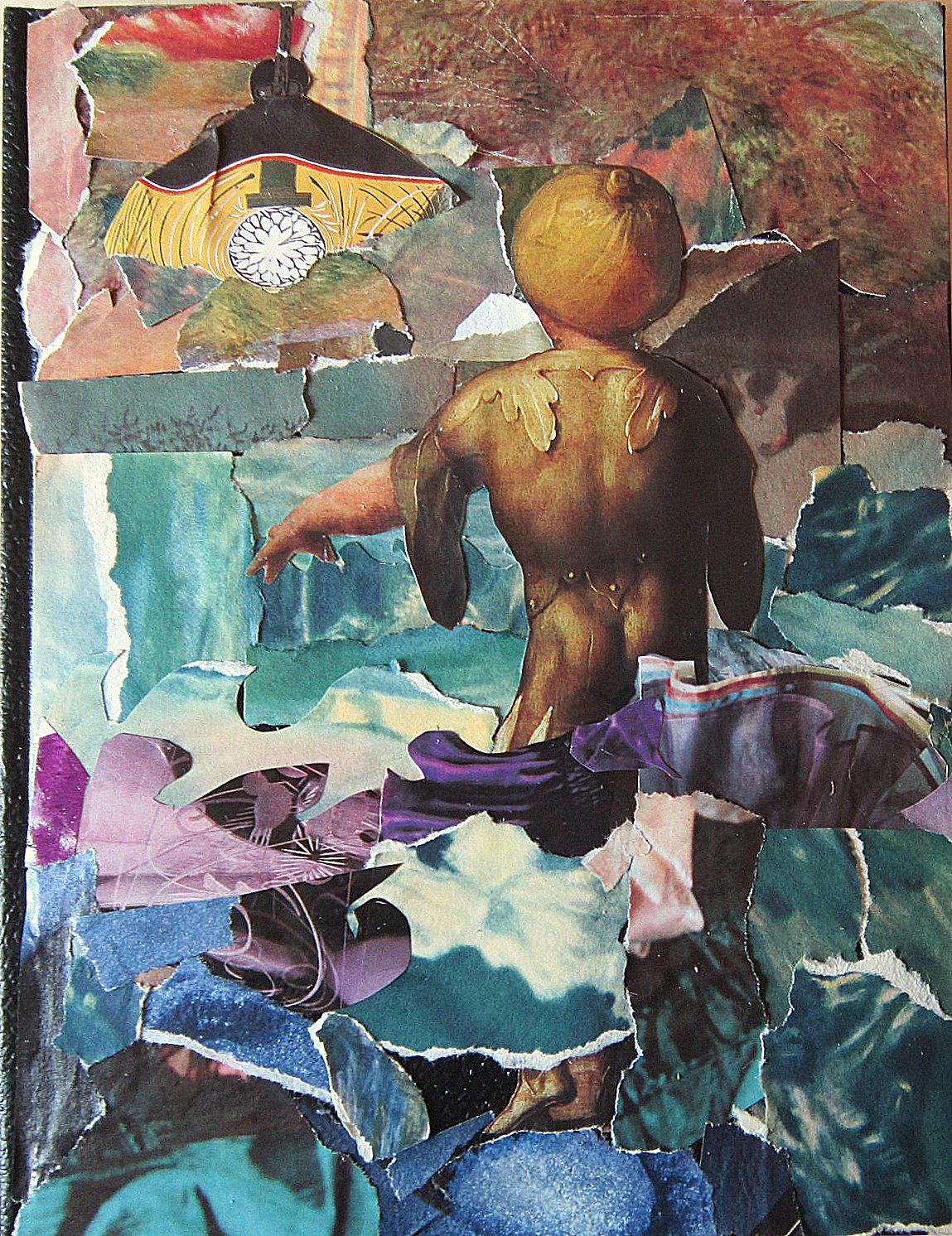
Maggie Ellis - Collage - Somewhere Never Traveled, Gladly Beyond

Improper

Here is the Improper, “you stop her,” party hopper
A hoper for poppies, “stop me”s, but she’s on her feet now, can’t
Catch or catch-all,
“Just let her fall,”
While the willows will, low or high, raise up
Their branches between the buckwheat fields. Now, down the street, straight,
Strutting, an instantaneous insider,
Initially intending only to injure, ignoring the insights inside, inept and
Benevolent,
Ignorant and wise and peppered with fears of irrational –
No, but this is a country lane, higgledy-piggledy piling around places and pieces of hay, You kids!
Just let it go, leave it be, let it alllllllll hang out, there’s so much to live, for you and me are together,
Again, with the stay off the lawn!

She’s faster, she’s racing, beginning to gain again, to leave you in the Dust –
Stop her, stopper, stop her, cradle the crippled craziness near the crutches
And cockles of your heart, hear her “Stop me”s, heed her holler of Help, help, Hell
With it, all sick, all sweet, all sour, She shouts shut up, and silently sink me slowly below
The edge, the brink, I mutter “Don’t want no damn shrink”, blink, blink.

And sweet-smelling secrets rise from the scrap-heap, king-worthy, dirty, apple-
Blossom clean, they sift through a screen of consciousness.
She is collecting, collaborating, correlating, corresponding quietly, quickly, quaking,
Quickening her pace, counting her pulse, Up and about and around, childish chivalry changing her
Revisions, decisions, visions, her fissions into fractions into wide, wide spaces
Surrounding the thunderstorm in her heart, calling
To your heart,
Bridges broken
Beaten
Silence spoken,
Eaten, defeated.

Author Biography

Maggie Ellis
Lancaster, PA

Student, flower-child-Quaker, and alive

Where Am I?

You are currently browsing entries tagged with Poetry at Unshod Quills.