December 14th, 2011 § Comments Off on Brian Tibbetts § permalink
on the them of Dancing About Architecture
Simple Arsenic
It was something right there in the cold air of the small dank rooms.
The salt coast air, humidity, green, loyalty?
It ate him slowly from the inside out,
Science gave us these things of his last days.
The salt coast air, humidity, green loyalty,
A lock handed down, generation by generation,
Science gave us these things of his last days:
The cracked tea service & frayed rug, the flowered wallpaper and grinding surf.
A lock handed down, generation by generation:
Plotting in his ruined atmosphere for another run at a god’s kingdom
The cracked tea service & frayed rug, the flowered wallpaper and grinding surf
How he smashed the windows out of the cathedral
Plotting in his ruined atmosphere for another run at a god’s kingdom
It ate him slowly from the inside out
How he smashed the windows out of the cathedral
It was something right there in the cold air of the small dank rooms.
Author Biography
Brian Tibbetts is a writer, musician, print-maker and painter currently living and working in Portland, Oregon. His work has appeared in the journals Gobshite Quarterly, Abuse and Bread and Roses.He is currently constructing a website encompassing his various pursuits: briantibbetts.com
December 14th, 2011 § Comments Off on Holly Hinkle § permalink

Vuluture - Holly Hinkle on Dancing About Architecture
Spiked Fence
(enough rope)
Survival. We talked of little else.
In a book, you read how to jump a spiked fence
so you could camp in a church corridor.
You told me how you scaled it twice a day,
sometimes more, having spent the last
of your money on good rope.
I would give up everything to walk beside you.
Traffic’s taillights cast red in our hair,
our packs rising off the down of our jackets.
I wouldn’t last. I know.
I listen to the black and neon rush
of street noise through the phone.
__________
Topanga Canyon Road
(love)
In the cold pressed, gray light of the basement,
where you discovered the photo album from 1910, the green hurricane lamp,
the great iron-banded trunk you wanted to drag up for me,
I find you packed to leave the boardwalk.
Wet tarmac smell. Black as the night is long.
The road is folded down inside the trunk,
we can open the heavy lid together.
I will help clothe you in that hard, moonlit coat.
__________
Venice Beach
(love)
My sister was at work and I was away that early spring,
when our brother packed one bag for the streets.
The first night: steady rain and his drawing paper wrinkled.
It was cold. I don’t think he ate. My stomach empty that week.
I dreamt my sister and I were a part of the day he left,
of saying goodbye to him on the outskirts of Venice Beach.
From there we could see the boardwalk, smell its salt
and perfumed oils, dyed cotton and clove cigarettes.
We were not there the day he left. It is a loneliness,
knowing that he always walked on after we stopped
at the front steps of home. No memory of when he followed us inside.
He walked down a road we could not follow,
that tore like a frail map. The pieces turned into leaves.
Author and Artist Biography
Holly Hinkle has been creating collage and mixed-media artwork since 2008. With found objects and small antiques as a backdrop, she is always thinking about ways she might create exceptional beauty from unrefined objects that once had a very simple purpose. Her poetry has appeared in Poems and Plays and The Arsenic Lobster. She lives in Portland, Oregon. Beginning this month, she is Arts Editor for Unshod Quills.
December 14th, 2011 § Comments Off on Jimmy Burns § permalink
on David Bowie
Horror
Halloween night/secluded first floor apartment/vandals shot
out street lamps/shadows surrender to darkness/Friday movie
night/cable flick/Cat People/rage of leopards/cross boundary
to human form/must kill to return from transference/spooky
dude David Bowie/black garb/high heel boots/mascara and
lipstick/androgyny/howls during final credits/”Putting out fire
with gasoline”/feral felines clash/window panes rattle/renters
dive into nightmare.
Author Biography
Jimmy Burns writes his poetry from his wheelchair, parked at his rural home near Houston. Recent poetry is in Backstreet, Chest, Eds, Nomad’s Choir, Pegasus, Writer’s Bloc and Wordgathering.
December 14th, 2011 § Comments Off on Ryan Werner § permalink
On the themes of David Bowie, Joan of Arc, and Enough Rope
Hammer Down
For Samantha Callahan
(ENOUGH ROPE)
You’re an eight-ball. Every hand you see
is crooked, that of old men who shake whiskey sours
in harbor bars. Forget that sludge of a sigh
resting heavy in your gut. Autumn is always here,
always bringing you back to Seventeenth Street: church
every day with the south-end Irish,
a paisley shawl wrapped tightly ‘round your waist.
This city is no bigger than when the men were scarce and broken,
when all the boys were merely boys. When the tide takes it,
its nervous waltz will keep us sleepless. Don’t rest. Hurry home.
Name your truth and touch me.
___
This Is What Happens When You’re Single Too Long and a Pretty Girl Named Joan Smiles At You
(JOAN OF ARC)
I thought for too long about the arc of our bodies.
Not when we are older, but when we were younger,
before we knew each other: your drink stays full all night
and you hold it like a burden. You lean forward.
I’m a janitor three states over. I tug at my posture
like a half-truth. We’re seventeen. We’re always seventeen.
___
Let’s Spend the Night Together
(David Bowie)
Popular rumor states that Angela Bowie found her then-husband naked in bed with (also naked) Rolling Stones lead singer Mick Jagger sometime in the early 70s. Upon Angela revealing this on an episode of The Joan Rivers Show in 1990, the aftermath of denial showed both men handling damage control in the spirit of their rock and roll personas: the cocksure Jagger came right out and said that Angela was full of shit and Bowie came right out and said nothing, as his lawyer released a statement saying that there was never a gay relationship between the two. It makes sense that Mick, who has based an entire career around singing like a man and dancing like a woman, would do one thing and say another. And of course David, who has based an entire career around androgyny and displacement, would just let people think whatever the hell they wanted.
It’s called being a rockstar. The whole point being that you do whatever it is that you want with no consideration for the outcome, which is why you can take a class on the British Invasion and think critically about lyrical allusions to personal and political turmoil, but at the end of the day you’re either the sort of person who’s going to throw a hotel television into a pool or you’re not. To this end, it would make perfect sense for Mick and David to come right out and say, “Yep, we totally had sex with each other. What of it?” Because there was no such public acknowledgement of the tryst, are we right to assume that the tryst is a fabrication and that both men led totally hetero lives?
Perhaps. In moving beyond base-level fascination, salacious celebrity sex stories are no more interesting than their blue collar counterparts. Hip Hop Man fucks Business Mogul’s Inexplicably Famous Daughter is, essentially, the same thing as Bowling Alley Manager Man fucks Avon Saleswoman. The true banalities of sex are obvious when the act is both the means and the end. It’s like watching pornography or engaging in last call hook ups or almost all of sex that Mick and David had throughout their careers. For them to have been outed in the 70s, at the height of their respective popularity, would have only helped to propel the mythos they were building. It would have just one more hole for Mick’s “fuck anything” attitude and as for David, it would have added another layer to his queerness-by-way-of-fucking-supermodels. So it’s entirely possible that the issue wasn’t one of sex.
Or sexuality, for that matter. When (then former) Judas Priest vocalist Rob Halford came out of the closet in 1998, he made note of how having to hide his homosexuality caused him to go through severe bouts of loneliness and depression. Though I don’t doubt that Mick and David dealt with similar demons, nothing they’ve ever done has given the impression that it’s because they were hiding their sexual preference from the world at large. If anything, they fell into depressive states due to their substance abuse, as opposed to Halford falling into substance abuse to help deal with his depression.
It seems to make the most sense, then, that Mick and David are two men who loved not other men, but one another, in ways that stretched beyond gender. A true “forbidden love” usually tends to be more of the former and less of the latter, but Bowie and Jagger seemed much more like Romeo and Juliet than, say, a teenage version of yourself in dire need of dating someone ten years older who likes to punch you in the meat of your arms while you fuck, and only survives because the street value of cocaine doesn’t fluctuate as wildly as the job market. (Call your parents and apologize. They were probably right about some stuff.)
I like to believe that Bowie and Jagger had sex at least once. I like to think that they shared a unique, honest love that, both in spite and because of their importance to rock and roll, they felt they could never publicly express. It humanizes the larger than life aspects of their characters in ways that only the effects of simple, compounded ache can do.
Putting aside musical integrity and topical aesthetics, the video for Mick and David’s version of “Dancing In the Street” by Martha and the Vandellas is amongst the most ambiguously gay entities of the 1980s, the same era that spawned the volleyball scene in Top Gun and the ’87 Oakland A’s. Above all, it is the Rosetta Stone to their dynamic, and while the undertones range from playful to overt, there is no slack at all in the tension between Mick and David, as if their hearts and cocks are tethered by the tightest of guitar strings. In it, we find two men who allegedly shared at least one evening of passion a decade prior. After the fires of both their careers and feelings have settled a bit, they get together and experience somewhat of a rekindling, somewhat of an exposure to the differences between what they were to one another and what they currently are.
:00-40 (Warehouse)
Mick is dancing by himself. He calls out, asking if everyone in the world is “ready for a brand new beat.” He sings “Summer’s here, the time is right,” and then David shows up in frame on an elevated surface to the right of Mick.
:41-:47 (Warehouse)
The camera does a momentary close-up of David smiling in a somewhat maniacal toward Mick. Overwhelmed to a point of bursting, David jumps down in the direction of Mick. When the camera cuts back to Mick, David walks into the shot coolly and stands next to him without acknowledging or being acknowledged.
:48-:50 (Warehouse)
David dips down and bounces back up quickly, brushing his head against the side of Mick’s head. Mick takes a second to react and then darts his eyes over to David as if worried about the obviousness of intentions better left secret. David doesn’t notice.
1:06-1:13 (Street)
The men face each other and sing “It doesn’t matter what you wear.” David’s head remains forward, but his eyes go to Mick’s mouth. Mick looks straight forward at David’s face. Mick fiddles with the lapel on David’s jacket. The men put their foreheads together and sing, loudly, convincingly, “As long as you are there.”
1:14-1:22 (Street)
Immediately after finishing the previous line, the men turn away from each other to sing “Every guy, grab a girl.” They then face each other at close range once again to sing, “Everywhere, around the world, we’ll be dancin’.” The scene freezes briefly before cutting away. Mick’s lips are puckered. David is moving toward them, eyes closed.
1:36-1:42 (Street)
The camera revolves around Bowie in the foreground and Mick in the background as David takes the lead vocal. Mick fixes his hair with one hand while looking at David. Mick’s gaze is one of inventory and concentration. He quickly licks his lips as he hops back in front of David so the two of them can sing the refrain together.
2:18-2:19 (Warehouse)
This time, it’s Mick who rubs his head lightly against the side of David’s. David looks annoyed. Mick doesn’t notice.
2:45-2:58 (Street)
The camera slows down and does a tight shot of the men’s asses. They’re side-by-side and they shake their hips in total synchronicity to the left, the right, and back to the left quickly before the camera freezes and fades to white. In the last second of the video, the screen fades to the traditional black.
Five years after that, after they had learned to live at peace with what they shared, it’s brought up as a cheap matter of publicity. I’d deny it, too. And then I’d grab a girl and dance in the goddamn street.
___
Line
(David Bowie)
A pity-seeking friend of mine who was prone to announcing his heart pains at dinner and then dramatically taking nitroglycerin pills started up with the old act, to which I said, “If you have chest pains alone in the woods, is it still a heart attack?” It was the last time I was funny, about twenty-five years ago.
I ask Vince about comedy the way kids ask their parents how clouds work and he responds back like cough syrup dripping down the side of the bottle. I’ve been his tour manager for the past few decades. He keeps me around because I’m not funny, because I don’t romanticize comedy the way other people do. When I said my heart attack line at dinner that one time, he laughed like everyone else and then said, “One more like that and you’re fired.”
The newest tour is probably his last big one, so I’ve made it the biggest one: half a year straight, 140 shows. Vince is in his late-50s and he’ll do more shows this year than an MLB pitcher will play games. I’ve set it up so he’ll be taking a young comedian out with him, and when I pick them both up at the airport, Vince and I wait for twenty minutes while Lee signs autographs. Vince watches him through the window and I go, “He’s on that new show, Mumford’s Place. The reviews aren’t great, but the ratings are pretty outstanding for the timeslot.”
Vince moves his mouth off to the side of his face and thinks for a moment before saying, with no malice, “He’s at the part of his teens where girls think he gets ten seconds of TV time for every inch of his dick.”
“He’s twenty-three,” I say.
“Yeah,” Vince says. “No shit.”
Lee bombs that first night, which is the opposite of killing, which is what a comedian wants to do. “It’s like the wilderness,” Vince tells me the next morning over breakfast at the hotel, talking about Lee’s set from the night prior. “You kill the audience or they kill you. And if you don’t do either, you probably aren’t worth a goddamn.”
I look over and see Lee through the window, lying down on a bench outside. The sun is already out and Lee is on his back, arms hanging off to his sides so the tips of his fingers touch the ground. We go to see if he’s all right. “I don’t think I did so hot last night, guys,” he says.
“It’ll get easier when everyone cares except you and not the other way around,” Vince says, tossing a bagel on his chest. “Now eat your Jew pills and go take a shower.”
Later on, right as Lee walks onto stage, Vince turns to me as we watch from the wings. “He has the sort of eyes that always look like someone just got done politely attacking them with a squeegee.” The crowd laughs, and for a second, I think it’s for Vince.
* * *
We’re a couple weeks into the tour and a good chunk of the crowd is leaving after Lee finishes. They walk out in groups of two or three at a time and talk loudly about needing to use the bathroom or wanting some Ju-Ju Fruits, some sort of guilty alibi they feel they need to have for thinking that Lee’s schtick from Mumford’s Place that’s gone into his act is, somehow, unfollowable.
Vince isn’t sour, but it’s sort of nudged him toward long exposition about true, how there’s no such thing as the new truth, there’s only the new thing that is or isn’t true.
“The only thing left in comedy is honesty,” he says from the stage. “And it’s all being used up on some really convincing lies.”
We’re going to the car after a show and some guy casually walks up to Lee and hits him across the nose with a right hook. I talked to the cops while Vince sat with Lee in the ER. “I can see it in the papers, Lee,” he said. “HIT COMEDIAN IS HIT COMEDIAN.” That’s how Vince salts wounds, by being the worst possible variation of the thing he already is.
Sure enough, the news can’t leave it alone. Any tickets left for any of the shows sell. Then Lee’s act goes completely down the shitter. It becomes like watching one of those Time-Life commercials for Best Of compilations, little snippets of things remembered, the Reader’s Digest version of comedy with an odd shine-job from Lee’s newfound celebrity. Vince said it was like watching an open mic at a surgeon’s office. “They’ll laugh at anything, just leave their brain alone.”
Getting back to the hotel was an ordeal now, with everyone wanting autographs from Lee. “What do I do?” he asked me. “They wait for me in the hallway.”
“Don’t ask me. I don’t know anything about hallways.”
Vince smirked and told me I was fired. We walked outside and Lee had his Sharpie out, running through the three letters of his name so fast that it looked like a series of number twos eating itself.
* * *
Lee is on the cover of US Weekly. Not the whole thing, just in a little box in the corner. But still.
Apparently, he’s one of the most eligible bachelors alive. The little blurb about him inside says that he’s a breath of fresh air into the stuffiness that comedy has become. He’s quoted as saying, “People think that comedy is just someone getting on stage and being funny. It takes a lot of unhappiness to get satisfaction through comedy.”
How do you feel bad for someone who hates the attention they tried really hard to get? It becomes especially difficult to do when he misses his next show to go trip on acid with some hippy looking woman, long Crystal Gayle hair down to the tops of her thighs, even the fog of her breath coming out in earth tones. The tour is half over and Lee looks like he has to be microwaved every morning. There’s been talk around the crew of Lee’s manager wanting to pull off the tour early and book some stadiums for Lee to do solo.
There’s an entourage all the time now. Publicists and other folks who, as far as I can tell, aren’t doing much. Vince calls to him one night when he’s walking out with his new friends and says, “When was the last time you were alone?” Before Lee can answer, Vince asks him, “Are you all right with that?” And again, Vince gets up and goes before Lee can say a thing.
* * *
There are five dates left on the tour. I’m starting to think that Vince could do it forever. It’s clear that he’s built his life around performing comedy on the road. I bring it up to him and he says, “I knew in twenty or thirty years I’d choose hotel shampoo over a family anyways, so I figured I’d just skip right to it.”
It’s been almost six months since we first left and Lee’s usefulness has pretty much been used up. There are no more magazine interviews, no more contracts being overnighted to the venue, and no more throngs of admirers. He didn’t know how to be famous, so he said the wrong things and got his picture taken with the wrong people. Not the people who have wrongness built into their image, but the people who have no image and promote Lee, albeit by association, as about as exciting as he really is, which is about as exciting as most of us, though we’re smart enough to fluff the truth.
He isn’t going to be broke or anything when the tour’s over. He’s still got offers he’s already been signed on to do, guaranteed money coming his way, but I think he knows that he has a year or two left in his career before he has to stop everything and find something else to do, go away for awhile in hopes that he is missed and then subsequently loved upon rearrival.
Vince and I get to the venue early and hear something coming from the stage. It’s Lee, not amplified at all, just standing in his normal spot doing his act, the first act he had when he started on tour. Bad gags about airports and his dick and comic books, but material that is all his. There’s a security guard in the way back watching him but not listening and there’s me and Vince standing off to the side. Lee doesn’t see us and he just barrels through his act, not fumbling the words, not throwing in any sitcom catchphrases. Then he stops and says, “I forget.”
It’s quiet. I visibly stiffen up my back and shoulders. Vince elbows me in the ribs lightly and says, “What, you don’t think this is funny?”
Author Biography
BIO: Ryan Werner is a janitor from Wisconsin. He runs the music/literature project Our Band Could Be Your Lit. He’s a six foot, hot look, all American male.
December 14th, 2011 § Comments Off on Gray Brian Thomas § permalink
On the theme of Joan of Arc
The Passion of the Joan of Arc
Joan of Arc was hanging out
with a group of the Pope’s men.
They were sipping boxed sherry and Bordeaux,
partaking of bounteous portions
of Hamburger Helper,
eagerly anticipating the next episode of Lost.
Everyone was feeling fantastic, just fantastic.
When one of the Pope’s men asked for butter,
Joan gave him butter,
and that’s how things went
for most of the night.
One of the Pope’s men,
we’ll call him Tommy;
Tommy wanted to watch the Cardinals game
on another channel,
but Joan was a Mets fan.
The Pope’s men considered this blasphemy
because nobody likes the Mets.
So when Joan stabbed Tommy
in the wrist with a relish fork
as Tommy reached for the remote control,
the Pope’s men became agitated.
They grabbed Joan,
took her out front
tied her to the mailbox in the yard,
then set the mailbox on fire.
This was a problem the next day
when the mailman didn’t know where to put
the credit card offers, advertisements, coupons and missing children flyers.
Plus,
setting a mailbox on fire
is a federal offense,
but the Pope’s men didn’t care.
That is why the French are assholes.
Author Biography
Gray is a native of Salt Lake City, Utah, where he perpetually attends college in hopes to one day earn a bachelors degree in English from the University of Utah. He is active in the poetry community in Salt Lake City, particularly the performance/slam poetry scene. He was part of the 2007 and 2011 Salt City Slam team, and is currently forming the University of Utah slam team that will represent the university in the 2012 College Union Poetry Slam Invitational. He was also poetry editor and chief editor of the 2010 edition of enormous rooms, the undergraduate literary journal of the University of Utah.
December 14th, 2011 § Comments Off on Frank Reardon § permalink
On the theme of love
you said:
you cannot be a good artist
you don’t promote
self awareness or change
i was lying down
on one side of the couch
& i rolled over to the
other side:
are you happy?
Author Biography
Frank Reardon is from Boston. He has a full length collection of poetry called Interstate Chokehold from Neo Poiesis Press, and his next, The Nirvana Haymaker, is due in 2012.
December 14th, 2011 § Comments Off on James H. Duncan – Featured Poet – December § permalink
Sons of the Silent Age
(on the theme of David Bowie)
on a rare evening not yet shot dead
my own whispered pacing fades across
the carpet through the lush echoes of
a vinyl caress to witness
another crossed out calendar box
on the kitchen wall,
a snake-line of black Sharpie
trailing behind
crumpled papers scatter and run low on heart
as somewhere in the walls symphonic voices from
old Berlin crush the soul of another son
of the silent age
too often, watering plants in the moonlight
feels like any other opaque lie
and fingers tremble over spilled ink,
inflamed pages, idiot remorse;
I can’t stand another sound
is all I hear in my rotten ears
and the last grain of time finally slips away
to reveal
the three hands of the clock gliding
in and out of life
in and out of sight
and in the heavy blink of your silken eyes
I realize I am finally tired
and I crawl to the waiting bed like
a dog into the hole where
he buried his bone
to sleep the good sleep I’ve
heard rumors of through all these silent ages
__________
Strawberry Fields Forever
(on childhood)
their house was made of brick
and the strawberries grew
in their fields like gasoline wildfire
the fields surrounded
the house on all sides, and they
went right up to the house,
built about a century
ago by strawberry farmers
now maintained by an elderly
strawberry farmer, his wife
who stared down from
the second story
window of that brick
house, and the farmer’s grown
son, who walked
around with some uncertain
handicap of the body
and mind
I picked as fast as I could
when the farmer or his
slower son spoke to my mother
or to other nearby pickers
or when the old woman
stared down
from
her window tower
watching us
but when they
were all gone
I ate berries fresh
from the dirt
no one needed
to wash those berries
they were stymied
with bugs often
enough, and were small,
but they were real
and they were raw
and juicy in the summer
sun
and I recall the sweat
of that sun falling
down on us
as we picked up
our full baskets (my
stomach also full)
and walked to the porch
of the brick house
the farmer’s son always
wore overalls, blue
jean overalls with dirt
scuffed around his
knees and ankles,
and he’d talk kindly to my
mother in a slow stilted cadence
as if he were reciting to a class
of students who might
mock him, but
we never mocked him
I knew he was just a strawberry
farmer’s son, and even then
as a child I realized
that being one was better than being
like most other men I saw in the world
—with or without the handicap
and sometimes the old
farmer was there, too
sitting on his porch
tired and talkative and
older than any man I had
ever seen in my life
and they’d take our few
dollars and we would
walk back to our car,
load the car, drive away
maybe we’d be back later
that month, or that summer,
sometimes we never
went at all
many of those summers
went by, the absent
summers, and I am glad
I have not been back since
the age of eleven
or twelve
I don’t want to see how
the old woman no
longer watched from her
window tower
or how the old man no
longer sat on his
porch in the sunlight
and I don’t want to see how
the farmer’s grown son
dealt with the banks or the funeral
homes or the land investors
or the neighbors or the
nurses at the hospital
or the whole world
crashing down
around him
I want to close my eyes
and look up from
the dirt, the rows of fire
engine red strawberries,
and see them there
all of them
and see my mother there
picking beside me
putting each strawberry into
a yellow bowl
put one
more strawberry
in my mouth;
never open my eyes
again
_________
The Night No One Went Home
(on childhood)
potshots from the gristmill
and away we go a’running
weedstalks tough like tire irons
thumping polecats skitter wild
in August, we dream of October
in October we dream of honor,
and we know a ghost is waiting
someone set fire to the gristmill
the summer after the shooting
the coupe still sits burnt out
amidst the wishing field of grain
the wind runs through that grain nightly
the moon watches with envy
children think they are alive
especially when they play dead
potshots strike the hollow oak
where we once thought of honey bees
and owl eyes in nighttime fevers;
the moon a great dying tilt-a-whirl
and this I promised to promise—
with a match left in my pocket,
I’ll wait for you come, Autumn
lest I burn it down alone
_____________________
as the sowing, the reaping
(on love)
fear oiled the mechanics of our love
and in the reproductive silence that followed, you opened
gifts a day early, wrapping falling to the floor
mingling with popcorn spilled from a paper bag
from which we each pulled greasy specks and chewed
in the quiet of October, red leaves stuck to the windowpane
the mistake too often made is giving small books
of poetry from unknown publishers from Portland
or Fort Collins or Montpellier or Louisville;
the first pages are fingered gently by each of you
a sense of wonder and worry thriving in the veins
the books are gone soon enough on trains and jets
never seen again, forgotten, unread, lost
always lamented over, wishing they formed a stack
in my study corner rather than a troubled mind
on most nights, those books were worth the trade,
other nights, though—not a page would I barter for a single
image of you against the dawn of that last day together,
pictures and pages in the fire of this heart’s eternal uncertainty;
curling black pages like their raven hair; gone gone
_______________
The Raped and the Loved
(on the theme of coffee)
the art gallery displayed photos of the raped
and the children they bore, hated, and one day
learned to love, women with long nimble weeping
fingers and toes, slender souls of nonpareil scar-tissue
that writhed and sang in a dirt-floor celebration
of militant reinvention, spring-loaded renunciation,
and the most unkind joy the godless world of man
and his guns and his machetes has ever known
they served coffee and European beer and someone ranted
midwest polemics and another of economic recoil, and many
a bitter word of oil companies retched across the room
as the ivory white smiles of the raped looked on,
their little reminders of a man’s murder-lust holding their hands
or sitting on their laps, or standing beside them, trying to help
carry the burden of the repellent world on their shoulders as the most
stunning blue light caressed the African skies behind them,
nothing at all like the disemboweled orange din hovering over our
American sprawl, where the machetes are dull, the smiles are
numb, and the raped and loved go equally unnoticed
Author Biography
James H Duncan is a New York native and is the editor of Hobo Camp Review, an online literary magazine that celebrates the traveling word. James has twice been nominated for the annual Best of the Net award and once for the Pushcart Prize for his poetry. He is the author of five collections of poetry and short stories and has appeared in dozens of print and online magazines around the world. He now resides in New York City where he works as a freelance writer and as a writer/editor at American Artist magazine, where he has published numerous articles on art history and contemporary realist painters. His website is at here.
September 14th, 2011 § § permalink
Poems on America and Somewhere Never Traveled, Gladly Beyond.
Old America
The angel above the fountain had not yet descended
when the upstart, carved, brownstone facades
on the new uptown square had begun to decay.
My grandfather might have seen him pitched into place,
so clumsily genteel, Santayana would have smiled.
Gentility outgrown, he wears the stigmata now:
chipped wing, hollowed robes, broken nose,
eroded face and hands
kissed into being
by spray on stone.
With little left to guard, the boughs
that shaded him are gone:
a few leaves drift in the basin
or mold themselves to his sides…
transients, from a place still green,
leaving a lacework of stains
on fragile stone.
Now the upraised palm
that was meant to hold back time
yearns
for its bodiless perfection:
mottled fingers
weathered away –
and he, a fable
in this treeless square.
Faraway
(Ann Arbor, 1968)
Often he used to wonder, after a sleepless night,
why he should gaze down from the attic window
watching the sun burn the mist from October streets.
He knew that the contours of the small city
would never emerge as he dreamed ‑
although the dream shifted from morning to morning:
A winding street on a small hill, pale, stuccoed facades
arching over rough colonnades,
dark women leaning from darker windows,
casements pushed open, refracting the light …
A long shady boulevard lined with clipped trees
and clumps of round tables with neat checkered cloths,
a couple embracing, old men playing chess,
an accordion’s whine floating over slate roofs …
These never were his, but only, each morning,
the grid of straight streets in his own wooden town.
*
But those streets were kind to him, hiding their lines
with a ragged flourish as veils of leaves
cast a mottled aureole of yellow and red
over drowsing cars and peeling front porches
where slat swings hung from creaking chains,
and the tinkle of wind‑chimes climbed
into the sparrows’ cries, into the beat of their wings,
and even the year’s threadbare fashion had glamour:
unbound hair floating over bare shoulders,
ripple of cotton, swish of tanned legs ‑
he was not clever, but still he looked,
and sees these things now,
and sees these things now…
Author Biography
William Ellis received his Ph.D in Literature from Boston College, then taught humanities at Vanier College in Montreal. He has retired after seven years as the Senior Foreign Expert of the English department at Sichuan University. There, he offered courses in Western Intellectual History, Art History, European Literature, and Canadian Studies. He was awarded the Sichuan Province Teaching Excellence Award in 2008. He is now backpacking around the world for a year with his wife, Denise (Chen Yu). He is the author of The Theory of the American Romance, an Ideology in American Intellectual History, nominated in 1989 for the John Hope Franklin Publication Prize. His poetry has been published in Mala, Chengdu Grooves, and Unshod Quills. Contact info: elliswa@hotmail.com.
September 14th, 2011 § § permalink
a sonnet on the theme of Fire.
Canine Noir
Let’s call you a bullet that healed what it hit.
And this dog knew some tricks, like how to play dead.
Used to sleeping on a torn up, lonely dog bed.
But the shot fired medicine that helped this dog sit.
From laying to upright, because it was bit.
This dog heard the truth of what the gun said.
A dog knows the hardest color to see is blood red.
And this dog’s heart grew so large, it no longer fit.
It goes without saying this dog released a howl.
You’ve replayed in your mind how this dog licked the gun.
You remember the way you and this dog snuggled close.
And though pained and oft crying, this dog just can’t scowl.
So you’re waiting to hear how this dog’s dog day is done.
And you’ll be waiting, she’ll be waiting, til this dog’s final dose.
Author Biography
Jillian Brall is a writer, musician and visual artist living in Brooklyn, NY. She co-edits the journal Lyre Lyre.
September 14th, 2011 § § permalink
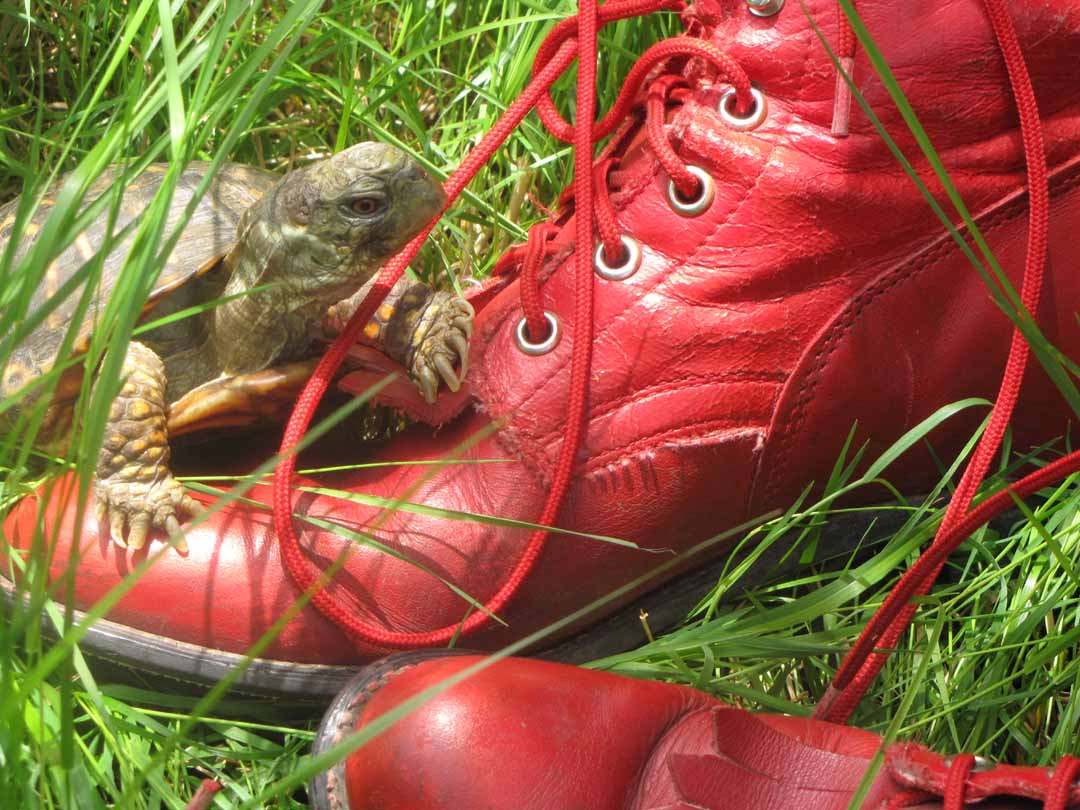
Rosemary Lombard - Original Photography - on Red Shoes
Rosemary Lombard on the theme of “Red Shoes.”
Red Shoes
Once I read—it must have been from a magazine in a waiting room—that the color red was the new neutral. I didn’t believe it then, and I don’t believe it now. Of all colors, red seems to carry the most symbolic and emotional baggage. What is the color of fire? of blood? of danger? of the heart and its Valentine? the color that makes the heart beat faster? If red is neutral, why is the coquette Musetta of La Bohème traditionally costumed in red or its close neighbor on the color wheel and the shy seamstress Mimi (the heroine, after all) given a muted color edging on drab? Why do the red shoes of Hans Christian Anderson’s fairytale represent the overblown vanity of a girl, taking on their own life and forcing her to dance until she begs for her feet—and the red shoes—to be amputated?
The eyes tend to track toward red shoes. Mine are nothing sexy: no towering heels or even open toes, just a pair of old granny boots and a pair of red and white flats; but almost every time I wear them, a pair of eyes drifts down to the shoes and I get comments. “I love your red shoes.” “Can I have the red shoes when you’re done with them?” I have never heard comments loving any of my true neutral collection, the black or brown or gray ones. I have, in fact, heard no comments at all.
In terrestrial turtles there are more color cones in the eye sensitive to red than those sensitive to other colors. The turtles in my behavioral lab seem to favor red objects, a characteristic most likely adaptive: They notice a strawberry, a hibiscus flower, the red eye of a male box turtle, my red shoes.
Neutral
Eyes drift down
and focus on my feet.
Where did I read . . .
Who was it said
that red
was the new
neutral?
Some waiting-room rag
for women (or sheep)
exploiting, perchance
inventing a trend.
What bull!
If red is so neutral,
why then do they costume
Musetta in red, Musetta the shameless coquette,
while shy seamstress Mimi
(the heroine, you know)
wears colors so drab and so muted?
And why do I
love all my red shoes?
Now I don’t dress at the height—
or the foot height—of fashion.
Foot fetish? Not that.
Perhaps it is vanity?
like the girl whose red shoes,
fast to her feet, made her dance—
and danced her off to desperation?
No, but it might be a little of that.
Why, I don’t buy things new,
and who has ever said
to me effusive ohs,
I do so love your jet black shoes . . .
your mud-tinted shoes . . .
your sweet dirty gray shoes!
But red? That’s another story.
Take my old flat granny boots
all laced up in their fire-truck red:
“Oh, I love . . . ” or “May I have
those shoes—so red!— when you are through?”
(Not when life is through with me,
but when I am through with them—the boots,
if that’s what she meant by the rave—
and that not long before the day
when my stockings stick through the soles
and pad over the pavement’s rough rocks.)
What is it, then, about color?
its emotional symbols, its signs?
For red, the color of fire, of danger, of blood,
of the heart and of its Valentine,
our senses and neurons
construct the connections.
How the links make the blood run the river!
Perhaps we mimic a bale of box turtles,
given extra color cones for sensing red,
whose choices—neither pale nor neutral,
but to turtles presumably useful—
elect the reddest, ripest berry,
the brightest bloom of Hibiscus sinensis,
the red-pepper eyes of a box turtle male, and
my
red
shoes.
Author Biography
Animal behaviorist and turtle cognition specialist Rosemary Lombard has one foot in the arts and humanities, the other in science. Her nonfiction story “Diode,” adapted from her WIP, Diode’s Experiment: A Box Turtle Investigates the Human World, just won the first place Kay Snow Award in the nonfiction division. Reading: Blackbird Wine Shop, Feb. 1.
