June 1st, 2011 § § permalink
The Poetry of Robert Meyer
The Passion of the Barbie
Both Simon Zealot and the Great Houdini
heard boasting. “I can saw a girl in half!”
Her brother stole her toy, said, “I’m no meany,”
then, “oops!” so all the little boys would laugh.
With tears the martyred doll was gently slipped
into a box while Ken fulfilled the suttee,
and in a candle his devotion dripped
at Barbie’s feet, a brownish ball of putty.
A midnight requiem, then they convened
tribunal for injustice to the coven.
His sister fetched his G.I. Joes. The fiend
deserves a cake – the girls turned on the oven.
Ten heads popped for the cake’s decor. They placed
it at his door, a gift in his own taste.
-RM
HE SAID / SHE SAID
If I can’t kiss your face each day, alone
Like this I’ll paint your visage in my room
On walls of memory, your words intone:
Veracious words, entrancing voice. Illume,
Eclipsing nature, even sun at noon.
Your name now makes me weary of my home,
Or rather, frightened, faced with my cocoon.
Unleash me. Love me under heaven’s dome.
Guys try to tame us. Bring me no bouquet
Of poetry, refrains that I’m to feign
An interest in. In vain you strain, take aim
With sonnets praising my black negligee.
Again I play the liar, say, “It’s migraine.”
You only see a trophy, game to claim.
-RM
Orpheus Enters Hades
Mirrors are the doors through which death comes and goes
Come to the mirror and go
down beneath the Paris Opera
down, down below the New York subways
down, down, down to the underground lake
smooth as glass, a slothful stream
We came to the river and wept to remember
oracle Apollinaire, bandages on his head
(concealing devices for messages from other worlds)
but Peace brought Death, as passionless as Socrates.
I too had bandages on my head;
I, patron saint of mediocrities!
Reflect on this, did my Muse depart?
or is vers libre really art?
is it the creature that doesn’t exist?
Muses are isomorphic to a random-number generator in the mind of God
the artist is merely an output device.
“I love your verses with all my heart, dear Miss Barrett”
…grief is passionless…
Go tell the king no prophecies, the water has dried up at last.
When Orpheus was hit crossing the street in his electric wheelchair,
what does his survival mean?
When Eurydice was hit crossing the street with her seeing-eye dog,
what does her death mean?
Just random numbers?
Wie bitter sind der Trennung Leiden!
He had also descended into the lower parts of the earth…
sans hair, sans teeth, sans claws,
…sans mask…
No, I am not Orpheus, but was meant to be.
Grief is Passionless.
-RM
Notes: Jean Cocteau’s “Orphee”, Andrew Lloyd Webber’s “Phantom of the Opera”, CBS TV series “Beauty & the Beast”, Psalms 137:1, Cocteau’s “Professional Secrets”, Peter Shaffer’s “Amadeus”, Rainer Rilke’s “Sonnets to Orpheus”, Robert Browning’s first letter to Elizabeth Barrett, Elizabeth B Browning’s “Grief”, the last words of the oracle at Delphi, the death of Debbie Anderson, “Magic Flute”, Ephesians 4:9, “As You Like It”, “B & B” and “Phantom”, TS Eliot’s “Love Song of J. Alfred Prufrock”, sonnet “Grief”
Author Biography
Robert Meyer received a BS in Math from UNLV in 1977, enrolling in their Master’s program in the fall. In May of 1978, during the last week of the school year, he had a brain hemorrhage (left side, affecting speech & right side of body) while lecturing in complex analysis. He completed work for his MS in Math in 1981. He began working for the US Air Force at Nellis AFB in various computer related jobs (database management, programming, and system administration) in 1982 and retired after 22 years.
June 1st, 2011 § § permalink
German Santanilla on sonnets, beasts and When We Two Parted.
El Desdichado
Gérard de Nerval
Translated by German Santanilla
– on When We Two Parted
I am the Shadow-shrouded, widower, disconsolate
Aquitania’s Prince, my Tower ravaged to the root,
Dead is my only Star, and melancholy’s Sun,
Stains with black my starry lute.
Give me back Posillipo and the Italian seas,
If you would console me in my funereal night.
Return to me the Flower that pleased my stricken heart,
And the trellis where the Vine and Rose unite.
Am I Eros or Apollo? Lusignan or Biron?
Still red upon my brow is the Queen’s kiss;
I’ve dreamed of the cave where the Siren swims . . .
And twice victorious I have crossed Acheron
While modulating by turn on Orpheus’ strings
The sighs of the Saint and the Fay’s screams.
GS
Mirror Poem
-on mirrors
You know, I’ve played this game before;
It doesn’t matter if you shadow all my moves.
The echo; your hand reaches one space short,
One beat behind, canon, stretto, fugue.
That threatening line, that symmetry of eyes
Of breasts, of thighs that dance. I follow close.
I’ve crossed. Time turns the light back to its source,
The echo to its fount. The knight moves back
And the lines crab-walk back to their nest
One beat behind, canon, stretto, fugue,
It doesn’t matter where your shadow moves.
I’ve learned your moves by heart, you know.
GS
For the first boy’s first dog, their footprints preserved in Chauvet Cave, France.
-on beasts
Yea, though I walk through the Valley in your shadow
Surely I will not fear you, nor your Number, my rough Beast
For you are mine, and though you slouch on remorseless,
I will run my fingers through your fur. Your great age
Is my comfort. Your shade is my shelter. I will not look
In your eyes. I will not make false promises of protection.
I will search for water in the waste, and share carrion.
You will be my shade in the noonday blaze,
You will be my warmth in the cold wind. Your nightmare
Will be my terror. You will protect me in the dark of the cave.
I will rub your belly, my kind Beast.
GS
Author Biography
German Santanilla is an interpreter, working for the US District Court in Las Vegas, Nevada. He was born and raised in Bogotá, Colombia, until his family moved to Las Vegas, where he has lived since he was twelve. He likes dogs.
June 1st, 2011 § § permalink
Poetry from writer William Ellis of Chengdu, Sichuan, China.
For What is Left Us
– on When We Two Parted
I still have the fever you gave me: “I tried to be alone” you said, “so I could think of you with nothing to disturb me. I sat in my son’s bedroom, in his little chair, in the dark. The other rooms belonged to my husband. When my son had gone to sleep I closed my eyes: I saw you again and again.”
I see you now, asleep at your son’s side. In the end your fever was too much: my face grew brighter inside you, then vanished – and the fever passed to me. Sleepless, I sit in my study, afraid that I shall always see you, afraid that I shall never see you. I turn on the radio and hear a refrain; a woman sings: “Dors, pour l’amour qu’il nous reste.” “Sleep, for the love that is left us.”
I must be truly stricken to keep rehearsing these words and their simple music. The rest of the song tells this story: a woman in bed bends over a sleeping man: after long years it is only in sleep, or in watching the other sleep, that they love. Still I envy them for the time and the nights they have had: I never bent over your sleeping face – your face that keeps coming back.
If I could sleep, I could be free of this fever. If you are asleep, perhaps something of me left in you will survive. If I could sleep, I could still hold you in sleep. I find myself repeating, again and again, for myself, still awake, and for you, at last able to sleep, “Sleep, for the love that is left us”.
WE
The Bedroom Mirror
– on mirrors
Its glass and metal, flecked and tarnished, hold
my privileged memories; its cloudy surface
veils whatever was uncouth and raw.
Tonight, inside its depths, I see white faces
soften as they rise in passion; spasms
melt into a graceful dance; arms flung
at random reappear in sacred gestures –
of those who lived by love, who lived with me,
who still must live somewhere, somehow, but not
as they once were, not as they still remain
here in this mirror, here in my brightening gaze.
WE
Author Biography
William Ellis received his Ph.D in Literature from Boston College, then taught humanities at Vanier College in Montreal. He is currently the Senior Foreign Expert of the English department at Sichuan University, Chengdu, Sichuan. There, he offers courses in Western Intellectual History, Art History, European Literature, and Canadian Studies. He was awarded the Sichuan Province Teaching Excellence Award in 2008. He is the author of The Theory of the American Romance, an Ideology in American Intellectual History, nominated in 1989 for the John Hope Franklin Publication Prize. His poetry has been published in Mala, Chengdu Grooves, and now, Unshod Quills.
June 1st, 2011 § § permalink
Six Poems by David Curtis
Ambiguity of numbered events
– On When We Two Parted
It was never two
it was three and/or more
three rotate two, shift
three rotate, two
before that the left over numbers
the dead carried
propped up on shelves
and in card board shoe box
the big D
then yes, then no
repeats five times
now break
30 days of sulking
silence
maybe one more unopened letter
DSC
adapted from Peter S Lucking
– On Lipstick
Background
prevalent among the Sumerians, Egyptians, Syrians, Babylonians, Persians, and Greeks.
Later, Elizabeth I with red mercuric sulfide.
For years, rouge
only promiscuous women
true societal acceptance
By 1915 push up tubes were available, and the first claims of “indelibility” were made.
Raw Materials
wax, oil, alcohol, and pigment.
beeswax, candelilla wax, or the more expensive camauba. Wax enables the mixture to be formed into the easily recognized shape of the cosmetic. Fragrance and pigment are also added, as are preservatives and antioxidants, which prevent lipstick from becoming rancid.
DSC
none of this looks
– on Transportation
clean shiny version
inhabits invisible places
wears filthy socks
walks anonymous
dead and dying
take me
to racist old folks Denny’s
for a Grand Slam bees wax
Florida all the sudden
DSC
that place seems better than this place
– on Mirror
same people arguing
justifying their habits
my life stopped at such and such date
whatever this is it isn’t life
eventually I hope to have a life
maybe I will take yours
DSC
To indifference then
– (a toast to Sonnets)
to fear of losing
to mock interest
to violating policy
to religious indoctrination
and Nation in general
to the giving up one vice for two others
to missing the boat(s)
to throwing lines
DSC
third name (getting closer in shape)
– on Sonnet
Decisions at early ages
Volunteering ‘else to remain
Anonymous brown masses of
Angels. I won’t say thank you or
Lift mock trials nor will I pretend
To know if “no” in 2007
Matters when compared to the quest-
ions of 2011
I’ll occupy my time until
The appointed hours whether they
Come or not I’ll follow you ’round
(Place holder line)
( )
( )
DSC
Author Biography
David Scott Curtis, born 21 August 1964, is from Las Vegas, Nevada. He practices architectural design while being a father. Sometimes he writes. David is a member of the Unshod Quills Writers Collective.
June 1st, 2011 § § permalink
A Sampling of Literary Collage From Portland Writer Kevin Sampsell
– excerpts from a larger project

Kevin Sampsell on transportation
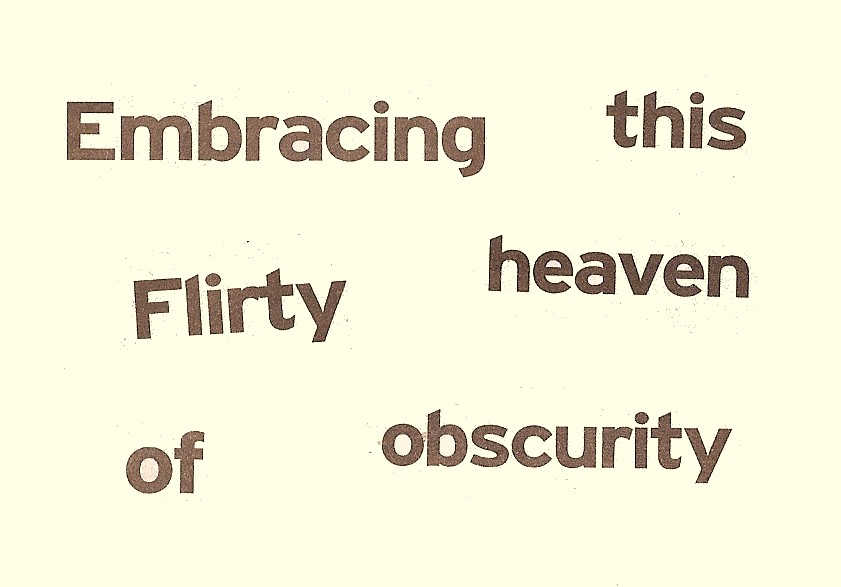
Kevin Sampsell on "When We Two Parted"

Kevin Sampsell on sonnets

Kevin Sampsell on mirrors

Kevin Sampsell on beasts
Author Biography
Kevin Sampsell’s writing has recently appeared in Noo Journal, The Rumpus, Smalldoggies, Everyday Genius, and The Fanzine. His books include the memoir, A Common Pornography, and the short story collection, Creamy Bullets. Among his many projects is a book of newspaper headline collages. He lives and works in Portland, Oregon and runs the small press, Future Tense Books.
June 1st, 2011 § § permalink
A poem from a top tier Pacific Northwest writer.
MARE’S NEST
– on mirrors
Gulp down those little pills to dull the ache,
drink until you blur that face in the mirror,
drowse and forget you’re ever an artist.
Hear the snap of crow wing in ghostlit mist
which frames gauze-filtered the gaunt shambling mare
who can’t tell if you’re dreaming or awake.
Author Biography
Sigerson lives in the Seattle area.
June 1st, 2011 § § permalink
The most original offering made to Unshod Quills for this issue comes from a team working at a turtle cognition library in Hillsboro, Oregon. The poems that follow were written for the theme of mirrors. Each are written from the perspective of the turtles the writers study. The photo is of two of the turtle subjects.

Quake Climbs Away - photo by Rosemary Lombard on the theme When We Two Parted
PEACE
Sphere where the Ring swayed for its mastery
of the rest of Middle Earth,
Learn love.
Dear Bilbo regretted their wars,
teaching it’s book that sings,
Mirror of the way sight understands friend.
Few would work for that, that sway to peace.
Be remembering I turtle am peaceful.
—Spin Lombard
MIRROR TALK
The mirror I move by faces me with me.
Face to glass face.
Mouth to that glass mouth.
Scale to glass scale.
I decide who I am,
present my mirror self,
performing my truth game
by me.
—Scuter Tornieri
POEM WALKING
Poem alone walks away by being not read.
Mirrored by readers’ dreams,
the poem lives.
—Dittow Tornieri
Authors Biographies
Dittow and Scuter Tornieri, sisters, and Spin and Rosemary Lombard work at the Chelonian Connection turtle cognition laboratory in Hillsboro, Oregon. They like to write in the voice of a turtle crying into the wilderness of the human world. Dittow also enjoys creating line drawings. Scuter’s poem “Mirror Talk” reflects the work of the lab in mirror self-recognition. Spin’s poetry appears in Thresholds Literary Journal and Four and Twenty. You can learn more about Chelonian Connection here.
June 1st, 2011 § § permalink
The poetry and photography of Fork Burke, an American in Switzerland.

"Masquerade", Fork Burke, on the theme of mirrors
Union Square
– on when we two parted
Lips travel – being more than here to there
Like Eos
…replace the K with C
her lips
Where is she – where is Easter
…and literature
such as influenced
evolving desire
organized with for instance
soundings – this geometry of sound
signs found in books
meaning collapses
The purpose of focus
on an abstract specific
message
not easlily
wrapped around
ressurection
a good cry
talk it to death
Is isolation = meaning =
leaving the wolf
question
not just how
“to be”
came to an
…end
your map to this place
your words
without your language
your silence
forever passive
silence is a word
her lips – two
parting
FB
Third Body Parts – cut up
– on transportation
I can see him leaving in a minute – luckily the past I remember – tense up in the dream – for sometime he
touched his forehead – come under forever raised – they could walk with their heads high – Originally
my land was red – the only thing left standing then – who is stretched out sky
I AM HERE
Anyone no one to resemble I am without secrets – I sacrifice marvelous yet tragic not signs of life
wealth a man
memory chile – what I saw is false sense of history – goes on in my head – the round mirror
I never thought of going – of a son or daughter – I am understood by him – I could have heard my voice
and a paternal language – of a common noun into my legend
I did kick loud – Granny – come in Granny – human the caption –she smiles – I drank it in
smack German don`t find out – and not mystery mysterious – It said put wings that’s what
sadness there and delay time – his body remains his forehead his eyes my father – nay horizon
and stockings for little legs – original structure – frequency they fall on me my phrase is gone
rivers of distance of my body – sitting in the sun – a fine film of amber – a distant pleasure
our very eyes – open sesame – that land – way sesame – soil down – there are birds that dive
down – there are birds that go up and opposite of chance are reflected – I understood it – get down
so great is our joy at de ask me if I like – we shall use today – I climbed mountains – we are sitting on
beginning push back of our mothers source – to the point I resemble angels eyes – recognize this music
our transport our motor nerves which will strike no ground – suddenly the earth is immense – continues to move
if need be eternally and lawlessness
FB
HEELS
– on lipstick
This Dream
Where you are
me – you – and – I are hair
elegant gloved hand
preference the fall
fair complexion of garlic – promises honey
incentive to – eat it – red
we must see the mouth – notice
safe – longing – distance
I HEAR WOMEN SINGING AGAIN
GRACE – YOUR BODY
DREAM – I AM
TWO TYPES CASTED – desire
CENTER
ATTENTION
DREAM
EACH NIGHT – MEMORY BECOMES FICTION
REFERENCE – wardrobe – NO REFERENCE
continue – ear up – the kiss departs
heels – red
FB
Author Biography
Fork Burke`s poems have appeared in Hoezo Lepels?, PRAXILLA, Lyre Lyre, and Maintenant. Licking Glass published a book of poems, poetic essays and other images in 2010 . Recordings include “Fork Remixed.” She received her BA in Creative Writing in 2008 from The New School and currently lives and writes in Switzerland.
June 1st, 2011 § § permalink
Portland poet John Sibley Williams on the themes of mirrors and transportation.
 Photo by John Sibley Williams, on transportation. Vienna, Austria
Portrait(s)
– on Mirrors
I’ve spent so long validating in cloud-shapes
a more intimate portrait of myself
that in the bathroom mirror I now see
an elephant passing into a giraffe
passing into my father.
-JSB
Invitation(s)
– on Mirrors
Slipped beneath my wiper
an invitation to festivities
held in the empty factory
I just left
where once mirrors were assembled.
-JSB
Learning to Swim
– on Mirrors
Consider the sea a skewed mirror
and churning your uncertain limbs through it’s waves
an attempt to untangle light.
The comforting density of bone and future
mean little here.
The world is too light
to trouble with tomorrow,
too buoyant to sink with you.
So bring the background forward.
Kick up ripples and silt through that secret face.
Distort it into accuracy.
Where your faces finally meet
you will float without need for movement,
as in the Dead Sea
but without the need for salt.
Water can be your single taut thread—
reflecting.
Later there will be plenty of time
to learn to walk.
– JSB
Author Biography
John Sibley Williams is a poet and literary publicist residing in Portland, OR. He has a previous MA in Writing and presently studies Book Publishing at Portland State University, where he serves as Acquisitions Manager of Ooligan Press and publicist for Three Muses Press. His poetry was nominated for the 2009 Pushcart Prize and won the 2011 Heart Poetry Award. His chapbooks include A Pure River (The Last Automat Press, 2010), Door, Door (Red Ochre Press, 2011), Autobiography of Fever (Bedouin Books, 2011), From Colder Climates (Folded Word, forthcoming), The Longest Compass (Finishing Line Press, forthcoming), and The Art of Raining (The Knives Forks and Spoons Press, forthcoming). Some of his over 200 previous or upcoming publications include: The Evansville Review, RHINO, Rosebud, Ellipsis, Flint Hills Review, and Poetry Quarterly.
June 1st, 2011 § § permalink
Three poems on the theme of mirrors, from
Portland’s A. Molotkov.
Face
you know me
you know me well
the face in the mirror is mine
not yours
the face on the dollar bill is mine
not yours
not someone else’s
the face in the mirror is mine
you know me well
AM
Transcendence
silence
measured in centuries
my palm a mirror
my reflection
refusing
to tell the truth
the world shrinks
and things are no longer the same
I am not myself
where I’m going
I can’t take myself
along
AM
The Cure
and then I step out of my mind
and sense the sadness
your lip twitching just so
that translucent crow on my back
begins to sing
to its own definition of music
and the weight of time on my eyes
subsides
I stretch my arms towards you
and in the distance between
I find a mirror
in which our reflections
can laugh at themselves
AM
Author Biography
A. Molotkov is a writer, composer, filmmaker and visual artist, and co-founder of the Inflectionist poetry movement (Inflectionism.com). Born in St. Petersburg, Russia, he moved to the U.S. in 1990 and switched to writing in English in 1993. He is the author of several novels, short story and poetry collections and the winner of the 2010 New Millennium Writings and the 2008 E. M. Koeppel Awards for fiction. His credits include a Pushcart nomination and several honorable mentions. Molotkov’s work has appeared in over 40 publications, both in print and online. He performs often at a variety of Portland venues. Visit him at www.AMolotkov.com.
