Short fiction on the theme of Fire.
Splinters
The worst of the summer crunch is over. I milk menial tasks all day, hide in the cool dark opera basement sending dirty texts, sneak a nap in the seat of the forklift, write stories in my notebook. For us year-round carpenters the crescendo builds to opening day of the opera season, and then we try to do as little as possible for only 40 hours a week til the end of August. Today’s busywork was to clean up the backstage deck, dispatching rusty debris from welding projects; old hardware; cracked, abandoned staging to our dumpster or to the trailer we will empty at the Santa Fe dump.
I grab a wood platform that’s been baking in the sun. The black paint is coming up in scales. It is heavier than I expect, as I pull to lift it I feel an ugly, sliding pinch in the palm of my hand. I freeze, knowing. I look, it’s worse than I expect. A black sliver of plywood is buried deep, about four inches long, an eighth of an inch wide. More than half is stuck in the heel of my right palm. The pointed end of the splinter is pressing against my flesh from the inside, making the skin protrude, but it doesn’t puncture all the way through. It’s so deep the black wood disappears from view inside my skin.
I try to pull it out with my fingers but the splinter does not budge. It’s pounding, pain travels down my forearm, louder and louder. My palm is swelling, turning red around the spear of wood. I bite the end of the splinter trying to wrest it free with my teeth. It doesn’t move, but the external part of the splinter snaps off, leaving the rest lodged. From the metal first-aid box mounted on the shop wall I retrieve the tweezers. I wipe them clean with an alcohol pad, then approach my boss, the master carpenter, whom I cannot stand. He’s a complete dick, but he’s a volunteer firefighter, I assume he has some medical ability, so I thrust my hand heel-forward to him, my fingers curled in.
“Can you help me.” I say matter-of-fact.
His thick mustache twitches at me, annoyed. He looks down at my hand and squints.
“Oh, wow.”
“Can you pull it out?”
He forgets he hates me too and shakes his head. “Nope. You’re going to the clinic.”
I get excited; I get to leave work, out of the blazing sun and into an air-conditioned room, probably get a vial of painkillers –these occupational clinics love to dole out narcotics. Another carpenter drives me to the workers’ comp clinic.
The doctor takes one look at my hand and goes “Jesus Christ! And it’s painted, too. Shit!”
“Just trying to keep things interesting. I know you’re sick of sprained ankles.”
Every summer the opera absorbs hundreds of college apprentices for the season, and we try to break as many of them as possible. This summer so far there’s been 112 injuries. I am 113.
The doc tells me she is going to have to cut the splinter out. I nod. I chat with her and the receptionist, make jokes: my survival tactic. She cleans my hand, the pain dances up my neck and forehead. She cuts a hole in a little blue paper-cloth, drapes it over my palm, I sit on the medical table, legs dangling. I watch with deep interest as she slices open my palm with a shiny scalpel. The skin parts like a sigh and blood seeps out and I am fascinated, when suddenly I feel very hot and dreaming that I am in Manhattan walking down a crowded sidewalk and everyone passing me says my name over and over again. Next thing, I’m laying down on the examination table with a cold wet cloth on my forehead, completely soaked in sweat. My hand is swaddled in an enormous bandage. The doctor laughs.
“I passed out?”
She nods. The doc shakes a plastic vial, making a high rattle. My splinter, saved like a relic of the cross.
I have a penchant for fucked-up splinters. Last time I was free-lancing, doing a carpentry project for a friend. I got a splinter in my right index finger, deep. I tried to pull it out with no luck, and showed it to Beth, who shivered and looked away. “We gotta take you to the hospital.”
“No, I don’t have health insurance.”
I pulled my Leatherman from its belt-sheath and tried to pull the splinter. It was stuck in the meat of the muscle, so much that I couldn’t bend my finger.
“Try it, just yank.”
“No,” Beth was horrified. “I’m gonna puke.”
“I can’t afford the hospital. I can’t deal with registering for indigent-status at the emergency room. It will take forever – this hurts!”
I thought of Killian, who sprained her ankle rollerskating. Our friend, a vet-tech, snuck her into the animal hospital at night and took an X-ray. Luckily her ankle wasn’t broken. I got an idea.
“Let’s go to Holy Holes!” Our friend Calliope’s piercing and tattoo studio.
“Dude, that place is cleaner than the hospital, they have scalpels and forceps. Besides, Calliope will love it!”
Calliope positively reveled in the yucky and perverse. She was an undertaker by trade, and often said without irony that she was on her last life. Blood and guts were of the corporeal world, which she was finished with, she was unflapped by any aspect of the human body. She was thrilled when I presented my swollen, impaled finger to her. She whisked me into a piercing room, sat me on an ancient barber chair, rustled through the vintage medical cabinets and pulled out cotton swabs, gauze pads, iodine, green soap, forceps, scalpel and bandages. She placed it all on a stainless steel tray. She tried to attach forceps onto the protruding nub of lumber in my finger. My whole body jolted.
“Want a Valium?” she asked. I nodded as she reached into her purse. She put on latex gloves and tried again to wrestle my splinter. It wouldn’t budge. The doorbells jangled and she left me to attend to a customer. The Valium kicked in. I giggled, even though it killed.
“I’m gonna have to cut you open a little, ok?”
“Fun. Are you psyched?”
“Umm-hmm.” She bent her head over my finger and sliced. I swallowed a groan.
For two hours Calliope and Wilton, another piercer, took turns trying to get a bite on the splinter in between piercing navels and eyebrows. Other friends came by the shop – Matty and Jen gave it a try too. In pain-delirium I gave it a go when Calliope left to pierce a nipple. I managed to clamp the forceps down on the splinter, and clicked them shut. “Wilton, Wilton!” He came running in with Beth, who had stayed out of the room, feeling ill.
“Look, I got it…pull the fucker out! Pull it!” He yanked, it didn’t move. I howled.
“Harder!” I hissed.
He pulled again, heaving his big shoulders back and I felt it pull free, my own little Excalibur, my little jesus-relic. Blood gushed and Calliope high-fived Wilton, bandaged me up and kissed me on the lips. “All better.”
I read about this bowhead whale caught near Alaska by Inupiat fishermen. They found a piece of 130-year old harpoon stuck in the whale’s flesh. Imagine carrying around something so old and painful inside of you for so long. My friend Kris had cancer everywhere in her body – she told me she knew it was because of the way she metabolized anger. She didn’t die of cancer, she died of suicide – she wanted the choice before the cancer took that away too. Choice is everything.
I’ve held so much anger inside of me, so much sadness. When I was younger I walked through my days spraying sadness like a shotgun blast. As an artist it was expected, to just explode in front of everyone. Creating and destroying in fits and bursts. Some called me angry. They judged. People saw I carried a blackness thick and cancerous inside of me so they stuck theirs inside me too. Like a Spanish bull with all of these broken lances riddling my back and ribs. Plenty of people cannot carry their own darkness, they try to sneak it onto your back. They didn’t understand, it was just grief; it was murder and sickness and loss, and loss. For what exploded out of me I buried ten times more deep inside my skin, all swole-up and festering.
I went out into the desert alone and by the light of the waning moon I pulled each splinter free. Lightning struck the forests and the dry crackling flames engulfed the mountains, who were begging to burn. Ponderosa pines love fire, it’s like sex for the trees, the propagation of a species catalyzed by heat, but people are afraid. It threatened towns and the opera and the national laboratory – all the bullshit, the collected hate of the human race with a half-life of 100,000 years buried in steel drums under tarpaulins. The christians call it rapture but they too woke up at home, feeling angry, abandoned. Ash peppered down on Santa Fe, people kept a packed bag next to their front doors. Can you outrun burning hatred? Festering anger? It is a cleansing fire, a destruction to fertilize creation. I cried to the cholla, the sage and the lonely sad coyotes yipping in the night. I dropped my splinters on the thirsty ground. I still feel the scars, they hurt sometimes, but I am free, I am free.
Author Biography
Cooper Lee Bombardier is a visual artist, illustrator, and self-taught writer and performer. He was raised in the South Shore of Boston. His visual art has most recently appeared in group shows like Meow Wolf in Santa Fe, NM; the 2011 National Queer Arts Festival in San Francisco and the forthcoming ‘zine Faggot Dinosaur. Cooper’s writing has appeared in many periodicals, most recently Pathos Literary Journal, and Original Plumbing; and the anthologies The Lowdown Highway; From the Inside Out, and Trans/Love. He is currently based in Portland, Oregon, where he listens to the trains all night.
Unshod Quills features Portlander Riley Michael Parker, musing on the themes of America, somewhere never travelled, gladly beyond and fire.
Five Killers –
on the theme of America
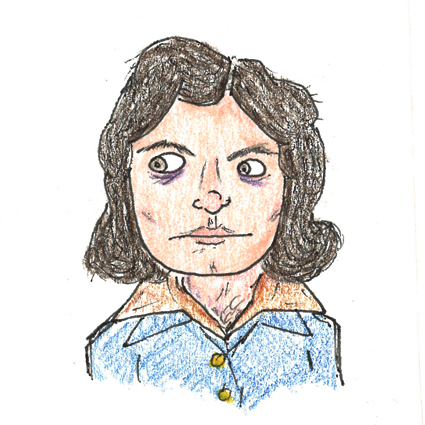
Riley Michael Parker - Alcala - ink and pencil on paper on "America"
RODNEY ALCALA
One of the most interesting American cases, Rodney was a contestant on The Dating Game in the midst of his career as a rapist and murderer. Had he been a known serial killer, I’m sure it would have been the television event of the year. The footage, available online, is difficult to watch. In the context in which he is now known, his actions are very creepy and his words telling, but he actually won the game, was selected that evening as the bachelor worth dating. Seeing him laugh, obviously having fun, is the most discomforting. We like to think that killers are nothing like us, but in truth they are, just like us, because they are all just people. Broken, wicked people, yes, but people first, people who crave fame, and try and get onto game shows, and laugh, and flirt, and make art, and have friends, and help build their communities, and believe wholeheartedly in the right to pursue happiness, if not so much the life and liberty bit. People. Always people. Often white. Often men.
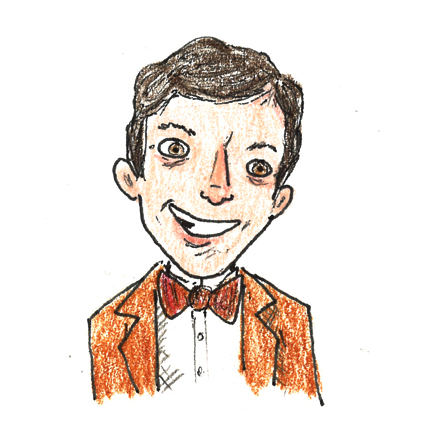
Riley Michael Parker - Bundy - ink and pencil on paper, America.
TED BUNDY
The chameleon. Ted was so good at killing people that it seems as if it happened by grand design. He was handsome, charismatic, and intelligent, all in an incredibly average way that witnesses could never seem to describe with any clarity. He had no sense of guilt. The man was arrested for or suspected of several of the murders that he eventually admitted to, but was so good at covering up his tracks, and, eventually, at physically escaping, that it seemed at one point that he would never be brought to justice. He eventually died in the electric chair, but didn’t understand how he ended up there. The concept of this man is so frightening and so unfathomable that he has inspired just as much comedy in the art world as he has horror, with several of the works based on him described by reviewers as “hilarious”.
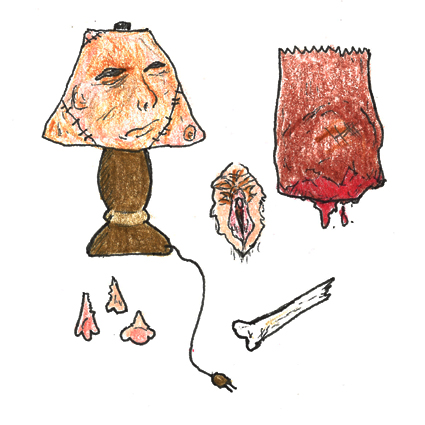
Gein - Riley Michael Parker - pencil and ink on paper, America
Ed Gein
Having only killed three people, Gein is possibly the most famous American killer of all time. Gein was obsessed with his mother, and after she died he decided that he wanted to be a female; that he wanted to be like her. His main approach to fulfilling this need was the creation of a suit made from women’s skin, skin that he stole from bodies he dug up in the middle of the night. Gein made masks, a lampshade, even seat covers out of human skin, and kept several preserved body parts. The man had several heads in his home, including the heads of two of his victims, both middle-aged women, and a skull on every post of his bed. He has been the inspiration for so many Americans, including writers, filmmakers, visual artists, americana pop musicians, and quite a few murderers. There’s a good chance that you have at least one piece of art in your house, whether it be film, or literature, or a picture in a magazine, that would not exist if Ed Gein hadn’t murdered women and desecrated human remains. As awful as it is, I would bet money.
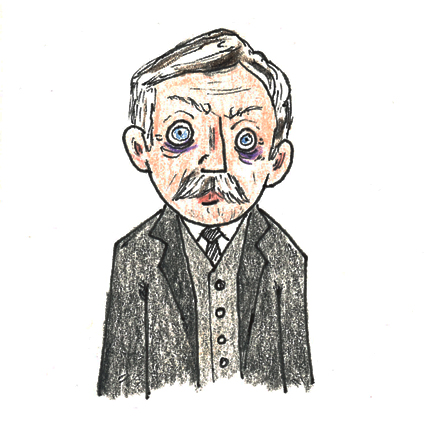
Riley Michael Parker - Fish - ink and pencil on paper, America
“ALBERT” FISH
Known as the “Werewolf of Wysteria” and “The Brooklyn Vampire,” Hamilton “Albert” Fish was a child murderer and a masochist of epic proportions. The man would stick needles into his groin and leave them there, and he swallowed objects to cause himself discomfort. Most notably, he was a cannibal. After being apprehended, Fish proudly described his cooking methods to anyone who would listen. You can google them. They are grizzly.
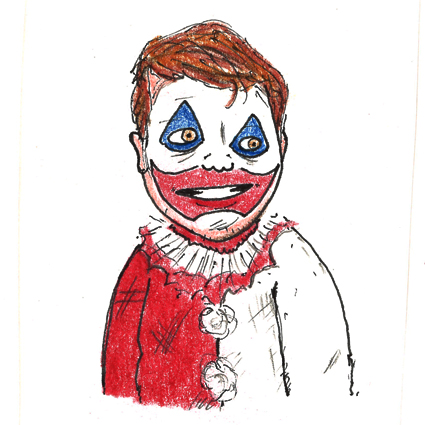
Riley Michael Parker - Gacy - ink and pencil on paper, America
JOHN WAYNE GACY
Gacy strangled and drowned young men and teenage boys, thirty-three in total. Most of these boys were hidden in the crawl space of his house, with a few more buried in his garden. He was a charitable man, a friendly figure, well-liked, and he was known to perform as a clown, a character named “Pogo”. Once in prison, Gacy made a small fortune selling clown paintings, and even painted a portrait of punk rock icon GG Allin (born Jesus Christ Allin), which later became the cover of one of his albums.
_________________________________________________________________________________
Riley, on “fire.”
IN THE HOUSE WE BUILT FROM COFFINS
In the darkness there is a woman in black panties, topless, sockless, with a pipe in her mouth that has never been smoked, her hair unkempt, unruly, but long and beautiful.
In the darkness there is a woman with three sons living inside her, not infants but full-grown men, dressed in pinstripe suits and black overcoats with buttons made of ivory.
In the darkness there is a woman hanging, strung up for talking back to her mother, her dress with unlit candles fashioned at the bottom, turning her from a woman into a chandelier.
In the darkness we are miserable, and so we bring the fire.
We light the candles.
We take up smoking.
We burn the things that remind us of the darkness.
In the light of the fire we see things that frighten and amaze us.
A brother once thought missing walks among us, the boy now mute, a blade stuck in his mouth and out through his neck. We ask him what has happened and he tells us, with ink and paper, that he had taken up sword swallowing to impress a woman, but in the dark someone mistook him for choking and attempted the Heimlich Maneuver.
An uncle who we thought was shrinking has grown to twice his original size, his body now bent over, the man walking like a horse, beatle boots on his feet and hands, wearing a pinstripe suit like any other worthy gentleman. We all ask him for a ride, and he takes us, two at a time, around the estate, kicking and bucking for the sake of excitement, proud to finally have a place in our hearts.
A son has become seven sons, the men huddled together, all immaculately dressed, their hair, black as night, all parted in the same place, their eyes, unblinking, identical wells of eternal depth. We ask them how long this has been going on, and together, the seven shrug.
Sisters in pointed hoods and nothing else.
Cousins naked, holding knives.
Snakes and shotguns and men like bats, antlers, mustaches, fingerless gloves.
An uncle who has become a room.
A mother who is down to fuck.
A father who is now a demon, his head that of a goat and a wolf mixed together, with wings of dark feathers spanning several feet, his black jean pants torn at the bottom from when his feet turned into hooves, and as he hovers a few inches off of the ground he spits leeches from his jaws, and maggots, and mice, and he looks us in the eyes, somehow he is able to focus his attention on all of us at once, and he invites us to be like him.
In the light of the fire we see, finally, the purpose of darkness.
___________________________________________________________________________________
On the theme “Somewhere Never Traveled, Gladly Beyond.”
BACK HOME
We were lost in Noble, a town too small to be lost in, looking for her mother’s house. She hadn’t been to Oklahoma in eight years, maybe nine, it was hard for her to say for certain, and since then her mother had moved twice.
I said, “It doesn’t matter how many times she’s moved, we just need to find her now,” but she was upset that the woman had moved at all, that the town had moved on without her, that the place where she grew up practically didn’t exist anymore.
She said, “None of this looks familiar.”
I said, “Should it?”
“Of course it should. I grew up in this goddamned town.”
We took our time driving through the neighborhoods, me looking for her mother’s house and her looking for herself as a child, trying to place memories with the streets that she had done her best to forget. She would almost speak every so often, just a soft little yelp as she would start to share something that had happened to her, or something she had done, but then she would stop herself, unwilling to validate the memory by acknowledging it out loud.
I said, “Is there anyone besides your mother that you want to try and see?”
She said, “I think I’m the only one I know anymore without a baby or a meth problem.”
I put my hand on her knee.
“Well it’s never too late to catch up.”
She said, “Yep,” but kept looking out the passenger side window, uninterested in sharing a smile with me.
We stopped at a local burger shop to get a soft serve and to ask directions, but when we got to the counter she wouldn’t let me give them the address.
“I spent my whole life here,” she said. “We’ll find the damn house.”
With ice creams in hand we got back in the car and I rolled down the windows. We were burning too much gas as it was and I didn’t want to run the AC anymore. It was a wet heat, not what I expected from Oklahoma, and our ice creams went faster than the station wagon, her eyes looking at each and every house as if it held everything she was looking for, but we couldn’t even find her mother’s street.
“There,” she said. “Let’s stop at that yard sale.”
If she hadn’t of told me it was a yard sale I would never have guessed it on my own. I didn’t grow up in Oklahoma, lived in Connecticut my whole life, but the lawn was how I had pictured all of the south to look like — parts from old cars, dishes and clothes in haphazard piles, two grizzled women sitting in a lawn chairs, smoking cigarettes and drinking sweet tea. We got out of the car and began to look through the women’s wares as they talked to one another.
“…the boy didn’t even stop to help her up, just kept on drivin’.”
One of the women, the younger-looking of the two, the one with strips of dark color in her white/yellow hair, was telling the other a story, smoking for dramatic effect.
“Christ… How did they catch him?”
“Well, that’s the thing, they didn’t.”
This other woman, the older-looking one, dressed in a pink sequined sweater and stretch pants, just glared at her friend, practically begging with her eyes for the lady to finish the story, but the stroyteller, the younger one, was relishing this control she had over the conversation, obviously practiced in keeping other old women in suspense. I tried to ignore the women, took to looking at a box of old VHS, just a couple of comedies from the era of Chevy Chase and Steve Martin, a Looney Tunes tape and the first half of Lonesome Dove, but I kept an ear turned to the conversation. My girlfriend just stood and stared at them, uninterested in subtlety.
“Damn it Betty,” the older of the two women said, “are you gonna tell me what happened or ain’t ya?”
“All right, all right,” she said, pretending to be burdened, “I’ll tell you. So the fella, the Johanson boy for those of you who showed up late,” the woman looked at both me and my girlfriend to let us know that we weren’t eavesdropping, to get it across to us that we were as welcome to her story as we were on her lawn, “was so guilt-ridden from hittin’ the girl, so upset from killin’ a little teenage nobody, and then, worse than that, for speedin’ off like a coward because he was too afraid of going back to jail, well, he got so down on himself that he…” the woman quieted, leaned in, added a quiver to her voice on purpose, “that he went home and strung himself up in his parents’ garage. God’s honest, the boy took his own life to stay out of jail.”
The woman leaned back, trying not to smile, obviously pleased with herself for having this information, pleased with the way that she was telling us the story, how well she was pretending to be broken up about it.
“Yep, killed himself,” she continued. “The mother found him the next morning, swingin’ from the rafters. And here’s the kicker,” she leaned in again, “the child he hit didn’t even die, didn’t even really get hurt, just a little scraped up, and she didn’t tell her parents about it either, worried that she would get in trouble on account of sneakin’ out in the middle of the night. The only reason any of this came to the light of day, the accident and all, was because the boy had a note in his pocket that said the whole thing, even about the girl. He’d recognized the girl he hit and still didn’t stop. I mean, the boy was a coward three times over.”
“Was his name Scott?”
The two women looked up at my girlfriend, their faces twisted in confusion as if she were speaking a foreign language.
“What now, honey?”
“Was the guy’s name Scott? The Johanson boy you mentioned, the one that hung himself, that hit the girl, was his name Scott?”
My girlfriend had told me about Scott before, not a boyfriend of hers but the boyfriend of a close friend all through high school. He was funny, if I remember right, and a bit reckless, the catalyst in a lot of her stories about being young and out for trouble. He was the one who first took her to Oklahoma City, there to see some band he had made friends with, her first concert, I think, held in a country western bar that had been taken over by what would pass for punks in the South, her and her friends having to sneak in the back because the lot of them were five years from the drinking age.
“No,” the older woman said, the one in the pink sequined sweater, “his name was Michael. Michael Johanson, Tom and Marsha’s boy”
“Wrong Johanson’s if you’re lookin’ for Scott,” the other one said. “That would be Bill and Cindy. Their boy hasn’t been around in a while. Last I heard he cleaned out their bank account and went off to Florida with a black girl.”
“Puerto Rican.”
“Like it matters.”
“I’d bet money that he’s in jail. That damn kid couldn’t seem to stay on the streets for more than two months at a time.”
“And he has at least three kids.”
“From three different women, no less.”
“Never had a job though.”
“Not unless you count stealing from his parents and sleeping half the day.”
“Well,” my girlfriend said, “I guess I haven’t missed much then.”
The two old women stopped their banter and looked at us for the first time with interest, first at my girlfriend, then me, and then our car, then back at the girl.
“You from around here, sugar?”
“No,” she said, trying her best to smile, “I don’t think I am.”
My girlfriend showed the women the address, the younger one gave directions, and I bought a romance novel off the older one just to be polite.
________________________________________________________________________________
On the theme “America.”
WE LIVE IN IDENTICAL HOUSES
My wife is a brunette, and you can’t quite say for certain, but it’s possible your wife is blonde. In the summers our children are best friends, but only because they can’t drive and we don’t have the time to take them anywhere, but at school they are strangers at best. Your daughter has told you this, and you told me. My daughter never talks about your daughter, even in the summertime. We have boys too, one a piece, both brunette. Your son once beat up my son in the locker room, over what, neither will say, but for two months a year they stare at the same television, throwing grenades, racing cars, jumping on the backs of turtles. Our wives drink themselves silly.
In the summer, we have barbecues. Your wife, now a redhead but possibly a blonde by birth, makes chicken macaroni salad, and my wife, the brunette, can’t cook anything worth a damn so we bring booze and ribs for the grill. We always cook at your house because we have the dog and your daughter is allergic. Your daughter has braces latched onto big teeth, and straight brown hair, and freckles, and no breasts to speak of. She is funny to compensate, but no one in your family ever laughs at her jokes, hoping to discourage her from being anything but pretty. Her straight A’s amount to next to nothing in your eyes, because good grades are not what it takes to find a husband, and you want your daughter to take after your wife (the woman has never even had a job, not as a teenager or anything, and though you sort of hate this you wouldn’t have it any other way).
In the autumn months my wife always returns to the life of a teacher, our last name scrawled on a white board above a page number, a homework assignment, a due date. She failed your son the year she had him, or moreover he failed himself, but your wife talked my wife out of it so that your boy could keep playing football. On paper he got a C+, but still, you hold a grudge against the woman. She is thin with small hips, has bags under her eyes, but she is pretty. She is an angry woman, not at anything in particular, just in general, usually out to pick a fight and always out to win. We get along best when there’s something to distract us, but I hear that’s how it is for everyone anymore. The sex is irregular at best.
One autumn, a few years ago, your wife made a pass at me. It was early afternoon, and I was home due to weather, and your wife was in her bathrobe on the porch, looking at the mailbox as if it were a hundred miles away, obviously afraid of the rain. As a gentleman, I took your mail up to your door.
“Come in,” she said. “Let me make you a cup of coffee.”
In your kitchen she served me a slice of cheesecake and a cup of re-heated coffee, and she smiled at me fiercely, like there was money in it, and when I looked down her robe was open. Your wife has breasts that look to be just over a handful, only a bit soft, hanging fairly low, but her stomach is flat, her thighs decent. Your wife has brown pubic hair, but this proves nothing. Some women are blondes and brunettes all at once.
I said, “Thank you for the coffee,” my eyes still on her chest.
Your wife said, “Maybe I can interest you in some dessert,” as if she had forgotten about the cheesecake.
I smiled and touched her cheek, then let myself out.
In the beginning of winter we put up Christmas lights, always on the same weekend, keeping each other company, yelling from one roof to the other about this and that, complimenting and teasing each other back and forth. We take pride in our display, take pride in appearances. Our wives buy each other presents, our daughters always get roles in the paegent, and we sit together, husband wife husband wife, me next to yours or you next to mine. Our sons stay home, living their shared life of electronic nothingness, but in separate rooms in separate houses.
In the winter we celebrate our children, both of yours born in February, both of mine born in January, their birthdays running in the shadow of Christmas. My son never wants a party anymore, has been against them since he was only six or seven, and both of our daughters have moved from a child’s party to the sleepovers of an adolescent, and so our winters are not what they used to be, but once, long ago, it was all one big party for us, a reason to drink and get together, to laugh, to confide in our friends and neighbors. Now, after the new year, we will nod to one another if we catch each other outside, or wave, or ask a meaningless question that we don’t care to hear the answer to. Once in a while we will mention a beer, but we almost never get one.
Every spring you lease a car, and I buy something new every three or four years, always a truck, not exactly out preference, but more for appearances. I spend my days with men, telling them where to dig, what to build, and you work with women, selling the houses that I bring into being. On the surface we need each other, but the truth is that no one needs either of us. I did not invent the structure, and you did not invent the sale, and both of our wives are the type to remarry if we passed away. They have never said such a thing out loud, but everyone knows it’s true. Sometimes it feels as if my wife is simply waiting.
On spring evenings we watch the same shows in nearly identical living rooms, drink the same beer from different bottles, call our wives the same nicknames. We are so similar, you and I. We never knew each other when we were young, but it feels like I grew up with you the way our kids have grown up together, but we keep to ourselves more and more with each passing year.
Now and then, if we find ourselves in our respective back yards at the same time of night, the two of us will sit at the fence and talk about our day, or sports, or what our children have been up to. Once, on a night like this, you tried to tell me something important.
You said, “It never feels like I’m me anymore. I look in the mirror and I see my face, but it doesn’t mean anything. I feed the kids, I house the wife, but I have nothing, and I used to feel like I had everything. I don’t really have a family anymore, because none of them will even talk to me. Anymore I feel like I am just a means to an end, like I am a necessary nuisance, a side character in my own life. Do you ever feel that way?”
I took a drink of my beer, looked up at the sky.
“Not really,” I said. “It’s not everything I thought it would be, but it gets me through.”
“Yeah,” you said. “I don’t really know what I meant by that anyway,” and then you walked back to your house, went inside, shut off the kitchen light.
__________________________________________________________
Author Biography
Riley on Riley:
Riley Michael Parker is a cat inside a fox inside a wolf inside a cabin in a forest hidden in the pubic hair of a beautiful (if only pale and kind of short) woman with big grey eyes more like switchblades than anything a woman should have, and this woman is in a coffin in a fox inside a wolf disguised as an old man drinking gin and tonics in the bowels of a sinking/burning ship so far from shore that there is no point in even trying to swim.
Also he is a writer, filmmaker, and visual artist living in the Pacific Northwest. His first novel, A PLAGUE OF WOLVES AND WOMEN, is available starting 10/19/2011 from Lazy Fascist Press, and he recently edited the epic story and poem collection NOUNS OF ASSEMBLAGE for his own publishing company, HOUSEFIRE (available now).

