September 14th, 2011 § § permalink
Short fiction on the theme of Fire.
Splinters
The worst of the summer crunch is over. I milk menial tasks all day, hide in the cool dark opera basement sending dirty texts, sneak a nap in the seat of the forklift, write stories in my notebook. For us year-round carpenters the crescendo builds to opening day of the opera season, and then we try to do as little as possible for only 40 hours a week til the end of August. Today’s busywork was to clean up the backstage deck, dispatching rusty debris from welding projects; old hardware; cracked, abandoned staging to our dumpster or to the trailer we will empty at the Santa Fe dump.
I grab a wood platform that’s been baking in the sun. The black paint is coming up in scales. It is heavier than I expect, as I pull to lift it I feel an ugly, sliding pinch in the palm of my hand. I freeze, knowing. I look, it’s worse than I expect. A black sliver of plywood is buried deep, about four inches long, an eighth of an inch wide. More than half is stuck in the heel of my right palm. The pointed end of the splinter is pressing against my flesh from the inside, making the skin protrude, but it doesn’t puncture all the way through. It’s so deep the black wood disappears from view inside my skin.
I try to pull it out with my fingers but the splinter does not budge. It’s pounding, pain travels down my forearm, louder and louder. My palm is swelling, turning red around the spear of wood. I bite the end of the splinter trying to wrest it free with my teeth. It doesn’t move, but the external part of the splinter snaps off, leaving the rest lodged. From the metal first-aid box mounted on the shop wall I retrieve the tweezers. I wipe them clean with an alcohol pad, then approach my boss, the master carpenter, whom I cannot stand. He’s a complete dick, but he’s a volunteer firefighter, I assume he has some medical ability, so I thrust my hand heel-forward to him, my fingers curled in.
“Can you help me.” I say matter-of-fact.
His thick mustache twitches at me, annoyed. He looks down at my hand and squints.
“Oh, wow.”
“Can you pull it out?”
He forgets he hates me too and shakes his head. “Nope. You’re going to the clinic.”
I get excited; I get to leave work, out of the blazing sun and into an air-conditioned room, probably get a vial of painkillers –these occupational clinics love to dole out narcotics. Another carpenter drives me to the workers’ comp clinic.
The doctor takes one look at my hand and goes “Jesus Christ! And it’s painted, too. Shit!”
“Just trying to keep things interesting. I know you’re sick of sprained ankles.”
Every summer the opera absorbs hundreds of college apprentices for the season, and we try to break as many of them as possible. This summer so far there’s been 112 injuries. I am 113.
The doc tells me she is going to have to cut the splinter out. I nod. I chat with her and the receptionist, make jokes: my survival tactic. She cleans my hand, the pain dances up my neck and forehead. She cuts a hole in a little blue paper-cloth, drapes it over my palm, I sit on the medical table, legs dangling. I watch with deep interest as she slices open my palm with a shiny scalpel. The skin parts like a sigh and blood seeps out and I am fascinated, when suddenly I feel very hot and dreaming that I am in Manhattan walking down a crowded sidewalk and everyone passing me says my name over and over again. Next thing, I’m laying down on the examination table with a cold wet cloth on my forehead, completely soaked in sweat. My hand is swaddled in an enormous bandage. The doctor laughs.
“I passed out?”
She nods. The doc shakes a plastic vial, making a high rattle. My splinter, saved like a relic of the cross.
I have a penchant for fucked-up splinters. Last time I was free-lancing, doing a carpentry project for a friend. I got a splinter in my right index finger, deep. I tried to pull it out with no luck, and showed it to Beth, who shivered and looked away. “We gotta take you to the hospital.”
“No, I don’t have health insurance.”
I pulled my Leatherman from its belt-sheath and tried to pull the splinter. It was stuck in the meat of the muscle, so much that I couldn’t bend my finger.
“Try it, just yank.”
“No,” Beth was horrified. “I’m gonna puke.”
“I can’t afford the hospital. I can’t deal with registering for indigent-status at the emergency room. It will take forever – this hurts!”
I thought of Killian, who sprained her ankle rollerskating. Our friend, a vet-tech, snuck her into the animal hospital at night and took an X-ray. Luckily her ankle wasn’t broken. I got an idea.
“Let’s go to Holy Holes!” Our friend Calliope’s piercing and tattoo studio.
“Dude, that place is cleaner than the hospital, they have scalpels and forceps. Besides, Calliope will love it!”
Calliope positively reveled in the yucky and perverse. She was an undertaker by trade, and often said without irony that she was on her last life. Blood and guts were of the corporeal world, which she was finished with, she was unflapped by any aspect of the human body. She was thrilled when I presented my swollen, impaled finger to her. She whisked me into a piercing room, sat me on an ancient barber chair, rustled through the vintage medical cabinets and pulled out cotton swabs, gauze pads, iodine, green soap, forceps, scalpel and bandages. She placed it all on a stainless steel tray. She tried to attach forceps onto the protruding nub of lumber in my finger. My whole body jolted.
“Want a Valium?” she asked. I nodded as she reached into her purse. She put on latex gloves and tried again to wrestle my splinter. It wouldn’t budge. The doorbells jangled and she left me to attend to a customer. The Valium kicked in. I giggled, even though it killed.
“I’m gonna have to cut you open a little, ok?”
“Fun. Are you psyched?”
“Umm-hmm.” She bent her head over my finger and sliced. I swallowed a groan.
For two hours Calliope and Wilton, another piercer, took turns trying to get a bite on the splinter in between piercing navels and eyebrows. Other friends came by the shop – Matty and Jen gave it a try too. In pain-delirium I gave it a go when Calliope left to pierce a nipple. I managed to clamp the forceps down on the splinter, and clicked them shut. “Wilton, Wilton!” He came running in with Beth, who had stayed out of the room, feeling ill.
“Look, I got it…pull the fucker out! Pull it!” He yanked, it didn’t move. I howled.
“Harder!” I hissed.
He pulled again, heaving his big shoulders back and I felt it pull free, my own little Excalibur, my little jesus-relic. Blood gushed and Calliope high-fived Wilton, bandaged me up and kissed me on the lips. “All better.”
I read about this bowhead whale caught near Alaska by Inupiat fishermen. They found a piece of 130-year old harpoon stuck in the whale’s flesh. Imagine carrying around something so old and painful inside of you for so long. My friend Kris had cancer everywhere in her body – she told me she knew it was because of the way she metabolized anger. She didn’t die of cancer, she died of suicide – she wanted the choice before the cancer took that away too. Choice is everything.
I’ve held so much anger inside of me, so much sadness. When I was younger I walked through my days spraying sadness like a shotgun blast. As an artist it was expected, to just explode in front of everyone. Creating and destroying in fits and bursts. Some called me angry. They judged. People saw I carried a blackness thick and cancerous inside of me so they stuck theirs inside me too. Like a Spanish bull with all of these broken lances riddling my back and ribs. Plenty of people cannot carry their own darkness, they try to sneak it onto your back. They didn’t understand, it was just grief; it was murder and sickness and loss, and loss. For what exploded out of me I buried ten times more deep inside my skin, all swole-up and festering.
I went out into the desert alone and by the light of the waning moon I pulled each splinter free. Lightning struck the forests and the dry crackling flames engulfed the mountains, who were begging to burn. Ponderosa pines love fire, it’s like sex for the trees, the propagation of a species catalyzed by heat, but people are afraid. It threatened towns and the opera and the national laboratory – all the bullshit, the collected hate of the human race with a half-life of 100,000 years buried in steel drums under tarpaulins. The christians call it rapture but they too woke up at home, feeling angry, abandoned. Ash peppered down on Santa Fe, people kept a packed bag next to their front doors. Can you outrun burning hatred? Festering anger? It is a cleansing fire, a destruction to fertilize creation. I cried to the cholla, the sage and the lonely sad coyotes yipping in the night. I dropped my splinters on the thirsty ground. I still feel the scars, they hurt sometimes, but I am free, I am free.
Author Biography
Cooper Lee Bombardier is a visual artist, illustrator, and self-taught writer and performer. He was raised in the South Shore of Boston. His visual art has most recently appeared in group shows like Meow Wolf in Santa Fe, NM; the 2011 National Queer Arts Festival in San Francisco and the forthcoming ‘zine Faggot Dinosaur. Cooper’s writing has appeared in many periodicals, most recently Pathos Literary Journal, and Original Plumbing; and the anthologies The Lowdown Highway; From the Inside Out, and Trans/Love. He is currently based in Portland, Oregon, where he listens to the trains all night.
September 14th, 2011 § § permalink
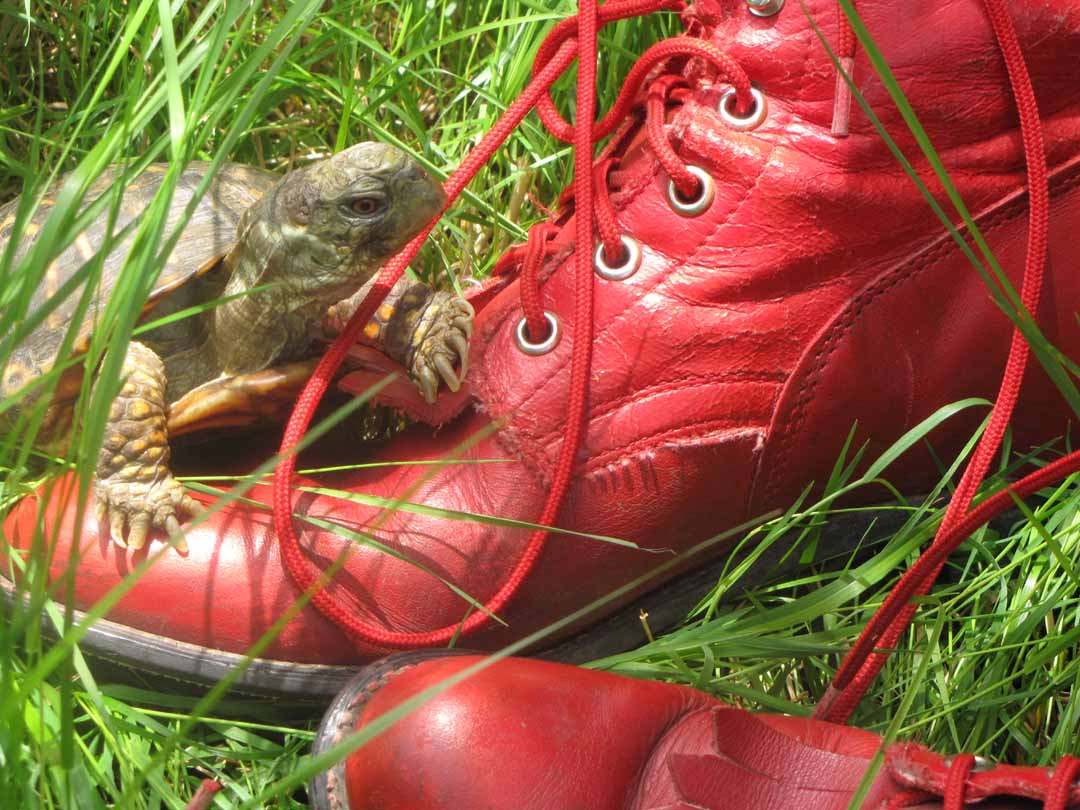
Rosemary Lombard - Original Photography - on Red Shoes
Rosemary Lombard on the theme of “Red Shoes.”
Red Shoes
Once I read—it must have been from a magazine in a waiting room—that the color red was the new neutral. I didn’t believe it then, and I don’t believe it now. Of all colors, red seems to carry the most symbolic and emotional baggage. What is the color of fire? of blood? of danger? of the heart and its Valentine? the color that makes the heart beat faster? If red is neutral, why is the coquette Musetta of La Bohème traditionally costumed in red or its close neighbor on the color wheel and the shy seamstress Mimi (the heroine, after all) given a muted color edging on drab? Why do the red shoes of Hans Christian Anderson’s fairytale represent the overblown vanity of a girl, taking on their own life and forcing her to dance until she begs for her feet—and the red shoes—to be amputated?
The eyes tend to track toward red shoes. Mine are nothing sexy: no towering heels or even open toes, just a pair of old granny boots and a pair of red and white flats; but almost every time I wear them, a pair of eyes drifts down to the shoes and I get comments. “I love your red shoes.” “Can I have the red shoes when you’re done with them?” I have never heard comments loving any of my true neutral collection, the black or brown or gray ones. I have, in fact, heard no comments at all.
In terrestrial turtles there are more color cones in the eye sensitive to red than those sensitive to other colors. The turtles in my behavioral lab seem to favor red objects, a characteristic most likely adaptive: They notice a strawberry, a hibiscus flower, the red eye of a male box turtle, my red shoes.
Neutral
Eyes drift down
and focus on my feet.
Where did I read . . .
Who was it said
that red
was the new
neutral?
Some waiting-room rag
for women (or sheep)
exploiting, perchance
inventing a trend.
What bull!
If red is so neutral,
why then do they costume
Musetta in red, Musetta the shameless coquette,
while shy seamstress Mimi
(the heroine, you know)
wears colors so drab and so muted?
And why do I
love all my red shoes?
Now I don’t dress at the height—
or the foot height—of fashion.
Foot fetish? Not that.
Perhaps it is vanity?
like the girl whose red shoes,
fast to her feet, made her dance—
and danced her off to desperation?
No, but it might be a little of that.
Why, I don’t buy things new,
and who has ever said
to me effusive ohs,
I do so love your jet black shoes . . .
your mud-tinted shoes . . .
your sweet dirty gray shoes!
But red? That’s another story.
Take my old flat granny boots
all laced up in their fire-truck red:
“Oh, I love . . . ” or “May I have
those shoes—so red!— when you are through?”
(Not when life is through with me,
but when I am through with them—the boots,
if that’s what she meant by the rave—
and that not long before the day
when my stockings stick through the soles
and pad over the pavement’s rough rocks.)
What is it, then, about color?
its emotional symbols, its signs?
For red, the color of fire, of danger, of blood,
of the heart and of its Valentine,
our senses and neurons
construct the connections.
How the links make the blood run the river!
Perhaps we mimic a bale of box turtles,
given extra color cones for sensing red,
whose choices—neither pale nor neutral,
but to turtles presumably useful—
elect the reddest, ripest berry,
the brightest bloom of Hibiscus sinensis,
the red-pepper eyes of a box turtle male, and
my
red
shoes.
Author Biography
Animal behaviorist and turtle cognition specialist Rosemary Lombard has one foot in the arts and humanities, the other in science. Her nonfiction story “Diode,” adapted from her WIP, Diode’s Experiment: A Box Turtle Investigates the Human World, just won the first place Kay Snow Award in the nonfiction division. Reading: Blackbird Wine Shop, Feb. 1.
September 14th, 2011 § § permalink
Satellite American
Satellite American
Part I
I was early but he was ready for me so I went in right away. The shadows had grown long by then. Golden light came in through the window and softened the deep lines of his face. Consoler. Counselor. Same roots maybe? The room was dim and yellow. Of care, of wisdom. Much nicer now than when I’d seen him before. Three forty-two when I turned off my phone.
He asked me a bunch of expected particulars but I didn’t mind. With each question came a space. He waited well and I was unusually honest. Even my hands were somehow truer. I suddenly wanted to tell him everything. Much more than what he was asking. Never felt quite like that before, a kid lost, lucky to be found this way and not another.
So I did. I told him everything. For the moment. All that could be true. All of the things that he wanted to hear and I wanted to say. Seemed like he’d stopped listening right away, right after the information part but dunno for sure. I wasn’t even listening to my self. I was watching him. His eyes, his hands, his pen, and then his eyes again when it stopped, the pen. After each uh-uh, my arm fell into my lap like a do-over. My voice seemed to be the only thing moving in the room, and then it was an hour later.
We scheduled for the same next week. I’ll look forward to it, I said, and I meant it.
Each day before it, something I had said that first day would roll back onto me. Especially the things that made him laugh or move his eyebrows, especially the ones that made him stop, look right into my eyes and part his lips.
Next week, not wanting to come off too eager, I went in right on time. I even faked being rushed. I fell fast into the big brown chair and his smile was warm. Call me Parker, he said, so I did.
The room was darker. The blinds mostly closed this time. He started in quickly about something I’d said the time before. All unexpected — nothing that had echoed during the week, nothing I wanted to talk about. He pressed a little and I looked away, at the floor, at the slices of light behind him and then, finally at my hands.
–Are you ok?
–Yeah I’m fine.
The first lie.
–You’re quiet today.
–I don’t want to talk about that stuff.
–Is there something you do want to talk about?
–Not really.
The second lie.
–Would you prefer to re-schedule?
I might have won with a ‘yes’ here but it’d be the third lie and I didn’t want that. Wasn’t sure what yet, but not that. I think I let go right then cuz the stream started. I’m just talking. There was that space again and I was filling it. It was not just emptiness, it was also safe and inviting, a room full of ok-ness.
I must have gone on this way and that about all kinds of things and I could see eventually that he was not getting me. I liked that he showed me that. That he was perplexed. A liar, if he was one, good at seeming genuine. But I couldn’t tell just yet, that’s how good he was. I like this in a person. Not cutthroat-honest and not totally cool as a cucumber all the time but somewhere in between. I figured that he was above me. I was beyond nervous and I could not. stop. talking. The space he was making was too big for me. I’d never fill it. Like running across a desert you know is going to dry you up. My sarcasm, my deflection, none of it would fly here.
–I want to study rhetoric, I said suddenly, surprising myself too.
He smiled as though proud of me. I’d pleased him with that, and that pleased me, but I didn’t know how to follow that act. It wasn’t an act to follow, it wasn’t an act, it was realizing about the desert.
A long pause and then I looked at my phone – four-twenty-five only. A thought whispered across my brain like a tiny crab … terrible to want so much and not know what it is. I could read him after all. No way could I tell him that so I said:
–Can we do something else?
–What do you suggest?
–You play má jiàng?
–You’re funny, he said, not laughing.
I started telling him all about Pan Pan, a neighbor friend. She lives in the building but she’s actually Moms’ friend. I barely know the woman. Its weird though because my Chinese is way better than Moms’, naturally, but Pan Pan doesn’t seem to know or care. Once, in our kitchen, she was on her mobile while Moms was making tea explaining about her husband, that they’d met at the fake-marriage market, he’s loaded, and totally tongzhi, gay. Just needs a tongqi, a homowife, and she gets a big apartment, a nicer car and a monthly allowance, and don’t worry, the laowai lady is married with kids, always busy. And, she can’t wait to see the person when the person comes to town.
I don’t always know why I’m such an ass to my parents, so jaded, in front of their friends and when it’s really inconvenient, I told Parker then, but that this might have something to do with it.
His pen stopped. I’d lost him again. His face told me that he didn’t even know what to do. Was it a mirage or was this desert smaller all of a sudden? Now I was on top and he was struggling so I threw him bone:
–Sorry, I thought perhaps Moms had told you about the outburst.
–Which one was that?
–You’re funny too.
I’d finally made him laugh. Of course she’d told him! And then I spelled it out.
–I get it most of the time. I understand what’s going on all around us and they don’t. Not because I’m so smart but because I’m from here and they’re not. Its not just a language thing either, its even when no one says anything. They look at me like, what does that mean? What now? And I explain to their blank faces what has gone unsaid. I’m American but only sort of. Satellite American.
–I see, he said but he didn’t, and he wouldn’t.
–Where are you from?
–Ohio, he said, shifting in his chair and moving his eyes to just above my head.
He reached for his desk drawer the way gangsters get their guns in the movies and a book popped out like pez. The cover had a person from behind, sitting on a cliff overlooking an ocean. The person was very alone and very high up. I was going to make a crack. I was going to say, O goodie, a guide to suicide! But I saved it. The real title was “Recalibrating Dynamics”. His name was in puffy gold at the bottom and the biggest thing on there: Parker J. White, Psy.D.
No more talking about anything else today. The hour was up. He didn’t have to say it, only look there again, where he’d hung his wall clock, for good reason.
Satellite American
Part II
–Where truth is a balancing act, said aunt Genie, she’s a tightrope walker — shards of a person but not from falls, from never coming down.
I’ve personally met a string of accomplices, all guilty of her slow self-murder. Meet Gwen, aka, Moms. Easy to play as long as the instrument she’s handed you can be recognized. Her trick is to switch them out when you’re not looking. Imagine, you are playing the saxophone, you pause for a breath and then it’s a tambourine, an accordion, the triangle. Few non-family ever register this about her. I’m better at it than Dad but only since this year.
Through the swamp of a family dining experience I’ll see Dad’s jelly-eyes quivering, a rescue plea. Use to be that protocol was to send aid right away but I’m a big girl now.
The day Dad discovered our new arrangement went something like this:
It was already an odd morning cuz us three were actually in the same service apartment, at the same time, sharing a space called the kitchen, and then Dad goes, Mrs. Chen says your attendance has been sporadic—
–I’ve been writing poetry instead!
I screamed it before the pepper hit their Bloody Marys.
–Wanna hear?
–Of course honey, said moms, a bit startled in her hangover.
I stood up, cleared my throat and faked a nervous but my eyes stayed on Dad’s cuz this was not to be missed:
–She was so Chinese, that she was Mexican.
Ice jiggled. It had hit him.
–What could that possibly mean?
He took a big, long, pissed-off pull from his cold tomato soup.
–It’s too lateral for you
–So is your taste in women
His face. From impatient to total meltdown in like a millisecond. I went interrogation beatnik for the last lines.
–Tonight, we hunt.
–You Skeez You!
This was no poem I’d penned. This was texting with Clubbing Dave he’d neglected to delete. Oops!
Moms was great. She gave me the obligatory support – you’re a poet, what a surprise, let’s develop that. I played into this crap and Dad shut the fuck up that’s what. And then he bolted in some kinda bullshit hurry of course.
When I told the story in session, Parker cracked up. I was laughing too and he went, Haha, what a fool! I was like, Yeah totally! But then the room turned horrible. I didn’t see it coming, a clamp on the back of my throat. Worst feeling ever and by my own hand.
The last laugh would not stay in the family. Parker went back to America, and then Moms and Dad, Ayi and even Fei Yue, our driver, were all gonna be out of town for six days. I’d spend the end of the semester, final exam week, alone.
–I’m sorry, said Ayi to my super sad face.
Moms was nodding yes behind her and saying, can’t be helped hun…
By the next day I didn’t care anymore. Smoothed over by the old bilateral kitchen table note and cash-pile:
“Morning Honey, fridge is stocked and this is your taxi money. Do well on those exams and there will be a BIG hong bao for you when we get back. Good Luck! Love, Mom & Dad
P.S. Emergency numbers on Dad’s desk!”
I would not be leaving these pajamas today and I’ll be turning the taxi money into entertainment. Oh Yes. And if Moms had something to say about it later I’d go, couldn’t be helped. You know how that is right?
In Dad’s robe and Moms’ slippers I mixed up a nice big stiff one and shuffled down to the lobby DVD cart. My stack was getting high when I spied it. A box of TV with the Shanghai skyline on it.
“SATeLLitE AmERIkA.” It said.
I put down the stack and paid for the box.
I was like, whatthefuck? Had this wriggled into my brain long ago all stealthy and I’m thinking that I had coined the term but not really? That was creepy but the truth was creepier.
In the elevator I read the back: “Meet Jax, an American teenager in Shanghai…Growing up in… SATeLLitE AmERIkA.”
The pilot went in and I pushed play.
Once, I was home alone after school and hungry. A can of pears I wanted but didn’t know how to use the electric can opener. So I started to use a steak knife and BLAM! Right through my hand, right through the fleshy web between my thumb and index. It was stunning. I mean, I was stunned. I yanked it out RAMBO-style and tossed it, throwing my blood like paint across the white bathroom. I left this world for a shocked place on the floor. That’s the only time that compares to this day.
One disc after the other was watched without pause. My breathing changed the rate of all life. It all blurred together. A blink later it was dusk. With each scene Parker’s use for me played out right in front of me on our humongous flat screen. There they were, my lies, uncoiling and slithering into fiction.
There was a Pan Pan but her named was Ming Ming. She was the friend of the Moms character and my secret best friend in the building. There was a drunk Moms and a derelict Derek the Dad. There was some crazy CGI one for my falling-off face dream. And then there was an episode called ‘Recalibration’ where Moms visits the Counselor, Patrick, to talk about her troubled Jax. One commercial-break later and they’re doing it right on his desk, with the blinds closed, below the clock, heaving. Next scene, they’re naked and glistening in a well-lit, gym-sculpted, post-coitus embrace where they jeer about the hour being up, about how his four-o-clock is Jax and due to show any minute and its not what he meant by ‘recalibrate your dynamic with your daughter’. I mean, holyfuckingshit, right? Holy. Fucking. Shit.
Seriously, who the fuck?
Low and behold, he indeed had more than one Omnipedia page — one as Dr. Parker J. White, Psychologist (the one I knew) and one as Parker White, Writer/Director. I wanted to find him and slap him. More than that though, to find him, shake his hand and say, Mr. White, Congratulations, damn good show.
The me was the truest to life there was. When her face filled the screen and her hands moved to the music to tell the stories I was literally beside myself. I gripped the belt of Dad’s robe with the nerves of my kin. There was no emergency number for this. When it was over I was nowhere.
Author Biography:
Renée Reynolds grew up in Chicago and Los Angeles. She currently works as a freelance writer in Shanghai, where she has lived since 2007. Contact: renrey2010@gmail.com
June 1st, 2011 § § permalink
Fiction from Portland’s Tammy Lynne Stoner
Because There Is A Story To Tell
Marie Curie was the first woman to receive a Nobel Prize. She left Poland to study in Paris, where women of the kind of woman she was could do such things. Later in life, she would watch her husband crumble from exposure to the radiation that they had unlocked.
Marie Curie had shared jokes with Einstein, my mother told me when I was younger. She was a brilliant, fearless scientist. And that, my mother said, is the reason I named you Curie.
Now I – who looks nothing like I think a Curie would – write. Why, you ask? Because there is a story to tell, of course.
This is a story has the smell of salty water and of a too-old onion in a moist container. It is a story with the taste of licorice seeds. It is the story of love.
I crossed that out because really, it is more the story of frogs.
***
Few people connect readily to frogs – perhaps it is because they leave their young before they hatch. We humans always have a hard time connecting with egg-bearing species that leave their young to hatch and fend for themselves: the fly, the fish, the frog.
***
Marie Curie died of long-term radiation exposure in the form of pernicious anemia, with a host of other ailments including cataracts and lung disorders. Her eldest daughter, Irene, had also worked in her mother’s lab with radium – the element Marie and her husband had separated out from uranium ore years before. Irene died of leukemia in her 50s.
Gamma rays come from radium. That was what really did them in – the gamma rays. Gamma rays have the smallest wavelength and the greatest energy of all waves in the electromagnetic spectrum. They are released as radiation in nuclear explosions.
Before their release, gamma rays are forced to move rapidly in order to survive – small, tight, passionate waves living too much life inside small boundaries. In this way, they live the way I live – growing but unable to expand, their energies consolidating under the pressure. Gamma rays create massive worlds in tiny spaces.
I am a short man. Shorter, probably, than most of the men reading this. Shorter, perhaps, than some of the women. And like the gamma rays, this, I believe, has compacted my energies and given me quite a bit more bang for the buck – if I were to charge for it which, excepting that one time in Madrid, I have not.
***
Frogs.
I saw my first three-legged frog on the same day that I saw him – or who I perceived to be a him, before I realized – to my shock – that he was a she. That, I thought at the time, is different, but in some ways much easier.
She was the one to explain to me the importance of the frogs. That their continuance guaranteed the continuation of the human race. She told me this while I looked at her watery green eyes, her body hidden under a huge coat that looked as if it had been felted from lama fur.
Many frogs are infertile now. And infertile frogs, she explained as the air turned salty and somehow onion-y, are forecasting the end of the human race.
Oh, I said, smiling, so how long do we have?
Long enough, she answered quietly – me not knowing if her pause meant I should kiss her then or not.
I stared at her boldly for a moment as the frogs continued making their frog noises in the background.
I am obsessed with infertile frogs, she said, and now maybe, with you too. She continued: the three-legged frogs here have birth defects because of pollution, although I guess we can never be sure if it is only from the pollution.
Then she took off her coat and became a girl.
It is good, I thought, to be with someone who can admit that there is no way of knowing something (or, really, anything). Plus I like her soft-looking breasts stretching against her white shirt.
***
Our brain reacts to thoughts in the same way it reacts to actions – as if they are really happening, even if they aren’t. The same centers of the brain light up when we see something really happen or when we watch it happen on TV. The same blood is delivered. The same emotion is directed.
Curie, she said to me then, laying her coat on the ground for us – and I remember moment this every day, playing it in my mind like a TV episode – Curie, she said, this is a good time to kiss me.
***
Frogs, she told me an hour later, touching my earlobes, lay eggs in clusters. Toads lay eggs in chains. That is one way to tell them apart, she said, but after a while, you get to see the difference straight away. Frogs look more… athletic.
Good swimmers with bad swimmers, I laughed, making a joke about the three-legged frogs and their birth defects.
She moved away for a moment, to let me know how serious she was about frogs.
I’m sorry I made that joke, I said, kissing her straight brown hair that smelled like the ocean.
Some toads, she continued with her watery eyes down, even have live births. . .
***
According to several interpretations, on the day of the Rapture, people will literally disappear. They will be hiking or driving or working or crying or yawning or baking or jogging or having babies and they will simply disappear.
Others think that disappearing might be possible, but for different reasons. They believe that since we were thought into existence, if enough people think the same patterns for long enough, then perhaps certain ones can be simply un-thought. We can un-think ourselves.
Later that night, after we laid a long time in the grass, I looked over at her sleeping and watched as she disappeared.
Stunned, I sat up and looked around – my guts pushing into my chest and my eyes rubbed with sandpaper, as the smoky tendrils of her ghost snapped suddenly like a piece of skin in the wind, and she simply disappeared.
Left behind was the taste of her kiss – like licorice seeds, the frogs that abruptly went silent, and me.
TLS
Author Biography
Tammy Lynne Stoner is the Fiction Editor for Gertrude Press. She is the creator/writer of “Dottie’s Magic Pockets,” which has been in a dozen international film festivals and is in 100+ libraries in the US and Canada. Her work has been published most recently in Draft and Society (Pale House). Her website: TammyLynneStoner.com.
June 1st, 2011 § § permalink
Fiction on the theme of beasts from Shanghai based American author Renee Reynolds.
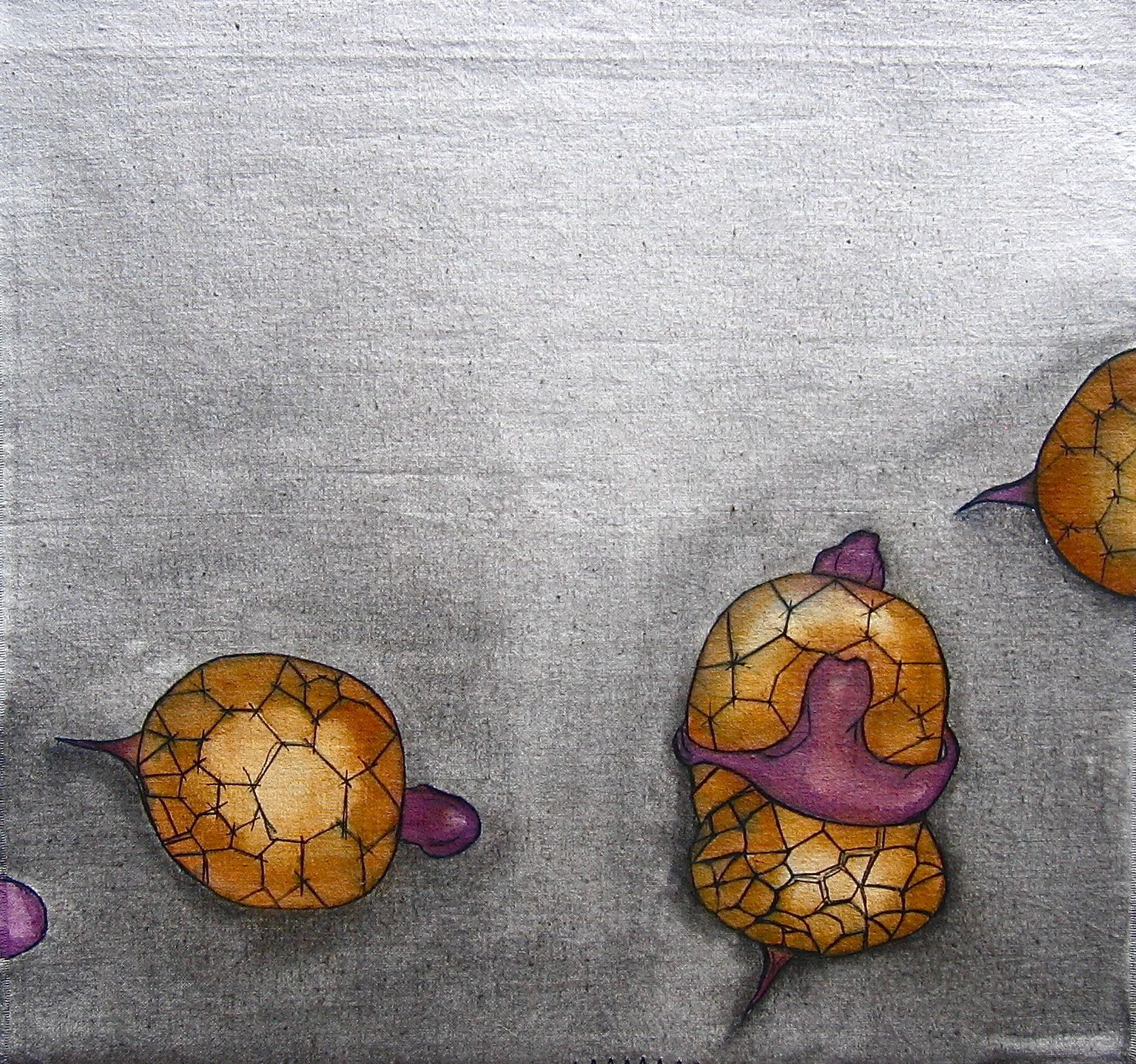
Watercolor, "Turtles," by Renee Reynolds, on the theme of beasts
A Man Called G.
Based on a story that was inspired by a true one
It continues to baffle G., the turns that life can take. He had graduated from a top US MBA program and moved to Shanghai for a high-salaried management position.
Career and life remained lucrative, and so in China, he too remained. By twenty-eight he’d bought a penthouse and by thirty he’d married his Chinese language instructor.
Promotions, bonuses and travel were frequent. There was a mistress in Wenzhou, and then one in Chengdu, and then there were the occasional xiao jie-flecked business weekends.
One day he went to the doctor because he wasn’t feeling well. Nothing conclusive but he was ordered to rest. The hiatus from the office and time home revealed what a shambles his marriage had become.
The divorce got nasty and then it got expensive. Quite fortunately, he’d had his fingers in a big fat Shanghai pie before this domestic unraveling started, and his cut of it came through just in time to help him jump ship all the faster. From then on, he disputed nothing and the ‘I do’ became an ‘I don’t’ just like that.
Back to work he went — a bachelor once again with the spirit of business as usual.
Shortly thereafter, a batch of high-grade lanolin landed in Hamburg to be spread across Europe via various cosmetics by multiple high-profile brands; the shipping end of that lucrative pie that G. had since spent his cut of. Turns out, it was tainted. So toxic that it caused copious cases of blistering rashes; pie in the face.
The probe linked G.’s company to the scandal. His team had overseen the deal between the German-based buyer and the Chinese manufacturer. Bribery, forgery, buck-passing…all standard practice until exposed; rotten pie in the face.
The press would need a monster to behead as soon as possible.
The company offered G. double severance plus a non-taxed informal sum as compensation to be that monster. He agreed.
Time in prison or have the face of his severed head published anywhere G. was spared of. But, his name and career as he’d built them, would henceforth be sunk: his passport was stamped ‘Criminal’ and he’d need to be on the next plane to the US, unavoidable conditions of the secret ‘reprieve’.
Urgings from his mother to stay in the US were followed by a series of job offers from various family members. None would keep him. Four months in the basement of his brother’s Chicago home later, he returned to Shanghai with a new identity. By the end of the following year, G. along with two former colleagues had started their own Quality Assurance operation. Slowly, he rebuilt his life one client at a time. Then he got the lump.
Where his hair ended and his cervical spine began; a tiny nodule of mystery on the back of his neck swelled. It could have been a bug bite, a skin irritation, a small cyst, maybe. It was not.
The first doctor found nothing in the biopsy and sent him home with antifungal cream. A few days later, it was a patch of leathery skin with a small crack at the apex of the lump. He went to see a dermatologist. Another lotion. Before application, G. read the tiny print on the metal tube: “…aloe, vitamin E, arnica, lanolin. Made in the USA.”
One week later, the crack was a scab but the pain in the neck had grown worse. ‘The ache is deep now, in the bone,’ he said. The dermatologist recommended an orthopedic specialist.
Again, nothing conclusive. G. was sent home with painkillers, more lotions, and the card of a therapist specializing in mysophobia (aka germophobia), hypochondria, and other related psychoses common among laowai.
In the therapist’s waiting room, G. read about turtles in last month’s issue of Natural Wonders.
Dr. Lane Fairwell, tells NW how studying turtles has provided new pieces of the evolutionary puzzle.
“Avoidance,” Fairwell explained, “is the most common form of defense in reptiles. With turtles, however, the development of the neck enabled them to turn toward the origin of their fears, thus expanding memory and awareness, changing the pattern of all life-forms to follow.”
G. imagined a turtle waiting to tell a fish about his problems. Then he tucked the magazine under his arm and went for a massage, opting instead for a regimen of hard work, painkillers, whiskey and one-night stands. He was pretty content with this executive decision until a morning somewhere in the third week. He woke flat on his back with unbearable pain and a neck stiff as a board. He reached back with searching fingers to find a tooth-sized thing poking out from the bottom of his skull.
He dropped a handful of painkillers in like peanuts, sucked them down with a swig of whiskey and waited. Once the pain subsided, he pried himself up slowly and with the mirror of a left-behind make-up case, examined his neck in the bathroom. “What the devil…?” It had broken the skin and grown in an upward curve — a tiny, pale-brown horn.
Internet investigations offered a cornucopia of plausible culprits: a bone growth, cancer, soul possession, meningitis, a witches curse, a nightmare or an incredible hallucination…
Again, nothing conclusive.
The pill and whiskey consumption grew almost as fast as the horn. A madness followed; mania. G. surged with an energy that turned him into a dynamo in his three favorite activities: work, sex and ping pong. Satisfied women and a newfound exhilaration greeted him each morning. And business had never been better – rain money it did.
Within a year, the sharp tip of the horn was in-line with the crown of his head. He was like a rhino walking backward. The best tailor in Shanghai fashioned him with fine shirts and suits, each collar with a giant buttonhole. Photographers and journalists came calling. City Holiday, This is Shanghai, Time In…all the local rags wanted a piece of him; pie redefined.
G.’d reached local celebritydom and the top of his game — but it got lonely up there. For the first time, he suddenly wanted his old life back. He considered going back to the US — at the very least, for a visit, to be with mom and the fam.
He had an X-ray just to see. And then he asked about it just to know…could it…could he have it…can it be…removed?
The doctor pinned up the X-ray but G. could already smell the answer, see it too. His spine was fused with it; one could say, it was the top of it, the biggest part of it. Removal would kill him. Second and third opinions said the same.
G. visited family anyway but the description was not enough to prepare them. He had downplayed it. Sure, moments of familial history would be revisited, aspects of the G. they all knew and loved would surface here and there, but this new appendage he wielded with a foreign beastly gait, no one, not even his own mother, could come to accept. Not ever.
G. returned to Shanghai crushed. After swallowing and snorting a plethora of drugs delivered by displaced citizens from nations in upheaval, G. teetered out of his window with nothing, really, to live for. He held out his arm, dropped the bottle of whiskey and decided to follow it.
Headfirst, down, down, down he went, toward the bottom, toward the concrete, toward the blackness of pain’s end.
The weight of the horn pulled him faster into Earth’s core, pushing everything back. G. became a bullet, cutting through the night air as a space-diver falls across galaxies. His head would have crushed upon the pavement if not for the flagpole jetting out of the building; a massive red flag flapping at the end of it.
The horn hooked the pole and swung G. back up into his own window.
With mouth agape and limbs loose as cooked noodles, he slumped there in his box and rested on his horn.
Author Biography
Renée Reynolds grew up in Chicago and Los Angeles. She writes short fiction and paints long pictures. When the voices come, she transcribes as much as possible in case its important but it usually results in a first-person narrative. There are regulars and ones who seem to be just passing through. She is currently writing a novella based on the life of an American business man in Shanghai. She works as a freelance writer and has lived in Shanghai since 2007. This is the first time she has written about herself in the third-person.
June 1st, 2011 § § permalink
Nevada’s Ron Rash shares an excerpt on the topic of beasts.
The Color of a Cotton Picker
Soft spring nights scented by flowers and antithetical skies filled with the threat of twisting violence had given way to the Oklahoma sun of an extended summer. The unwavering heat of the mid-September sun seemed to add weight to late morning humidity already pressing hard on the backs of the field hands.
To a child of five, the arched backs of the workers, most dressed in white or light colored clothes in a pitiful attempt to reflect the sun’s brilliance, looked not unlike humped back whales feeding in a sea of brown, brittle shrubbery dotted with the white of their cotton flowers. The fruit of the cotton pickers’ labors often ended up as starched dress shirts on the backs of well-dressed men. The small boy watching the field hands this day wore another garment made from the cotton; a hand-sewn, scratchy shirt stitched from the colored print of a flour sack.
The boy looked up to see how far behind his mother he had fallen. The grown workers and young adults were already well away from him as they expertly worked their assigned rows. The cotton stalks and bowls had dried into brittle, glasslike organic shards waiting to slash and cut poorly protected hands in defense of their soft white flowers.
Young Guthrie Collins marveled that the grownups could pick so much cotton so quickly as they labored under the weight of the long white sacks slung over their shoulders and dragged on the ground behind them. His daddy, whom he was taught to call Mr. Collins, but whom he called Daddy anyway, said the sacks could hold upwards of 100 pounds, and at two and a half cents a pound for the pickers, a man had to stuff every pound he could in that damned sack. Guthrie’s momma, Audrey, didn’t like Mr. Collins to swear, but he knew a lot worse bad words than damn. Mr. Collins seemed to know every bad word ever spoken, especially when he was working on his broken down old Studebaker or talking about his boss.
Guthrie carried his own collection sack for the cotton, but it was not even half as big as the grownups. Completely full it might top out at 30 pounds. Since he weighed only 40 pounds himself it was a burdensome load when full. He inspected the load carefully and fluffed it up as best he could, but try as he might he wasn’t able to make the bag appear full. Mustering as much focus as fear will allow in a young mind, Guthrie decided it was better to have the weigh-in boss tease him about his poor work ethic than to try to catch his momma with such a heavy sack dragging behind him, especially when the weigh-in boss was just a few feet away.
A beaten and ill-maintained old Ford stake bed truck sat just inside a barbed wire fence that ran along side a lonely stretch of Oklahoma state road. On top, the weigh-in boss had already spotted Guthrie and was grinning through his tobacco stained beard at the boy’s hesitant approach. The boss’s voice carried the slow, melodic drawl of a lifelong Oklahoman. “Well, well sonny, y’all don’t seem to have a full bag o’ cotton there, know do ya!” A laugh followed that could only come from a slack-jawed half wit with nothing better to do than torment the helpless.
The boss peered through gray-blue eyes at Guthrie as he bent to lift the boy’s half-full cotton sack to the weigh hook. A series of counterbalanced springs moved the arrow of the circular face to just over 20 pounds. Again came the noxious laugh that the boy hated so much. “Y’all can fluff up the cotton in this here bag all ya want sonny boy, but the scales say twenty and one-half pounds. That’s it … that’s all.” The bully held the sack high above his head as if it were a trophy head of some animal he had just slaughtered.
Guthrie was always in awe of how easily the weigh-in boss could lift the heavy sacks of cotton to the weight hook. Granted his bag was puny by comparison, but the men’s sacks often went over 100 pounds.
He felt his clothes begin to ‘itch’ him as he adjusted them in all the tight places… under the arms, in the crotch and in the seat. He felt a welcome breeze kick up the front of his light blond-brown hair and cooled his forehead as the sweat of his brow evaporated. Tears were trying to form in Guthrie’s bright, dark blue eyes but he choked them back.
This time the boss’s voice boomed at Guthrie. “Go on now boy, you’re a startin’ to bother me. Go find that injun mother of yours afore I tell your daddy about this half empty sack you toted up here.”
“My momma ain’t no injun. And she ain’t that bad word you called her yesterday, neither.” Guthrie struck a defiant pose in defense of his mother but his bravado gave way to the indignity of a runny nose, which he promptly wiped on the tail of his shirt.
“You back talkin’ me boy?” bellowed the fat weigh-boss, scaring the boy almost to tears. “If’n I say yore momma’s a nigger and a injun, then that’s the way it is!”
Guthrie felt tears running down his cheeks and a lump forming in his throat, and the truth being self-evident, he was deathly afraid that the boss man would jump down off that old Ford truck and snap his head off his shoulders. But he was committed now, and he was going to defend his momma to the end. “My momma says she’s a woman of color. She says she’s part African, part Cherokee Indian, and Irish from the waist down.” Guthrie had no idea what the last part meant but it sounded important.
The boss man had had enough. He was afraid that the others standing close by would hear him losing an argument to a five-year-old brat. He tossed the young man’s cotton collection sack back at him with so much force that he lost his footing and fell hard on his butt in the bed of the old truck. “Get the hell outta here boy afore I take my belt to yer backside.”
Guthrie was knocked to the ground by the force of the light bag hitting him in the face and chest. As he pulled it from his eyes the first sight he caught was of the red faced boss man flat on his butt, and all the people around him trying to restrain their giggles. Realizing he was now in real danger, the boy ran. And ran. And ran. He was looking for his momma Audrey. As he closed in on the pickers at the far end of the field he looked frantically for her. Then he spotted her white trousers, white apron and slim legs standing just behind him and on his right. He turned and leapt at her and felt her strong arms carry him up to her breast. He buried his head in her bosom and cried softly, “The boss man called you an injun today, but I tole him you was a woman of color just like you tole me.”
“Boy, I love to hold on to ya like this, but I ain’t your momma … she’s right over there.” The woman laughed loud but affectionately and pointed to Audrey for the frightened boy. “And I don’t knows nuthin’ bout this woman of culah bi’ness.”
Guthrie was mortified and panic-stricken, still trying to beat back the tears as he fought furiously to escape the strong woman’s grip. A funny thing though, even as he fought to get loose, Guthrie was drawn to the woman’s big smile filled with bright, white teeth greatly contrasted against her brown-black skin. As the fight ebbed from him he was beginning to be reassured by her throaty laughter and pats on his behind.
Eventually the tall woman let him down, and with another pat on his small butt, scooted him towards his momma. He would remember her warm touch and rich laughter for the rest of his life.
Seeing his momma for real, the boy let loose with genuine tears and some unabashed wailing. “Guthrie child, y’all better hush now. Mr. Collins will beat you sure if’n he catches you cryin’ like this.”
She held him tightly and smiled at the other women watching the scene.
RR
Author Biography
Ron Rash is an occasional writer of fiction and non-fiction stories. Ron resides in Henderson, Nevada with his wife Joanna. He has authored several short stories and novels, both published and unpublished. He enjoys his three grandsons and fly fishing, and loves to spin a good yarn.
