December 14th, 2011 § § permalink
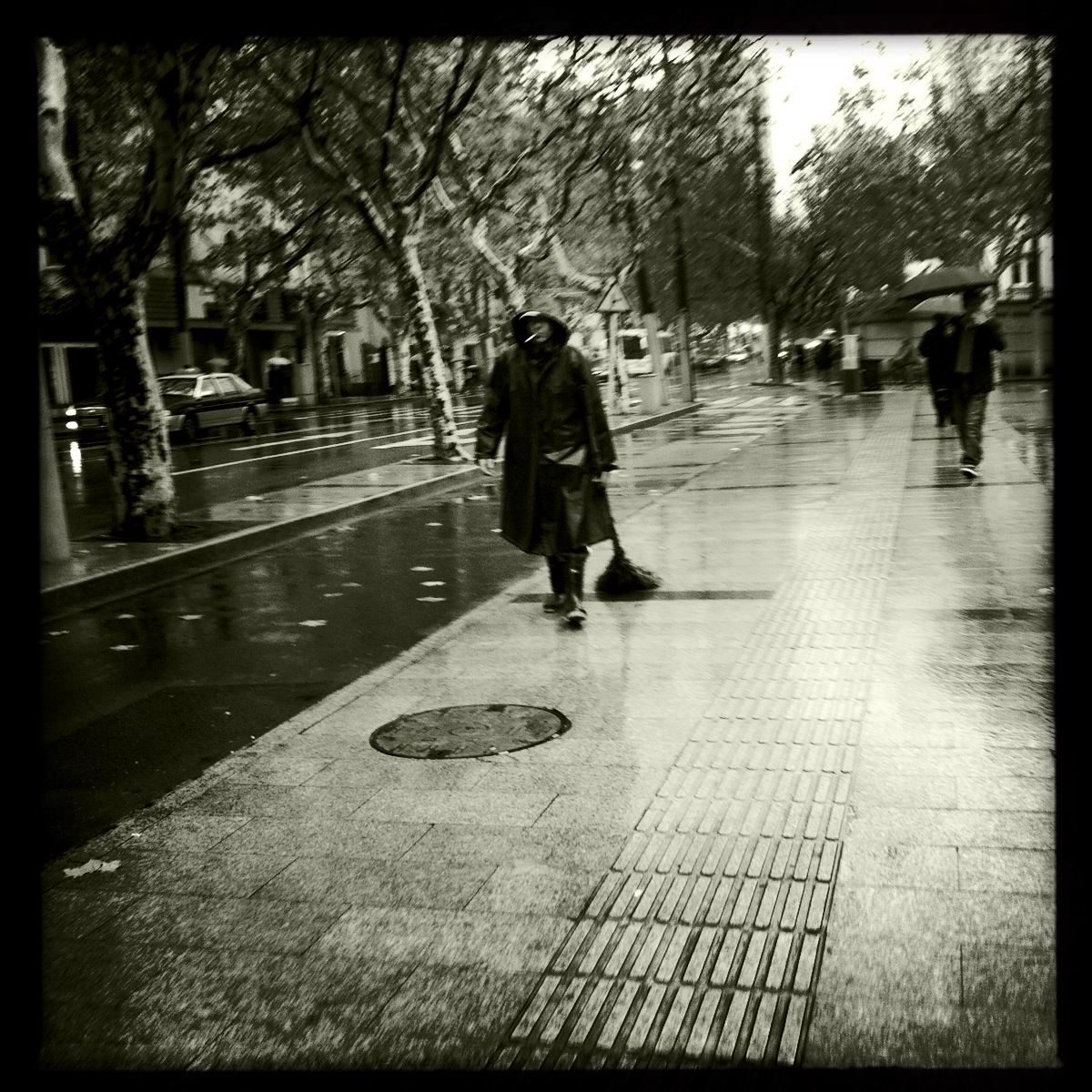
Study of a Shanghai Street Sweeper in the Rain on the Way to Morning Coffee - Shanghai, China, 12/11 - Dena Rash Guzman - on the theme of Coffee
Dear Readers,
DAVID BOWIE DAVID BOWIE DAVID BOWIE!
Unshod Quills is a theme based publication, centered around themes chosen by the editor or other participants in the Unshod Quills Writing Collective. DAVID BOWIE! One of my dream themes, and this issue is very much about him. With just the beerlight to guide us, we also feature works based on the themes of love, coffee, Joan of Arc, dancing about architecture, and enough rope.
Speaking of coffee, David Bowie and enough rope, this is how I spent my pre-Christmas unvacation:
My publisher, HAL Publishing, flew me to its hometown of Shanghai earlier this month. I was there to stage, for an audience of over 300, a group performance of my smutty little short story, “A Brief History of Dan Orange of Shanghai.” This was a multimedia presentation featuring myself and a truly international cast of artists including Estel Vilar, UQ Contributor Ginger wRong Chen, UQ contributor Katrina Hamlin, the enigmatic Barbara A., and Mr. Brian Keane. Video backdrop was provided by Colorado’s own Jerimiah Whitlock. The occasion? The River South Arts Festival, a four day celebration of independent Shanghai art and literature, featuring Slamhai3 and the release of HAL’s second collection of short stories,
Middle Kingdom Underground: short stories from the people’s republic of
The US edition should be ready for sale around February 15 and I’ll have two stories in the book, one co-written with HAL founder and regular UQ contributor, Mr. Bjorn Wahlstrom. The book’s theme of vice in modern China is heavy and dark, and the stories by fifteen authors, both local and non-native to China, are accordingly complex and delightful.
In the meanwhile, a click to the title above will take you to the stunning and beautiful and bizarre Middle Kingdom Underground book trailer, produced and directed by September Unshod Quills contributor, Portlander Posie Currin. In addition, the HAL book release was filmed and will soon be broadcast internationally on the new fine arts internet TV network Bravoflix.
Where do coffee, David Bowie and enough rope come into the above recap? Let me write you a prose poem, that will make no sense, in order to explain myself.
Coffee – I drank a lot while I was in China. Not so much tea. Coffee. I learned that I make a terrible pot of French press. David Bowie – that’s Bjorn, but minus any glitter and plus a freighter of stardust. Bjorn wears all black all the time, unless it’s raining, and then he wears white leather tennis shoes. Enough rope – after nearly setting his neighbor’s kitchen on fire with my suitcase, I learned that Bjorn keeps enough rope on hand to escape out a window just in case of some such event as a clumsy American starting fires with suitcase and a hotplate in a stairwell. There are no fire escapes in those old buildings. Rope is good. He’s four stories up and to get in or out one must pass through two neighbor’s kitchens and twisty flights of narrow, steep stairs. It’s a gorgeous place, though, and Bjorn has a cat that is in the process of self-actualization. Perhaps soon big fat Blackie cat will get his own rope.
I’m grateful to HAL for having me as a guest performer at their book release party, and for all the support they’ve shown to Unshod Quills over the past year.
Meanwhile, back in America, managing Editor Wendy Ellis and I struggled to confine our selections of art and literature for December to a reasonable number. That is why we chose not one, but two featured poets for this issue.
Having worked with James H. Duncan a number of times over the past four years, I am already acquainted with his eloquent ornate minimalist style, and have long been a fan. James was an easy choice to feature, and we hope you enjoy his work as we do.
Our second feature is an amazing writer who sent a suite of submissions on the theme of childhood alone, and our skirts were blown nearly clean off by the gale force of their brilliance. Be sure to look at the poetry of Catherine Woodard.
Both of our featured poets are based in New York City. We get it, New York: we want to be a part of it, too.
December’s featured artist is from another part of the universe: Greece. Sugahtank John Roubanis is a talented graphic design artist and illustrator; his King Kong poster take this month’s front page. We love his work, from the scratchy, ropy sketches of near-human figures to the sublime political graphics to his logo work. Sugahtank’s vision told us it needed a good sharing with the Unshod Quills readership. It actually spoke to us.
We are also happy to see the return of Kevin Sampsell. His Bowie piece is hilarious and I for one will never be able to look at him the same way, fiction or not. Rusty Barnes is in this issue with some uniquely elegant and rough country flavored fiction, while Timothy Gager tells you you’re gonna need a bigger sandwich. Order up. Also look for the work of Portlander Jenny Forrester and the best middle school Bowie obsession fiction we’ve ever read – Jenny Hayes is in the house. HAL Publishing’s W.M. Butler shares a treacherous story about bullies and rabbits and the beauty and brutality of childhood, and it’s an editorial favorite. We have the work of Frank Reardon, Matty Byloos and Nancy Flynn… Ryan Werner kills it with his minute by minute rundown of Bowie and Jagger’s video for “Dancing in the Street.” I love Bowie, yes, but everyone makes mistakes. Look for UQ’s own X. Joloronde and Robert Myer on Joan of Arc, too.
I could go on but just look to the right and click away. Thanks for visiting, and we’ll be releasing our next call for submissions on New Year’s Day – I’ll let you know now that one of our themes will be David Lynch.
Spread these writers around like the pandemic they are.
Ever yours,
Dena Rash Guzman
Editor
Unshod Quills
in the woods near Portland, Oregon, USA

Dena Rash Guzman, seated, listening to Ginger wRong Chen in Shanghai - 12/11
December 14th, 2011 § Comments Off on Matty Byloos § permalink
On the theme of Enough Rope
THE FREED PRISONER VERSUS HIS HOROSCOPE
The prisoner back in society, just like that. One day he’s in, and the next day, he’s reading the newspaper like none of it ever happened, only it did.
He’s never not still surprised by the light. He gets swallowed up a lot now, in his new life. Just like when he reads the newspaper and has to contemplate certain things like freedom. And what it means.
Most of the time, it doesn’t mean that much to him.
The first time he went for a walk, he wasn’t sure where exactly he was going. Just headed off in a direction, and that was hard to stomach because he found himself looking for how he was confined. What walls were out there waiting for him? What was this thing they told him about being free? He kept walking.
And then he found them. It hadn’t taken more than a few hours, when he came upon a bank of chain-link fences, stretching in both directions to either side, into the darkness somewhere small. To places that he could now see were equally hopeless, places he wouldn’t ever bother traveling to. What would be the point?
A dog saunters up from somewhere behind him, smells his hand as if he’s looking for a pat on the head. The prisoner kicks him instead, has to take this out on someone or something. As soon as it’s done he feels guilty, figures it’s just the institution still in him somewhere. He always assumed the guilt would just be his to carry, but it surprised him every time just the same. Now was another one of those times.
So he kneels down to call the dog over from wherever he went, maybe just a few feet away. It takes a minute but eventually he does. No collar. What would be the point? They’re both in a cage. In fact, once his eyes adjusted to the oncoming darkness around them, he realized it was several rows of cages, hedging them in like some kind of concentric maze – more than enough of them to convince anyone in their right mind that trying to escape was futile. What had he been looking for when he went on this walk anyway? The prison psych doctor would have told him he was looking for exactly what he had found.
But that was a bunch of bullshit, and he knew it. Who the hell would be looking for captivity again after what he’d just been in?
Maybe everything of consequence had been washed down the single drain in the center of that cell back there in his past. Maybe it had all disappeared, and him with it.
Right down the drain.
And then everything around him was quiet again, back in the present. This was one of those moments his prison counselor had told him about. More like a warning, actually, now that he was in it, alone.
The dog had trotted off in the direction he came, and the prisoner looked around him for something, for a light or a house or someone who could tell him where the hell he’d been put once they let him out of prison.
About a mile east of where he ended up finding the fence, and another quarter-mile inside of it, he comes upon a house with a soft blue light on, the kind that a television would make. At least he had found some kind of civilization. He wondered if someone else in his position would be scared of what he was about to do. He wondered where his fear had gone to, because he couldn’t feel any of it anymore, and maybe this made him less than human. Maybe this is why they had put him right back in a cage.
A man answers the door. “Watchin’ t.v., what the fuck you want, mister? Me an’ my buddy here are watchin’ some t.v. and then there’s a knock at the fuckin’ door, and guess who it is?” he says, hardly realizing what he’s doing. Or maybe he’s another one without any fear.
None of this registers on the prisoner’s face. He can see something familiar off behind the man on top of a table in what looks like a kitchen. “Gimme’ the newspaper,” he says to the man. “I want it,” he says, not blinking at all.
“Get this, Earl. This fuckin’ guy here wants the newspaper,” he says, leaning over to grab the papers with his left hand while keeping his right one on the door knob the whole time. “Can you believe it?”
“Thanks. I need to read my horoscope. That’s all. G’nite,” the prisoner says to him, turning to walk farther down the street. He hears the door close somewhere behind him, and opens the paper underneath a street lamp about a block away. Flipping to the back, he finds it. The horoscope. His horoscope
Author Biography
Matty Byloos’s first collection of short stories, Don’t Smell the Floss, was published in 2009 by Write Bloody Books. His work has appeared in Everyday Genius, Matchbook, Bomb, Dark Sky Magazine, among others. With Carrie Seitzinger, he runs Smalldoggies Magazine & Press. He is currently working on his first novel.
Learn more about him at his personal blog: www.mattybyloos.com
Or at the Smalldoggies Magazine site: www.smalldoggiesmagazine.com
December 14th, 2011 § Comments Off on Nancy Flynn § permalink
A Brief History of Cockroaches, Glitter Rock, and Inappropriate Love Objects
(on the theme of David Bowie)
Once upon a time, my nemesis was the cockroach,
that summer I worked at the Indian import shop in Brattle Square.
Their squadrons aligned for daily battle over the barricades:
drying dishes next to the apartment kitchen sink.
Whenever I got up in the night, turned on the light,
how they’d scatter, their claws a skin-skimming whisper
married to hiss. I tried every variation of the “Vegas roach trap”—
stale beer, coffee grounds, sticks up the sides of a Mason jar
and Vaseline around the lip to increase the slick.
All hail, the cockroach, apotheosis of tenacity!
It was the roaches in their 4th of July parade
across my futon, the final straw that finally
drove me into Ted’s bed (and arms)
even though we weren’t that kind
of roommates—one more who was gay not bi.
This was, after all, 1974: the U.S. still in Vietnam,
the Dead on their first tour without Pigpen,
and Bowie at the Music Hall in Boston where he donned
a Ziggy Stardust jumpsuit for half the evening’s songs.
My enemy should have been tanning
so to protect this Irish-mottled skin.
Or Camel straights because of my (future) asthma lungs.
Or bare feet on the hot tar, bottle-shard Massachusetts Avenue.
Or the guy who grabbed my crotch under my hippie skirt
that eve walking home from King of Hearts
at the cinema on Central Square.
Those days of rush and foolish trust,
any stranger might be christened “friend.”
A guy’d walk into a store, blond hair a waterfall
over his Pendleton plaid. Back-and-forth sallies
about what you’re reading (Anaïs Nin), the decline
of literacy (shameful), whether Mr. “Enemies List” Nixon
will really be impeached. Then, cosmic coincidence,
you’re both Tassajara Bread Book devotees!
The next night, you’re on the Red Line to Alewife,
a dinner of lentil loaf, alfalfa sprouts, and Something Missing
muffins. Followed by lips locked over a rickety
kitchen table then the (requisite) screwing on the linoleum floor.
After? Midnight’s T back to the Buddha
who, by the way, is not in favor of lust.
Who teaches to love, accept, live and let every enemy live,
cockroaches and all. I’m not sure I ever got to that,
that August when I watched the swans in the Public Garden
and walked walked walked those city streets, restless
to escape my awkward infestation-situation,
notebook in a messenger bag, my temporary
enemy an inkless fountain pen.
_________
Ligature
(on the theme Enough Rope)
Tie Me Down, Tie Me Up
Strips of rag, one nubby wool, one silk,
we re-arrange our cast-offs, braided, taut.
Down to what’s underneath we merge—
your strapless bustier, my Gucci jock.
Touch is our glove, our tether,
& our truss—the ties that lash,
that fret us to the bed. Oh,
lift your legs & let them wrap around
my clarinet,
my woody reed,
my head!
Licorice Stick
Jimmy Dorsey tootled “Green Eyes,”
with—oh, the power to send me ogling
your rings of amber, my cautionary hepcat.
Hell, even Ol’ Blue Eyes wanted to fly us
to the moon. Why didn’t we take him up on that?
Go go-go before Bechet blew jail, his clarinet
emptied of the gone-away blues while we two
dueled, all our wrong chords snorted out.
Likely, the reed was simply slipping,
needed a new ligature, thread or hemp.
Ampersand
Our typeset was a unit.
Two graphemes make a glyph
& letter shapes depend on circumstance.
The Latin et for “and” signs & in Trebuchet.
And per se and (ampersand):
& by itself is and.
And me myself?
I start, you stop,
I finish sentences. Fee! Fie!
Foe! Fum! Why won’t you let me
fl-fl-float, slurred ligature,
disfigured cuneiform?
And What About the Necktie?
He went crazy for the ties,
that winter of detox,
rehab, the county
psychiatric ward.
Every pattern,
every hue to match
the expensive suits
tailored to fit.
Blame it on the manic—
he must have draped
one hundred
by the end.
When his landlord walked
the rooms with me
an empty rack,
all that was left.
Where Mandrakes Grow
Estragon: What about hanging ourselves?
Vladimir: Hmm. It’d give us an erection.
Estragon: (highly excited). An erection!
Vladimir: With all that follows. Where it falls mandrakes grow.
That’s why they shriek when you pull them up. Did you not know that?
Estragon: Let’s hang ourselves immediately!
—Samuel Beckett, Waiting for Godot
Pressure on the cerebullum from the noose.
Forensically, postmortem priapism is an indicator—
death was likely swift and violent.
Lynch me, hog-tie, jute my carotid,
cinch it closed. All I wanted was
to merge—the font, the fount, the godhead.
Angel lust.
Suicide Vaudeville
Way out on Sapsucker Road,
a sidewalk to shovel and snowdrift
steps to reach the song & dance.
Rifle behind the door,
a wineglass shattered on the stairs.
Daisy-chained neckties lassoed to beams
in the living room where the radio
belted the “Best of Broadway,”
Ethel Merman and Everything’s coming
up roses, her mezzo soprano clobbering
every tenor within reach.
Better Gypsy than Sweeney Todd,
the ambulance driver said. Meat pies
and a trail of blood would have been—
let’s face it, a little too burlesque.
The Final Inamorata
That tightening loop,
a failed
meridian.
Un-
blessed the bruising ties.
They bind.
They rend.
Author Biography
Born in the coal country of northeastern Pennsylvania, Nancy Flynn’s writing has received a James Jones First Novel Fellowship and an Oregon Literary Fellowship; her second chapbook, Eternity a Coal’s Throw, will be published by Burning River in 2012. A former university administrator, she now lives in Portland, Oregon. In 2004, she happily reclaimed www.nancyflynn.com from the realtor in Massachusetts who had it first.
December 14th, 2011 § Comments Off on Holly Hinkle § permalink

Vuluture - Holly Hinkle on Dancing About Architecture
Spiked Fence
(enough rope)
Survival. We talked of little else.
In a book, you read how to jump a spiked fence
so you could camp in a church corridor.
You told me how you scaled it twice a day,
sometimes more, having spent the last
of your money on good rope.
I would give up everything to walk beside you.
Traffic’s taillights cast red in our hair,
our packs rising off the down of our jackets.
I wouldn’t last. I know.
I listen to the black and neon rush
of street noise through the phone.
__________
Topanga Canyon Road
(love)
In the cold pressed, gray light of the basement,
where you discovered the photo album from 1910, the green hurricane lamp,
the great iron-banded trunk you wanted to drag up for me,
I find you packed to leave the boardwalk.
Wet tarmac smell. Black as the night is long.
The road is folded down inside the trunk,
we can open the heavy lid together.
I will help clothe you in that hard, moonlit coat.
__________
Venice Beach
(love)
My sister was at work and I was away that early spring,
when our brother packed one bag for the streets.
The first night: steady rain and his drawing paper wrinkled.
It was cold. I don’t think he ate. My stomach empty that week.
I dreamt my sister and I were a part of the day he left,
of saying goodbye to him on the outskirts of Venice Beach.
From there we could see the boardwalk, smell its salt
and perfumed oils, dyed cotton and clove cigarettes.
We were not there the day he left. It is a loneliness,
knowing that he always walked on after we stopped
at the front steps of home. No memory of when he followed us inside.
He walked down a road we could not follow,
that tore like a frail map. The pieces turned into leaves.
Author and Artist Biography
Holly Hinkle has been creating collage and mixed-media artwork since 2008. With found objects and small antiques as a backdrop, she is always thinking about ways she might create exceptional beauty from unrefined objects that once had a very simple purpose. Her poetry has appeared in Poems and Plays and The Arsenic Lobster. She lives in Portland, Oregon. Beginning this month, she is Arts Editor for Unshod Quills.
December 14th, 2011 § Comments Off on Ryan Werner § permalink
On the themes of David Bowie, Joan of Arc, and Enough Rope
Hammer Down
For Samantha Callahan
(ENOUGH ROPE)
You’re an eight-ball. Every hand you see
is crooked, that of old men who shake whiskey sours
in harbor bars. Forget that sludge of a sigh
resting heavy in your gut. Autumn is always here,
always bringing you back to Seventeenth Street: church
every day with the south-end Irish,
a paisley shawl wrapped tightly ‘round your waist.
This city is no bigger than when the men were scarce and broken,
when all the boys were merely boys. When the tide takes it,
its nervous waltz will keep us sleepless. Don’t rest. Hurry home.
Name your truth and touch me.
___
This Is What Happens When You’re Single Too Long and a Pretty Girl Named Joan Smiles At You
(JOAN OF ARC)
I thought for too long about the arc of our bodies.
Not when we are older, but when we were younger,
before we knew each other: your drink stays full all night
and you hold it like a burden. You lean forward.
I’m a janitor three states over. I tug at my posture
like a half-truth. We’re seventeen. We’re always seventeen.
___
Let’s Spend the Night Together
(David Bowie)
Popular rumor states that Angela Bowie found her then-husband naked in bed with (also naked) Rolling Stones lead singer Mick Jagger sometime in the early 70s. Upon Angela revealing this on an episode of The Joan Rivers Show in 1990, the aftermath of denial showed both men handling damage control in the spirit of their rock and roll personas: the cocksure Jagger came right out and said that Angela was full of shit and Bowie came right out and said nothing, as his lawyer released a statement saying that there was never a gay relationship between the two. It makes sense that Mick, who has based an entire career around singing like a man and dancing like a woman, would do one thing and say another. And of course David, who has based an entire career around androgyny and displacement, would just let people think whatever the hell they wanted.
It’s called being a rockstar. The whole point being that you do whatever it is that you want with no consideration for the outcome, which is why you can take a class on the British Invasion and think critically about lyrical allusions to personal and political turmoil, but at the end of the day you’re either the sort of person who’s going to throw a hotel television into a pool or you’re not. To this end, it would make perfect sense for Mick and David to come right out and say, “Yep, we totally had sex with each other. What of it?” Because there was no such public acknowledgement of the tryst, are we right to assume that the tryst is a fabrication and that both men led totally hetero lives?
Perhaps. In moving beyond base-level fascination, salacious celebrity sex stories are no more interesting than their blue collar counterparts. Hip Hop Man fucks Business Mogul’s Inexplicably Famous Daughter is, essentially, the same thing as Bowling Alley Manager Man fucks Avon Saleswoman. The true banalities of sex are obvious when the act is both the means and the end. It’s like watching pornography or engaging in last call hook ups or almost all of sex that Mick and David had throughout their careers. For them to have been outed in the 70s, at the height of their respective popularity, would have only helped to propel the mythos they were building. It would have just one more hole for Mick’s “fuck anything” attitude and as for David, it would have added another layer to his queerness-by-way-of-fucking-supermodels. So it’s entirely possible that the issue wasn’t one of sex.
Or sexuality, for that matter. When (then former) Judas Priest vocalist Rob Halford came out of the closet in 1998, he made note of how having to hide his homosexuality caused him to go through severe bouts of loneliness and depression. Though I don’t doubt that Mick and David dealt with similar demons, nothing they’ve ever done has given the impression that it’s because they were hiding their sexual preference from the world at large. If anything, they fell into depressive states due to their substance abuse, as opposed to Halford falling into substance abuse to help deal with his depression.
It seems to make the most sense, then, that Mick and David are two men who loved not other men, but one another, in ways that stretched beyond gender. A true “forbidden love” usually tends to be more of the former and less of the latter, but Bowie and Jagger seemed much more like Romeo and Juliet than, say, a teenage version of yourself in dire need of dating someone ten years older who likes to punch you in the meat of your arms while you fuck, and only survives because the street value of cocaine doesn’t fluctuate as wildly as the job market. (Call your parents and apologize. They were probably right about some stuff.)
I like to believe that Bowie and Jagger had sex at least once. I like to think that they shared a unique, honest love that, both in spite and because of their importance to rock and roll, they felt they could never publicly express. It humanizes the larger than life aspects of their characters in ways that only the effects of simple, compounded ache can do.
Putting aside musical integrity and topical aesthetics, the video for Mick and David’s version of “Dancing In the Street” by Martha and the Vandellas is amongst the most ambiguously gay entities of the 1980s, the same era that spawned the volleyball scene in Top Gun and the ’87 Oakland A’s. Above all, it is the Rosetta Stone to their dynamic, and while the undertones range from playful to overt, there is no slack at all in the tension between Mick and David, as if their hearts and cocks are tethered by the tightest of guitar strings. In it, we find two men who allegedly shared at least one evening of passion a decade prior. After the fires of both their careers and feelings have settled a bit, they get together and experience somewhat of a rekindling, somewhat of an exposure to the differences between what they were to one another and what they currently are.
:00-40 (Warehouse)
Mick is dancing by himself. He calls out, asking if everyone in the world is “ready for a brand new beat.” He sings “Summer’s here, the time is right,” and then David shows up in frame on an elevated surface to the right of Mick.
:41-:47 (Warehouse)
The camera does a momentary close-up of David smiling in a somewhat maniacal toward Mick. Overwhelmed to a point of bursting, David jumps down in the direction of Mick. When the camera cuts back to Mick, David walks into the shot coolly and stands next to him without acknowledging or being acknowledged.
:48-:50 (Warehouse)
David dips down and bounces back up quickly, brushing his head against the side of Mick’s head. Mick takes a second to react and then darts his eyes over to David as if worried about the obviousness of intentions better left secret. David doesn’t notice.
1:06-1:13 (Street)
The men face each other and sing “It doesn’t matter what you wear.” David’s head remains forward, but his eyes go to Mick’s mouth. Mick looks straight forward at David’s face. Mick fiddles with the lapel on David’s jacket. The men put their foreheads together and sing, loudly, convincingly, “As long as you are there.”
1:14-1:22 (Street)
Immediately after finishing the previous line, the men turn away from each other to sing “Every guy, grab a girl.” They then face each other at close range once again to sing, “Everywhere, around the world, we’ll be dancin’.” The scene freezes briefly before cutting away. Mick’s lips are puckered. David is moving toward them, eyes closed.
1:36-1:42 (Street)
The camera revolves around Bowie in the foreground and Mick in the background as David takes the lead vocal. Mick fixes his hair with one hand while looking at David. Mick’s gaze is one of inventory and concentration. He quickly licks his lips as he hops back in front of David so the two of them can sing the refrain together.
2:18-2:19 (Warehouse)
This time, it’s Mick who rubs his head lightly against the side of David’s. David looks annoyed. Mick doesn’t notice.
2:45-2:58 (Street)
The camera slows down and does a tight shot of the men’s asses. They’re side-by-side and they shake their hips in total synchronicity to the left, the right, and back to the left quickly before the camera freezes and fades to white. In the last second of the video, the screen fades to the traditional black.
Five years after that, after they had learned to live at peace with what they shared, it’s brought up as a cheap matter of publicity. I’d deny it, too. And then I’d grab a girl and dance in the goddamn street.
___
Line
(David Bowie)
A pity-seeking friend of mine who was prone to announcing his heart pains at dinner and then dramatically taking nitroglycerin pills started up with the old act, to which I said, “If you have chest pains alone in the woods, is it still a heart attack?” It was the last time I was funny, about twenty-five years ago.
I ask Vince about comedy the way kids ask their parents how clouds work and he responds back like cough syrup dripping down the side of the bottle. I’ve been his tour manager for the past few decades. He keeps me around because I’m not funny, because I don’t romanticize comedy the way other people do. When I said my heart attack line at dinner that one time, he laughed like everyone else and then said, “One more like that and you’re fired.”
The newest tour is probably his last big one, so I’ve made it the biggest one: half a year straight, 140 shows. Vince is in his late-50s and he’ll do more shows this year than an MLB pitcher will play games. I’ve set it up so he’ll be taking a young comedian out with him, and when I pick them both up at the airport, Vince and I wait for twenty minutes while Lee signs autographs. Vince watches him through the window and I go, “He’s on that new show, Mumford’s Place. The reviews aren’t great, but the ratings are pretty outstanding for the timeslot.”
Vince moves his mouth off to the side of his face and thinks for a moment before saying, with no malice, “He’s at the part of his teens where girls think he gets ten seconds of TV time for every inch of his dick.”
“He’s twenty-three,” I say.
“Yeah,” Vince says. “No shit.”
Lee bombs that first night, which is the opposite of killing, which is what a comedian wants to do. “It’s like the wilderness,” Vince tells me the next morning over breakfast at the hotel, talking about Lee’s set from the night prior. “You kill the audience or they kill you. And if you don’t do either, you probably aren’t worth a goddamn.”
I look over and see Lee through the window, lying down on a bench outside. The sun is already out and Lee is on his back, arms hanging off to his sides so the tips of his fingers touch the ground. We go to see if he’s all right. “I don’t think I did so hot last night, guys,” he says.
“It’ll get easier when everyone cares except you and not the other way around,” Vince says, tossing a bagel on his chest. “Now eat your Jew pills and go take a shower.”
Later on, right as Lee walks onto stage, Vince turns to me as we watch from the wings. “He has the sort of eyes that always look like someone just got done politely attacking them with a squeegee.” The crowd laughs, and for a second, I think it’s for Vince.
* * *
We’re a couple weeks into the tour and a good chunk of the crowd is leaving after Lee finishes. They walk out in groups of two or three at a time and talk loudly about needing to use the bathroom or wanting some Ju-Ju Fruits, some sort of guilty alibi they feel they need to have for thinking that Lee’s schtick from Mumford’s Place that’s gone into his act is, somehow, unfollowable.
Vince isn’t sour, but it’s sort of nudged him toward long exposition about true, how there’s no such thing as the new truth, there’s only the new thing that is or isn’t true.
“The only thing left in comedy is honesty,” he says from the stage. “And it’s all being used up on some really convincing lies.”
We’re going to the car after a show and some guy casually walks up to Lee and hits him across the nose with a right hook. I talked to the cops while Vince sat with Lee in the ER. “I can see it in the papers, Lee,” he said. “HIT COMEDIAN IS HIT COMEDIAN.” That’s how Vince salts wounds, by being the worst possible variation of the thing he already is.
Sure enough, the news can’t leave it alone. Any tickets left for any of the shows sell. Then Lee’s act goes completely down the shitter. It becomes like watching one of those Time-Life commercials for Best Of compilations, little snippets of things remembered, the Reader’s Digest version of comedy with an odd shine-job from Lee’s newfound celebrity. Vince said it was like watching an open mic at a surgeon’s office. “They’ll laugh at anything, just leave their brain alone.”
Getting back to the hotel was an ordeal now, with everyone wanting autographs from Lee. “What do I do?” he asked me. “They wait for me in the hallway.”
“Don’t ask me. I don’t know anything about hallways.”
Vince smirked and told me I was fired. We walked outside and Lee had his Sharpie out, running through the three letters of his name so fast that it looked like a series of number twos eating itself.
* * *
Lee is on the cover of US Weekly. Not the whole thing, just in a little box in the corner. But still.
Apparently, he’s one of the most eligible bachelors alive. The little blurb about him inside says that he’s a breath of fresh air into the stuffiness that comedy has become. He’s quoted as saying, “People think that comedy is just someone getting on stage and being funny. It takes a lot of unhappiness to get satisfaction through comedy.”
How do you feel bad for someone who hates the attention they tried really hard to get? It becomes especially difficult to do when he misses his next show to go trip on acid with some hippy looking woman, long Crystal Gayle hair down to the tops of her thighs, even the fog of her breath coming out in earth tones. The tour is half over and Lee looks like he has to be microwaved every morning. There’s been talk around the crew of Lee’s manager wanting to pull off the tour early and book some stadiums for Lee to do solo.
There’s an entourage all the time now. Publicists and other folks who, as far as I can tell, aren’t doing much. Vince calls to him one night when he’s walking out with his new friends and says, “When was the last time you were alone?” Before Lee can answer, Vince asks him, “Are you all right with that?” And again, Vince gets up and goes before Lee can say a thing.
* * *
There are five dates left on the tour. I’m starting to think that Vince could do it forever. It’s clear that he’s built his life around performing comedy on the road. I bring it up to him and he says, “I knew in twenty or thirty years I’d choose hotel shampoo over a family anyways, so I figured I’d just skip right to it.”
It’s been almost six months since we first left and Lee’s usefulness has pretty much been used up. There are no more magazine interviews, no more contracts being overnighted to the venue, and no more throngs of admirers. He didn’t know how to be famous, so he said the wrong things and got his picture taken with the wrong people. Not the people who have wrongness built into their image, but the people who have no image and promote Lee, albeit by association, as about as exciting as he really is, which is about as exciting as most of us, though we’re smart enough to fluff the truth.
He isn’t going to be broke or anything when the tour’s over. He’s still got offers he’s already been signed on to do, guaranteed money coming his way, but I think he knows that he has a year or two left in his career before he has to stop everything and find something else to do, go away for awhile in hopes that he is missed and then subsequently loved upon rearrival.
Vince and I get to the venue early and hear something coming from the stage. It’s Lee, not amplified at all, just standing in his normal spot doing his act, the first act he had when he started on tour. Bad gags about airports and his dick and comic books, but material that is all his. There’s a security guard in the way back watching him but not listening and there’s me and Vince standing off to the side. Lee doesn’t see us and he just barrels through his act, not fumbling the words, not throwing in any sitcom catchphrases. Then he stops and says, “I forget.”
It’s quiet. I visibly stiffen up my back and shoulders. Vince elbows me in the ribs lightly and says, “What, you don’t think this is funny?”
Author Biography
BIO: Ryan Werner is a janitor from Wisconsin. He runs the music/literature project Our Band Could Be Your Lit. He’s a six foot, hot look, all American male.
