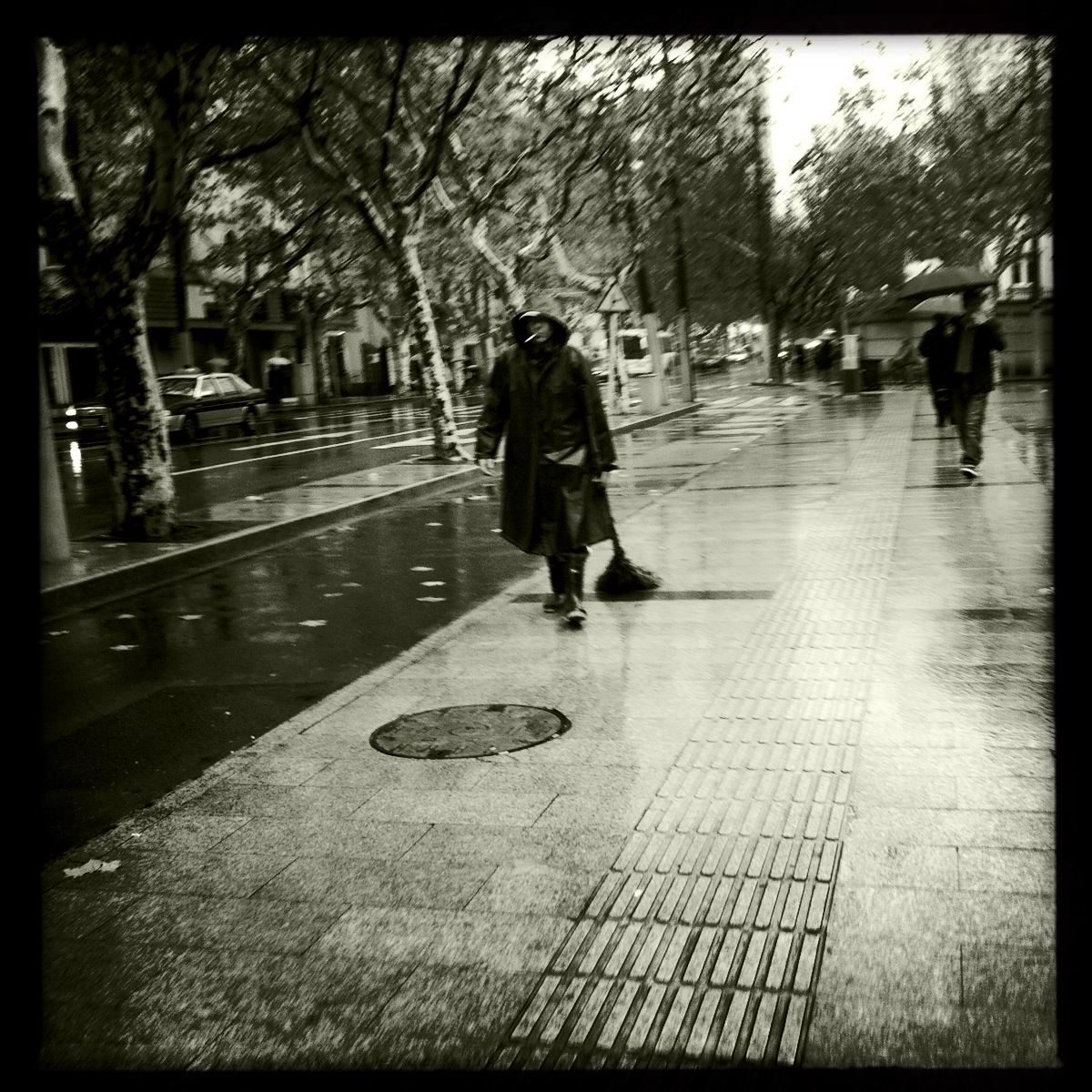
Study of a Shanghai Street Sweeper in the Rain on the Way to Morning Coffee - Shanghai, China, 12/11 - Dena Rash Guzman - on the theme of Coffee
Dear Readers,
DAVID BOWIE DAVID BOWIE DAVID BOWIE!
Unshod Quills is a theme based publication, centered around themes chosen by the editor or other participants in the Unshod Quills Writing Collective. DAVID BOWIE! One of my dream themes, and this issue is very much about him. With just the beerlight to guide us, we also feature works based on the themes of love, coffee, Joan of Arc, dancing about architecture, and enough rope.
Speaking of coffee, David Bowie and enough rope, this is how I spent my pre-Christmas unvacation:
My publisher, HAL Publishing, flew me to its hometown of Shanghai earlier this month. I was there to stage, for an audience of over 300, a group performance of my smutty little short story, “A Brief History of Dan Orange of Shanghai.” This was a multimedia presentation featuring myself and a truly international cast of artists including Estel Vilar, UQ Contributor Ginger wRong Chen, UQ contributor Katrina Hamlin, the enigmatic Barbara A., and Mr. Brian Keane. Video backdrop was provided by Colorado’s own Jerimiah Whitlock. The occasion? The River South Arts Festival, a four day celebration of independent Shanghai art and literature, featuring Slamhai3 and the release of HAL’s second collection of short stories,
Middle Kingdom Underground: short stories from the people’s republic of
The US edition should be ready for sale around February 15 and I’ll have two stories in the book, one co-written with HAL founder and regular UQ contributor, Mr. Bjorn Wahlstrom. The book’s theme of vice in modern China is heavy and dark, and the stories by fifteen authors, both local and non-native to China, are accordingly complex and delightful.
In the meanwhile, a click to the title above will take you to the stunning and beautiful and bizarre Middle Kingdom Underground book trailer, produced and directed by September Unshod Quills contributor, Portlander Posie Currin. In addition, the HAL book release was filmed and will soon be broadcast internationally on the new fine arts internet TV network Bravoflix.
Where do coffee, David Bowie and enough rope come into the above recap? Let me write you a prose poem, that will make no sense, in order to explain myself.
Coffee – I drank a lot while I was in China. Not so much tea. Coffee. I learned that I make a terrible pot of French press. David Bowie – that’s Bjorn, but minus any glitter and plus a freighter of stardust. Bjorn wears all black all the time, unless it’s raining, and then he wears white leather tennis shoes. Enough rope – after nearly setting his neighbor’s kitchen on fire with my suitcase, I learned that Bjorn keeps enough rope on hand to escape out a window just in case of some such event as a clumsy American starting fires with suitcase and a hotplate in a stairwell. There are no fire escapes in those old buildings. Rope is good. He’s four stories up and to get in or out one must pass through two neighbor’s kitchens and twisty flights of narrow, steep stairs. It’s a gorgeous place, though, and Bjorn has a cat that is in the process of self-actualization. Perhaps soon big fat Blackie cat will get his own rope.
I’m grateful to HAL for having me as a guest performer at their book release party, and for all the support they’ve shown to Unshod Quills over the past year.
Meanwhile, back in America, managing Editor Wendy Ellis and I struggled to confine our selections of art and literature for December to a reasonable number. That is why we chose not one, but two featured poets for this issue.
Having worked with James H. Duncan a number of times over the past four years, I am already acquainted with his eloquent ornate minimalist style, and have long been a fan. James was an easy choice to feature, and we hope you enjoy his work as we do.
Our second feature is an amazing writer who sent a suite of submissions on the theme of childhood alone, and our skirts were blown nearly clean off by the gale force of their brilliance. Be sure to look at the poetry of Catherine Woodard.
Both of our featured poets are based in New York City. We get it, New York: we want to be a part of it, too.
December’s featured artist is from another part of the universe: Greece. Sugahtank John Roubanis is a talented graphic design artist and illustrator; his King Kong poster take this month’s front page. We love his work, from the scratchy, ropy sketches of near-human figures to the sublime political graphics to his logo work. Sugahtank’s vision told us it needed a good sharing with the Unshod Quills readership. It actually spoke to us.
We are also happy to see the return of Kevin Sampsell. His Bowie piece is hilarious and I for one will never be able to look at him the same way, fiction or not. Rusty Barnes is in this issue with some uniquely elegant and rough country flavored fiction, while Timothy Gager tells you you’re gonna need a bigger sandwich. Order up. Also look for the work of Portlander Jenny Forrester and the best middle school Bowie obsession fiction we’ve ever read – Jenny Hayes is in the house. HAL Publishing’s W.M. Butler shares a treacherous story about bullies and rabbits and the beauty and brutality of childhood, and it’s an editorial favorite. We have the work of Frank Reardon, Matty Byloos and Nancy Flynn… Ryan Werner kills it with his minute by minute rundown of Bowie and Jagger’s video for “Dancing in the Street.” I love Bowie, yes, but everyone makes mistakes. Look for UQ’s own X. Joloronde and Robert Myer on Joan of Arc, too.
I could go on but just look to the right and click away. Thanks for visiting, and we’ll be releasing our next call for submissions on New Year’s Day – I’ll let you know now that one of our themes will be David Lynch.
Spread these writers around like the pandemic they are.
Ever yours,
Dena Rash Guzman
Editor
Unshod Quills
in the woods near Portland, Oregon, USA

Dena Rash Guzman, seated, listening to Ginger wRong Chen in Shanghai - 12/11
Walter Edgewater Talks to God on the Train
(on the theme of David Bowie)
The trees outside are slow today.
God, are you there? It’s me, Walter.
You again? Yes, me again. Whaddaya want?
I’ve got a brand new song to show you,
though it probably won’t blow your mind.
So sing it already. Jesus. I’m on the home
stretch. Only a few more months of pills
& this brain fog. You’re welcome.
What did you do? I never asked for your help.
You’re stuck with me now. Well, unstick me.
I’m not playing your game. I give back
my ticket. I’m done. You entered
into a contract, Walter. That was the old me.
I doubt that’s valid anymore. Until the end
of time. You don’t run the atomic clock.
You swam against the tide but you drowned
in the sky. That makes sense to me now.
I’ve got a song for you too: Because my love
for you would break my heart in two,
if you should fall
into my arms
& tremble
like a flower.
What happened to originality? It was lost
when I became man. Not so easy, is it?
I don’t know how you people do it.
It’s a matter of resolve—a feeling
that everything will get better. The body,
this fleshy mess, repairs itself & houses
whatever it is that writes my songs.
You know I’m the ghost writer, don’t you?
No, you’re not. It is mankind
that sings. It’s why we gave ourselves
vocal chords, chatterbox. You wouldn’t
understand. Hey, I put this thing in motion
in a matter of days. Do you realize how quickly
I could take it all away? You should read
my latest pamphlet. That’s okay, old
friend. Things have changed. We built this
up & we’ll be the ones to tear it down.
But what about me? We’ll give you
a front row seat & then, once it’s gone,
it’s back to the infinite nothing for you.
Maybe I’ll see what Beelzebub’s up to.
Whatever you do, get ready.
You’ll wish that you had somebody
to sing your songs for you.
________________________
Walter Edgewater & The Tiny Cup
(on the theme of coffee)
Frankly, gentlemen, I don’t care
about what business was like
when you were street vendors.
All I want is a place to sit, but not
atop rogue coats left by a ghost
or a robot. Everything belongs
to someone. No apparitions, only
partitions between the real
& the right, plate glass window
connected by sunlight—showing
insides, smudges, & tape stains.
Two girls sit next to me:
1. The one I love, wrote her
love poems on Valentine’s, & now,
President’s Day. 2. One wearing the same
green & black flannel shirt as me.
Hunched over the same way.
Hair tossed & messed the same way.
Chomping fingernails the same way.
Funny how these minute details
& modicum appearances are missed
by one & celebrated by another persona.
1. She’s got polka-dotted sneakers,
gray & white flannel. Before we were
seated, she raised her voice & needed to
leave immediately—people crashed
& bumped her like she wasn’t there.
Now seated in the sun, she’s kissed—
now, again. Still wearing sneakers.
3. Girl across table: please stop
picking your nose. By now, you should
know that I see everything, all
is filtered through me. To understand,
I throw myself into the depths.
Someday I’ll get out & we’ll see.
Until then I’m here & we’ll see.
_________
Walter Edgewater Sees a Nosaj Thing
(on the theme of coffee)
Is this what the kids are listening to
today—zombie music? Two guys
in overcoats, eyes like silver dollars,
(sand dollars, Papier Gamâché says), skulk
& swing arms, shoulders brandished, ready
to strike anyone willing to look. I’m sore
to the spine, back cracking & knees rigid.
In a shifty room I’m not moving,
not even the softest toe tap or head nod.
In between acts, tripping patrons flock
to doors, need to leave. They reach the back,
run into the rope blocking the path
from the pit, gaze around, befuddled.
This is the strangest thing they’ve ever seen.
Nosaj Thing finally takes the stage,
the shakers rush forward & nod knowingly
to the music of the skinny kid,
barely twenty, so busy, knob-twisting,
head-neck-shoulder dipping & ducking,
so busy up there, an art so intricate,
tempo controlled by twists of the wrists,
effortless, he only stops midair
to casually wipe sweat from his brow,
a movement figured into the equation,
all so mathematical, precise, every single
sound placed in its proper container.
He plays for ninety minutes straight
without even the slightest silence. I pay
attention as best I can with some guy
swaying in front of me, inching closer
& closer with every loop, no regard
for my space, until I’m purposely mouth-
breathing down his neck so he knows
I’m the strangest thing he’s ever seen.
He asks me to back up. I do not change.
I leave early, joints too tired to stand.
Today is a Sunday. I drink coffee
in my leopard print robe. Tomorrow,
I’ll listen to last night’s songs
through headphones at my desk
as I answer work emails.
_______________
Walter Edgewater Never Gives all the Heart
(on the theme of love)
I never give all the heart, for love
is bullshit, mostly. I leave
work early to find your sheets
left at last night’s laundromat, children
threatening as I enter. They’re right
where you left them—cold
in the dryer. You return home
again, but only to complain
about the heat—we can’t control it,
or our hearts. I hope you’re happy
when you’re not here, where others
appreciate you more, as you remind me.
I was happy, years ago, & I was
last night. A thin young woman
danced next to me—I leaned
against the stage—her hairy arm
brushed mine bare. She stared
at me, I thought, but really
she looked through to the stack
of empty beer cups left
by the night’s opening
act. She split them apart
& swung the little swill
& screamed, I’m just really thirsty!
All night I heard airborne signals
of love from another (You know
I love you, right?). I tried giving
everything once before—I failed.
Tonight I sloppily tuck you in
after you chastise me for stealing
the blankets last night, as I do
each night, while I sleep & you lie
awake. Everything is sometimes
lovely & a brief, dreamy, kind
delight (the latter a word used
so often to describe me)—sometimes.
I have lost before
& I will lose again.
You have lost me before
& you will lose me again.
_________________________
Walter Edgewater’s Reasons to Fall in Love with Walter Edgewater
(on the theme of love)
I have a job.
I am a locomotive.
My name is an anagram for “Wet, Wet, Large Dear.”
As a boy, the tip of my finger
was ground in the gears
of a mechanical chicken.
I have no will to live.
I live to serve my maker, wherever he is.
I see stars.
I drink shit coffee.
I skinned my foreskin
in a bicycle accident
as a child & didn’t
know if I should show
my friend because I didn’t know
if he or she was a he or a she.
I’m pretty okay at math.
I contemplate the philosophies
of everything in the universe.
I can do as many sit-ups
as Herschel Walker,
the former Dallas Cowboys star less famous
for his multiple personality disorder.
I’m a language poet.
I’ve never been to a dogfight.
…
Okay, I’ve been to one dogfight.
I lost my virginity on a kitchen floor
next to bowls of dog food.
Horses ride me.
I’m a champion
luchador.
I make my own cardboard.
Everything I buy is on sale.
I’m lonely.
I see the best minds of my generation
at the titty bar.
I’m really good at pissing
money away at the greyhound track.
I’m a member of a world-
wide poetry collective
based on chicken sandwiches.
I once stepped on a beehive
& when they swarmed on me,
I stung them.
Do I contradict myself?
I fall in love but never
out of it.
I’m a sailboat skipper.
I’m a coxcomb
but I just found out.
I planted America’s seed
in the sun.
I am the godhead
on fire.
I was born at a very early age.
I intend to live forever,
or die trying.
I can seal an envelope.
I am an actor
& this page is my stage.
I am a Renaissance man
on weekends in April & May
at the Oklahoma Renaissance
Festival in Muskogee, OK
at the Castle of Muskogee.
I get jokes.
I’ve been to the center
of the earth to search for the black sun
but found only rotten dinosaurs
(also known as oil, according to someone
who claims to have loved me once).
I objectify the human form.
I make a mean grilled cheese.
I make a gentle grilled cheese.
I make cheese.
Please, please, please—I’m in love
with the world, so help me
make it love me back.
I’m in love with you.
________________________
I Give Walter Edgewater a Haircut
(on the theme of childhood)
Walter has been here since childhood,
numbed & sleeping & threaded with cloth
to a three-post bed—the fourth yanked off
for whenever he thrashes or tries to
sail off. He’s fitted with a permanent sleep
mask, smeared with coal & threaded
with green & white electrical wires. I speak
into his ears while I cover my mouth
with the mesh of a window screen. First
I state the true meaning (here, “paper”)
& then what I will really say (here, “piper”).
Piper, Walter. Piper. He doesn’t know
anything but the boxy outlines of letters
projected onto the back of his sticky eyelids,
& the white text forging lines on black
expanse. I really mean “source” but say
“sauce.” Sauce, Walter. I’m feeding him
sleep intravenously & I stick patches
on his forehead & chest. All is hooked
with a nest of messy wires to the plasma
TV hanging rigid on the wall. I suppose you can say
he can only see what I tell him to imagine, indirectly.
Tonight, it’s time for a haircut in our old home-
town: the barbershop run by the local ex-con (Mike
the Butcher, as our grandmother called him).
He’s known for slicing little boys’ ears. Walter, gracious,
shows me the list of rules on the brown wall: “1. If your hair is long
we’re going to buzz it.” But wait—who’s that outside
in the darkened lot, next to the wooden wagon?
It’s her, last’s night final procession,
the woman with silken locks & no face. Why can’t you
give her a goddamned face, Walter? I’m saying face
& I MEAN IT. Face. Face. Fine.
Author Biography
Kevin Shea is originally from Quincy, MA. He now lives in Brooklyn, NY and currently works at The New School for Social Research. He is also a recent graduate of the MFA program at The New School. His writing has previously appeared in The Alembic, Asinine Poetry, The Equalizer, and is forthcoming in Forklift, Ohio:A Journal of Poetry, Cooking & Light Industrial Safety.
Sons of the Silent Age
(on the theme of David Bowie)
on a rare evening not yet shot dead
my own whispered pacing fades across
the carpet through the lush echoes of
a vinyl caress to witness
another crossed out calendar box
on the kitchen wall,
a snake-line of black Sharpie
trailing behind
crumpled papers scatter and run low on heart
as somewhere in the walls symphonic voices from
old Berlin crush the soul of another son
of the silent age
too often, watering plants in the moonlight
feels like any other opaque lie
and fingers tremble over spilled ink,
inflamed pages, idiot remorse;
I can’t stand another sound
is all I hear in my rotten ears
and the last grain of time finally slips away
to reveal
the three hands of the clock gliding
in and out of life
in and out of sight
and in the heavy blink of your silken eyes
I realize I am finally tired
and I crawl to the waiting bed like
a dog into the hole where
he buried his bone
to sleep the good sleep I’ve
heard rumors of through all these silent ages
__________
Strawberry Fields Forever
(on childhood)
their house was made of brick
and the strawberries grew
in their fields like gasoline wildfire
the fields surrounded
the house on all sides, and they
went right up to the house,
built about a century
ago by strawberry farmers
now maintained by an elderly
strawberry farmer, his wife
who stared down from
the second story
window of that brick
house, and the farmer’s grown
son, who walked
around with some uncertain
handicap of the body
and mind
I picked as fast as I could
when the farmer or his
slower son spoke to my mother
or to other nearby pickers
or when the old woman
stared down
from
her window tower
watching us
but when they
were all gone
I ate berries fresh
from the dirt
no one needed
to wash those berries
they were stymied
with bugs often
enough, and were small,
but they were real
and they were raw
and juicy in the summer
sun
and I recall the sweat
of that sun falling
down on us
as we picked up
our full baskets (my
stomach also full)
and walked to the porch
of the brick house
the farmer’s son always
wore overalls, blue
jean overalls with dirt
scuffed around his
knees and ankles,
and he’d talk kindly to my
mother in a slow stilted cadence
as if he were reciting to a class
of students who might
mock him, but
we never mocked him
I knew he was just a strawberry
farmer’s son, and even then
as a child I realized
that being one was better than being
like most other men I saw in the world
—with or without the handicap
and sometimes the old
farmer was there, too
sitting on his porch
tired and talkative and
older than any man I had
ever seen in my life
and they’d take our few
dollars and we would
walk back to our car,
load the car, drive away
maybe we’d be back later
that month, or that summer,
sometimes we never
went at all
many of those summers
went by, the absent
summers, and I am glad
I have not been back since
the age of eleven
or twelve
I don’t want to see how
the old woman no
longer watched from her
window tower
or how the old man no
longer sat on his
porch in the sunlight
and I don’t want to see how
the farmer’s grown son
dealt with the banks or the funeral
homes or the land investors
or the neighbors or the
nurses at the hospital
or the whole world
crashing down
around him
I want to close my eyes
and look up from
the dirt, the rows of fire
engine red strawberries,
and see them there
all of them
and see my mother there
picking beside me
putting each strawberry into
a yellow bowl
put one
more strawberry
in my mouth;
never open my eyes
again
_________
The Night No One Went Home
(on childhood)
potshots from the gristmill
and away we go a’running
weedstalks tough like tire irons
thumping polecats skitter wild
in August, we dream of October
in October we dream of honor,
and we know a ghost is waiting
someone set fire to the gristmill
the summer after the shooting
the coupe still sits burnt out
amidst the wishing field of grain
the wind runs through that grain nightly
the moon watches with envy
children think they are alive
especially when they play dead
potshots strike the hollow oak
where we once thought of honey bees
and owl eyes in nighttime fevers;
the moon a great dying tilt-a-whirl
and this I promised to promise—
with a match left in my pocket,
I’ll wait for you come, Autumn
lest I burn it down alone
_____________________
as the sowing, the reaping
(on love)
fear oiled the mechanics of our love
and in the reproductive silence that followed, you opened
gifts a day early, wrapping falling to the floor
mingling with popcorn spilled from a paper bag
from which we each pulled greasy specks and chewed
in the quiet of October, red leaves stuck to the windowpane
the mistake too often made is giving small books
of poetry from unknown publishers from Portland
or Fort Collins or Montpellier or Louisville;
the first pages are fingered gently by each of you
a sense of wonder and worry thriving in the veins
the books are gone soon enough on trains and jets
never seen again, forgotten, unread, lost
always lamented over, wishing they formed a stack
in my study corner rather than a troubled mind
on most nights, those books were worth the trade,
other nights, though—not a page would I barter for a single
image of you against the dawn of that last day together,
pictures and pages in the fire of this heart’s eternal uncertainty;
curling black pages like their raven hair; gone gone
_______________
The Raped and the Loved
(on the theme of coffee)
the art gallery displayed photos of the raped
and the children they bore, hated, and one day
learned to love, women with long nimble weeping
fingers and toes, slender souls of nonpareil scar-tissue
that writhed and sang in a dirt-floor celebration
of militant reinvention, spring-loaded renunciation,
and the most unkind joy the godless world of man
and his guns and his machetes has ever known
they served coffee and European beer and someone ranted
midwest polemics and another of economic recoil, and many
a bitter word of oil companies retched across the room
as the ivory white smiles of the raped looked on,
their little reminders of a man’s murder-lust holding their hands
or sitting on their laps, or standing beside them, trying to help
carry the burden of the repellent world on their shoulders as the most
stunning blue light caressed the African skies behind them,
nothing at all like the disemboweled orange din hovering over our
American sprawl, where the machetes are dull, the smiles are
numb, and the raped and loved go equally unnoticed
Author Biography
James H Duncan is a New York native and is the editor of Hobo Camp Review, an online literary magazine that celebrates the traveling word. James has twice been nominated for the annual Best of the Net award and once for the Pushcart Prize for his poetry. He is the author of five collections of poetry and short stories and has appeared in dozens of print and online magazines around the world. He now resides in New York City where he works as a freelance writer and as a writer/editor at American Artist magazine, where he has published numerous articles on art history and contemporary realist painters. His website is at here.
