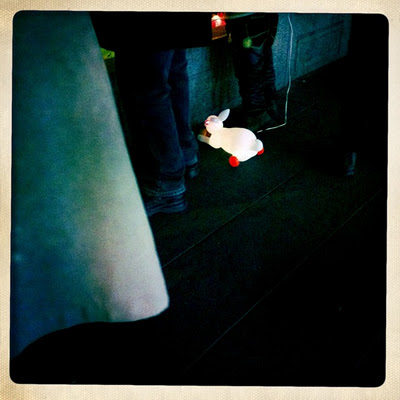
December 14th, 2011 § Comments Off on Kevin Shea § permalink
Walter Edgewater Talks to God on the Train
(on the theme of David Bowie)
The trees outside are slow today.
God, are you there? It’s me, Walter.
You again? Yes, me again. Whaddaya want?
I’ve got a brand new song to show you,
though it probably won’t blow your mind.
So sing it already. Jesus. I’m on the home
stretch. Only a few more months of pills
& this brain fog. You’re welcome.
What did you do? I never asked for your help.
You’re stuck with me now. Well, unstick me.
I’m not playing your game. I give back
my ticket. I’m done. You entered
into a contract, Walter. That was the old me.
I doubt that’s valid anymore. Until the end
of time. You don’t run the atomic clock.
You swam against the tide but you drowned
in the sky. That makes sense to me now.
I’ve got a song for you too: Because my love
for you would break my heart in two,
if you should fall
into my arms
& tremble
like a flower.
What happened to originality? It was lost
when I became man. Not so easy, is it?
I don’t know how you people do it.
It’s a matter of resolve—a feeling
that everything will get better. The body,
this fleshy mess, repairs itself & houses
whatever it is that writes my songs.
You know I’m the ghost writer, don’t you?
No, you’re not. It is mankind
that sings. It’s why we gave ourselves
vocal chords, chatterbox. You wouldn’t
understand. Hey, I put this thing in motion
in a matter of days. Do you realize how quickly
I could take it all away? You should read
my latest pamphlet. That’s okay, old
friend. Things have changed. We built this
up & we’ll be the ones to tear it down.
But what about me? We’ll give you
a front row seat & then, once it’s gone,
it’s back to the infinite nothing for you.
Maybe I’ll see what Beelzebub’s up to.
Whatever you do, get ready.
You’ll wish that you had somebody
to sing your songs for you.
________________________
Walter Edgewater & The Tiny Cup
(on the theme of coffee)
Frankly, gentlemen, I don’t care
about what business was like
when you were street vendors.
All I want is a place to sit, but not
atop rogue coats left by a ghost
or a robot. Everything belongs
to someone. No apparitions, only
partitions between the real
& the right, plate glass window
connected by sunlight—showing
insides, smudges, & tape stains.
Two girls sit next to me:
1. The one I love, wrote her
love poems on Valentine’s, & now,
President’s Day. 2. One wearing the same
green & black flannel shirt as me.
Hunched over the same way.
Hair tossed & messed the same way.
Chomping fingernails the same way.
Funny how these minute details
& modicum appearances are missed
by one & celebrated by another persona.
1. She’s got polka-dotted sneakers,
gray & white flannel. Before we were
seated, she raised her voice & needed to
leave immediately—people crashed
& bumped her like she wasn’t there.
Now seated in the sun, she’s kissed—
now, again. Still wearing sneakers.
3. Girl across table: please stop
picking your nose. By now, you should
know that I see everything, all
is filtered through me. To understand,
I throw myself into the depths.
Someday I’ll get out & we’ll see.
Until then I’m here & we’ll see.
_________
Walter Edgewater Sees a Nosaj Thing
(on the theme of coffee)
Is this what the kids are listening to
today—zombie music? Two guys
in overcoats, eyes like silver dollars,
(sand dollars, Papier Gamâché says), skulk
& swing arms, shoulders brandished, ready
to strike anyone willing to look. I’m sore
to the spine, back cracking & knees rigid.
In a shifty room I’m not moving,
not even the softest toe tap or head nod.
In between acts, tripping patrons flock
to doors, need to leave. They reach the back,
run into the rope blocking the path
from the pit, gaze around, befuddled.
This is the strangest thing they’ve ever seen.
Nosaj Thing finally takes the stage,
the shakers rush forward & nod knowingly
to the music of the skinny kid,
barely twenty, so busy, knob-twisting,
head-neck-shoulder dipping & ducking,
so busy up there, an art so intricate,
tempo controlled by twists of the wrists,
effortless, he only stops midair
to casually wipe sweat from his brow,
a movement figured into the equation,
all so mathematical, precise, every single
sound placed in its proper container.
He plays for ninety minutes straight
without even the slightest silence. I pay
attention as best I can with some guy
swaying in front of me, inching closer
& closer with every loop, no regard
for my space, until I’m purposely mouth-
breathing down his neck so he knows
I’m the strangest thing he’s ever seen.
He asks me to back up. I do not change.
I leave early, joints too tired to stand.
Today is a Sunday. I drink coffee
in my leopard print robe. Tomorrow,
I’ll listen to last night’s songs
through headphones at my desk
as I answer work emails.
_______________
Walter Edgewater Never Gives all the Heart
(on the theme of love)
I never give all the heart, for love
is bullshit, mostly. I leave
work early to find your sheets
left at last night’s laundromat, children
threatening as I enter. They’re right
where you left them—cold
in the dryer. You return home
again, but only to complain
about the heat—we can’t control it,
or our hearts. I hope you’re happy
when you’re not here, where others
appreciate you more, as you remind me.
I was happy, years ago, & I was
last night. A thin young woman
danced next to me—I leaned
against the stage—her hairy arm
brushed mine bare. She stared
at me, I thought, but really
she looked through to the stack
of empty beer cups left
by the night’s opening
act. She split them apart
& swung the little swill
& screamed, I’m just really thirsty!
All night I heard airborne signals
of love from another (You know
I love you, right?). I tried giving
everything once before—I failed.
Tonight I sloppily tuck you in
after you chastise me for stealing
the blankets last night, as I do
each night, while I sleep & you lie
awake. Everything is sometimes
lovely & a brief, dreamy, kind
delight (the latter a word used
so often to describe me)—sometimes.
I have lost before
& I will lose again.
You have lost me before
& you will lose me again.
_________________________
Walter Edgewater’s Reasons to Fall in Love with Walter Edgewater
(on the theme of love)
I have a job.
I am a locomotive.
My name is an anagram for “Wet, Wet, Large Dear.”
As a boy, the tip of my finger
was ground in the gears
of a mechanical chicken.
I have no will to live.
I live to serve my maker, wherever he is.
I see stars.
I drink shit coffee.
I skinned my foreskin
in a bicycle accident
as a child & didn’t
know if I should show
my friend because I didn’t know
if he or she was a he or a she.
I’m pretty okay at math.
I contemplate the philosophies
of everything in the universe.
I can do as many sit-ups
as Herschel Walker,
the former Dallas Cowboys star less famous
for his multiple personality disorder.
I’m a language poet.
I’ve never been to a dogfight.
…
Okay, I’ve been to one dogfight.
I lost my virginity on a kitchen floor
next to bowls of dog food.
Horses ride me.
I’m a champion
luchador.
I make my own cardboard.
Everything I buy is on sale.
I’m lonely.
I see the best minds of my generation
at the titty bar.
I’m really good at pissing
money away at the greyhound track.
I’m a member of a world-
wide poetry collective
based on chicken sandwiches.
I once stepped on a beehive
& when they swarmed on me,
I stung them.
Do I contradict myself?
I fall in love but never
out of it.
I’m a sailboat skipper.
I’m a coxcomb
but I just found out.
I planted America’s seed
in the sun.
I am the godhead
on fire.
I was born at a very early age.
I intend to live forever,
or die trying.
I can seal an envelope.
I am an actor
& this page is my stage.
I am a Renaissance man
on weekends in April & May
at the Oklahoma Renaissance
Festival in Muskogee, OK
at the Castle of Muskogee.
I get jokes.
I’ve been to the center
of the earth to search for the black sun
but found only rotten dinosaurs
(also known as oil, according to someone
who claims to have loved me once).
I objectify the human form.
I make a mean grilled cheese.
I make a gentle grilled cheese.
I make cheese.
Please, please, please—I’m in love
with the world, so help me
make it love me back.
I’m in love with you.
________________________
I Give Walter Edgewater a Haircut
(on the theme of childhood)
Walter has been here since childhood,
numbed & sleeping & threaded with cloth
to a three-post bed—the fourth yanked off
for whenever he thrashes or tries to
sail off. He’s fitted with a permanent sleep
mask, smeared with coal & threaded
with green & white electrical wires. I speak
into his ears while I cover my mouth
with the mesh of a window screen. First
I state the true meaning (here, “paper”)
& then what I will really say (here, “piper”).
Piper, Walter. Piper. He doesn’t know
anything but the boxy outlines of letters
projected onto the back of his sticky eyelids,
& the white text forging lines on black
expanse. I really mean “source” but say
“sauce.” Sauce, Walter. I’m feeding him
sleep intravenously & I stick patches
on his forehead & chest. All is hooked
with a nest of messy wires to the plasma
TV hanging rigid on the wall. I suppose you can say
he can only see what I tell him to imagine, indirectly.
Tonight, it’s time for a haircut in our old home-
town: the barbershop run by the local ex-con (Mike
the Butcher, as our grandmother called him).
He’s known for slicing little boys’ ears. Walter, gracious,
shows me the list of rules on the brown wall: “1. If your hair is long
we’re going to buzz it.” But wait—who’s that outside
in the darkened lot, next to the wooden wagon?
It’s her, last’s night final procession,
the woman with silken locks & no face. Why can’t you
give her a goddamned face, Walter? I’m saying face
& I MEAN IT. Face. Face. Fine.
Author Biography
Kevin Shea is originally from Quincy, MA. He now lives in Brooklyn, NY and currently works at The New School for Social Research. He is also a recent graduate of the MFA program at The New School. His writing has previously appeared in The Alembic, Asinine Poetry, The Equalizer, and is forthcoming in Forklift, Ohio:A Journal of Poetry, Cooking & Light Industrial Safety.
December 14th, 2011 § Comments Off on Catherine Woodard – Featured Writer § permalink
on the theme of Childhood
5 poems from For Coming Forth By Day
FOR BEING ANY SHAPE ONE MAY WISH
My brother collects the dead
sparrows that crash
into the roof.
He thinks the birds
kill our shot
at Yard of the Month.
Ladies of the Garden Club
inspect, drive slowly
round town
with a white proclamation
in the trunk.
Only the front yard matters.
FOR NOT PERISHING AT SUNDAY LUNCH
Mother kills my joyride in the new red Opel.
Says his breath stinks. He roars off without me—
With my last stick of Juicy Fruit and a thin mint.
I drink more sweet tea, pout and wait
For my grandfather to finish banana pudding
And the story of Mother baptizing kittens.
Rescue lights race us on Raleigh Road, as red
As the car flipped in the fallow field.
Mother jumps the ditch in church heels,
Her daddy right behind.
We wait.
PSALM 43
I rustle the bulletin to make a fan;
Mother shoots me the eye, shushes.
Why cast down thine eyes?
Sweats the preacher. His chins jiggle.
Why so disturbed within,
Put hope in Him. I stare down.
Lace socks, white patent toes.
Where does hope hide?
I ask me, eye scuff marks.
I find lost keys with him.
MAKING A THIRD-GRADE SOUL
WORTHY TO MRS. MINNIE LEE LONG
Mrs. Long doesn’t like erasing.
Any mistake, I copy the page again.
Even if at the last sentence.
Even if my hand cramps.
If I erase, I need to know
That very second
The ghost of the pencil
Leaves without a tear.
Eraser shavings smell
Like forgotten socks,
Cling dingy to lined paper
Or scatter across my desk.
She holds up bad examples:
Messy math, crumpled spelling,
A hole in history.
THE PUMPKIN MAN
As I land for my father’s funeral,
My first plane ends in an orange orb:
Dawn lifts off the runway.
More poems by Ms. Woodard
MY STORY FOR THIRD GRADE
(After Mrs. Long Fixed the Spelling)
Slaying dragons requires lots of planning and practice. You must listen very carefully in dragon school. Dragons hide themselves. Sometimes they pretend to be kittens and just when you stroke their fur they snap back into dragons. But as long as you pretend they aren’t dragons they cannot eat you. That is the rule. You have to pretend hard even if your head hurts.
Other times they look like dragons, pretend to sleep outside your bedroom. I tiptoe to bed, guard against dragon thoughts. If I sleep before they creep in, I am safe until dawn.
MY DIARY, AGE SEVEN
My Diary, Age Seven
I am in a bad mood.
I get sweet. I help Daddy
fix supper. Daddy makes Mother
a pretty birthday dinner.
***
My nose bleeds at my cousin’s wedding.
I am the flower girl. The white dress is itchy
Hot. Mother pulls my head way back,
holds tight with a big wad of wet tissues.
***
My pillow has a problem.
The feathers lump up.
Mother says it’s been loved
Too much. Was her pillow too.
FAMILY ALBUM
My parents run
Through wedding rice.
She is 19. Hopes her linen suit
Makes her look mature.
***
My brother at three plugs a gap
Between holster and hips
With a bear plucked of fur.
He stuffed his nose and ears
Till Mother bribed him with guns.
His pistols drag the ground.
***
I am starched at four
In pinafore and smocking.
A hand cups my chin.
I stare where the photographer asks.
Author Biography
Catherine Woodard lives and plays basketball in New York City. She swerved to poetry in 2001 after an award-winning career in journalism. More poems about a Southern family miming Egyptian death rituals have appeared in Poet Lore, Southern Poetry Review, RHINO and other journals. She co-published Still Against War/Poems for Marie Ponsot. Woodard has a MFA in poetry from The New School and is a 2011 fellow at the Virginia Center for the Creative Arts. She is a past president of Artists Space and a board member of the Poetry Society of America, working to return Poetry in Motion to NYC’s subways. Her recently launched website can be found here.
December 14th, 2011 § Comments Off on Jenny Forrester § permalink
Cake
on childhood
The little boy and I were at his house. It was just after his birthday party (it was just him and me) and we were standing on the picnic table because we were about to stomp around on his cake because we thought it would be fun. His mama came out screaming, “What’re you two doin’?
We jumped down off that picnic table and he ran one way and I ran the other.
She had a stick in her hand and she was swinging it. It was a small branch, she called it a switch and I could see why cuz when she waved it, I heard it say, “Switch, switch.”
She was screaming and saying things I couldn’t understand. That little boy and I ran and ran and ran.
Then my mama came over the fence. I had never in my short life seen her do anything like that. My mama was big with comfy arms for resting your head on and she grunted whenever she stood, but she was over that fence.
She went at that little boy’s mama like my dog went after a squirrel.
That boy’s mama went down and limp like that squirrel. That fast. And she was like a sock on the ground.
My mama sat down on the bench. She sat and looked at the moon over the trees – a sliver in the midday sky. She sat like that breathing and breathing, like me when I play real hard, until she was normal again.
She talked quiet and calm the way she can when she wants to and the little boy and I went to her. I sat on her lap and the boy leaned on her leg with his head against that comfy arm.
She went to touching that little boy’s bruises and cuts. He had bruises everywhere. I had never once touched those bruises.
She talked slow like a river of honey to that little boy, “I used to talk to your mama. I thought we were the same about children, raising them up right with manners. With discipline.”
The little boy backed away from her then. Fear made his shoulders rise and his face go hard and sad.
Mama looked at him like she was the angel who picks people up when they die and takes them to heaven – sad for them cuz living is good.
She said, “But I didn’t mean that the way she did.”
“She means spankins’,” the boy said.
The boy and my mama kept looking at each other with a silence of understanding like birds and small things when they all know their places.
“I didn’t know your mama had the devil whispering in her ear to put you in your place – he puts people in hell and that’s what your demon mama did.”
That little boy and I said, “Puuaa,” with our breath and then mama remembered to say, “God rest her soul.”
She picked me up off her lap and knelt down at the boy’s feet and I don’t know how, but it looked like she was gonna pray to him.
“Will she hurt me when she wakes up?”
“She’ll never wake up again,” mama said with her eyebrows thick and fallen down tree branchy.
That little boy smiled. He whooped and hollered like a little boy again.
My mama grunted and stood. “Now, it’s time for you two to go inside for awhile.”
She turned to the little boy and said, “I want you to call your daddy.”
The daddy came home and the little boy and I watched while he dug a big hole.
I never did see that little boy again.
Somebody else moved into the house.
The boy grew up, as we all did. He sent my mama letters. Photos. No return address.
“We don’t want any connections, you know.” That’s what mama said about that.
On his birthday, every year till I was grown, my mama made a big cake and we danced in it in our bare feet.
______
Writer’s Block and The Imaginary Phone Call
on the theme of Love
I say, “I’m writing a book about you and mom and I.”
“Uh-huh.”
My brother isn’t one to talk to fill the air. Well, yea, he is, what’m I saying. He totally is.
So he fills the air with his words. His rage. His…well, I’ll let him tell you.
Not that it matters, but you’re almost always wrong. And you went to college and got your head messed with – liberalized. You haven’t ever been to war so you don’t know anything about life and death. You’ve never pulled the trigger. You’ve killed, but abortion’s not the same and you know it. The wife already hates you and if you say anything bad about her, we’ll sue you. And I’d be careful cuz some of her relatives are mean as the day is long (and I mean that in a good way) and they’ll find you. Or your daughter. You should think of Emma. What’s she gonna think of what you have to say about yourself. You can’t tell her about abortion cuz then she’ll have one. You can’t tell her about your boyfriend in high school cuz then she’ll have sex. And my kids. What’ll happen to them if people find out they’re related to you – could cost them. We don’t live in a place where it’s ok to talk like you do, telling people shameful things and being ashamed of your ancestors and telling history wrong. We just can’t say things like that. And you know about our cousin, but you don’t know how he’s hurt our uncle – how he went to Vietnam and then had to raise a gay son – do you know what that was like. No, of course you don’t and you don’t spank. Your kid’s gonna grow up cussing and acting like she can do anything she wants and how’s that gonna work out for her. You know she’s a girl, right? And how’s your husband John gonna feel when he knows what you did and what you were like and he’s gonna feel so cheated.
And you never had a son either while we’re talking.
You don’t have anything to write about anyway. I don’t know why anyone should listen to you.
If you write anything about me, I will sue you.
Yea, so…
Give Emma my love. Tell John hello.
Author Biography
Jenny Forrester was the 2011 winner of the Richard Hugo House New Works Competition contest and the runner up in Indiana Review’s 1/2K prize. Find out more about her writing at Trailer Trash Writing on Facebook.
December 14th, 2011 § Comments Off on Terry Faust § permalink
On Childhood

Nick Who Became Max - by Terry Faust - on the theme of Childhood
Artist Statement/Biography
My son Nicholas posed for this photo illustration that was for an article about the connection between music and math. He later decided he liked his middle name, Maxwell (Max for short), and changed it. Thus, Nick Who Became Max.
December 14th, 2011 § Comments Off on W.M. Butler § permalink

Year of the Rabbit - W.M. Butler
on the theme of Childhood
Tú Nián*
(Year of the Rabbit)
The path was narrow. It wound in a lazy meandering way, cloistered on each side with thickets of tall birch. It wasn’t until the path peaked in a broad slanted rise that Soong realized that he was lost. Cursing his luck, he spun around trying to gather his bearings. How was this possible? Thought Soong. Had his own feet not touched every blade of grass, bled on every stone from the abandoned iron smelting plant to Hu’s Peach orchards? Had he not spent six summers running wild with a pack of gangly village boys, planning mock wars from the gnarled juniper tree behind his Uncle Ji’s farm, to wage battle on the Monkey Kings who laid claim to everything from the Moon Shadow Bridge to the KTV in the northern corner of the village? How could Soong be lost in the very place he was born? How was it that he did not recognize this path or these trees?
Angry at himself for not being attentive, but more so at Piao Xu for taunting him today after class, he stood with his fists clenched and his whole body rigid. He stomped his foot in frustration, kicking up small plumes of dirt that swirled for a brief and tumultuous moment, only to settle back down as if there had been no disturbance at all. Even the dirt seemed to be mocking Soong. His temper burned hot at the memory of his loss of face on the playground earlier that day and how Piao had made him look the fool. Soong wanted to smash in Piao’s smug, stupid head. How dare that fat dog turd make him kneel before his classmates and lick a half-rotted, fly infested jiaozi! But what could Soong do? Piao was much bigger than he and to make matters worse Piao was now the new leader of the army of boys that Soong himself had recently put together and trained. The fact that his own men, should oust him for the likes of that pudgy fool, was unbearable to Soong. It was the lowest thing his men could have done! And to think that Soong welcomed Piao into his band when the boy first arrived at the school, and all he got for his kindness was betrayal. Some men it would seem, where just born bastards.
When Soong fled the schoolyard that morning, his eyes stung hot with salted tears. He stopped and turned, raised his fists towards the crowd of boys who stood jeering at him and yelled,
“I, Soong Zhi Wei, will return! I will have my vengeance!”
The boys taunted him; mockingly wiping imaginary tears from their eyes while Piao Xu held his bulging gut and laughed the hardest of all.
Enraged and upset, Soong had no recollection of which way he ran or for how long. Soong was lost. All he knew was that dusk was coming fast. If he did not find his way home within the next forty minutes he may very well have to spend the night outside. Soong was about to turn back the way he had come when he was startled by a rustling in the underbrush to his left. He called out with whatever bravado he could muster but his voice got choked up and ended up a mere whimper.
“Who goes there?”
There was a pause as the rustling stopped, then the movement started again. Soong braced himself for whatever came out of those bushes. Hanging on a cliché, he told himself that he would stand and fight, and no longer would he be pushed or bullied. Thinking that perhaps some of the boys lead by Piao had followed him in the hopes of tormenting him some more, he quickly lost some of his steel but somehow managed to steady his nerves again. He stood ready, challenging whomever was in the bushes to come out and face him like a man.
It was no man that emerged, but a small charcoal coloured rabbit. Feeling relieved but foolish at his momentary lapse into cowardliness, Soong chastised the tiny animal for frightening him. The young animal with its dark glimmering eyes quietly observed Soong as though it were mocking him for being such an idiot. Then without ceremony, it turned and leapt away through the tangled brush. Soong was insulted by the little Black’s indifference. He debated whether he should go after that rabbit and capture it. He hadn’t had good meat for sometime and since he was most assuredly going to be late getting home, perhaps some fresh rabbit for the table might appease his mother’s anger.
And so it was in the way that boys have of never truly thinking a situation through, Soong left the path and entered the thicket of birch in the hopes of trapping the Black that had snubbed him. It’ll serve that little shit right if I eat him, and won’t mother be so proud that her youngest boy was clever and brave enough to wonder into a strange wood on a strange path to capture dinner for the family, thought Soong.
Tracking and trapping rabbits was nothing new to Soong. A boy his age was used to lurking after small prey in the forest. His elder brother had taught him the skills he needed to be a successful hunter. He was pretty sure that he was the best trapper of animals in the whole village; even his brother had often praised his quickness. Yet Soong knew he was at a disadvantage, as rabbits are known to be clever themselves, and not inclined to end up in the cooking pot. He knew that it was best to hunt them with a partner; one person to flush the animal towards its den and the other to wait nearby to grab it and snap its neck before it went to ground. He did not have a partner and so went with his next best option. He placed his schoolbooks on the ground and unfastened the young pioneers scarf from around his neck, he then fashioned a noose of sorts. Digging in his lunch canister, he pulled out some raw vegetables his mother had packed for his lunch that day but which he did not eat. Instead he had opted to save them for his favorite pig at The Model Workers Pig Farm, which was just around the bend from his house. Soong scanned the moist ground looking for tracks of his prey, knowing it couldn’t have gone far. A few paces in front of him he spotted a tiny indentation in the soil and from the paw print’s direction, followed it until he found another tiny print leading into a hole. Quietly he crept over to the burrow and placed the vegetables a few inches from the entrance, scattering dirt over the makeshift noose to mask his scent.
He crouched down just off to the side to wait patiently.
He didn’t have long to wait. A black head soon jutted out from the hole and an obsidian nose twitched, testing the air for danger. After what seemed like an eternity, the Black cautiously edged towards to food. When the animal finally was in position, Soong snapped the noose closed. He pulled the rabbit towards him, picking it up, ready to ring its neck. As the initial snap of the noose had not worked, he brought the panicked creature up to his chest and placed his fingers around its neck. He could feel the lighting beat of its heart, the surging struggle of the Black’s body vainly attempting escape, lashing out with a silent scream, biting at the air for flesh which with to connect. Soong made ready for the killing stroke but stopped short. Something about the animals struggle began gnawing within him. He held the black close and felt the thumping terror of its heart, tasted its fear on the very edge of his tongue. He felt the urge to kill slowly ebb away.
Was this creature not in the very same position in which he himself had been only a short time ago, tortured as he had been by Piao and his band of thugs? Was he not the same as this creature, scared and all alone in the darkening woods? How could Soong be the person to end the Black’s life when he himself knew the terror of being hunted? The anger and shame of being chased and forced to debase himself in front of his peers slacked somewhat, settling deeper within, and like a bandage, the compassion for the hare and its plight was placed over his anger. Yet, it was mixed with the pity he himself felt at his own weakness, and this he began to impose on the rabbit.
Soong stood with the small Black clasped to his chest. He stroked the animal, cooing softly to calm the wretched thing that had come so close to death. Soong did not want to let it go so he decided to place it in his coat to take it home. He would have to be sure to hide it from his family or they would most assuredly want to eat it. As the last of the sun began to sink beneath the horizon, gloaming set in. Soong began formulating a plan. All that was left for him to do was find his way home.
∞
Soong skulked around the eastern side of the school, peeking his head around the corner, cautiously looking for Piao and his gang. The traitors who used to be his friends were nowhere to be seen, and neither was the fat bastard, Piao. Last night when Soong had finally made his way home, his mother had given him a solid beating with the business end of a foot massager, leaving a cluster of perfectly uniform bruises in the shape of little circles on his shoulders and arms. Before the beating he had hidden the Black in an abandoned chicken coop on the edge of their tiny piece of land. Soong took his mother’s thrashing in his typically stoic way, which only made his mother beat him harder, but it wasn’t as though his mother was unusually cruel to him. His older brother had gotten his fair share of punishment over the years too, but Soong couldn’t help but think his mother always added a little extra to his punishment.
Soong had managed to elude Piao and his lackeys all the way through to lunch by hiding in a clump of bushes by the older children’s territory. Sitting on his school bag, Soong drew in his notebook blueprints for the house he would build the little rabbit. He also sketched a map to the thicket of birch were he had found it. While Soong had avoided the brunt of Piao’s attention that day in the yard, he was still at his mercy in the classroom where later Piao and some of the other boys shot him threatening glares or bumped into him on their way to the waste basket or the washroom while the teacher’s back was turned. At one point Lin Lui, a girl who sat behind him passed Soong a folded slip of paper. Once opened he discovered a crude drawing depicting Soong eating a piece of pig shit while rocks were being tossed at him. When he turned to glare at Piao, the fat boy only smiled and petted his lunch box. A boy next to him alluded to throwing a stone at Soong’s face. At that point the teacher tossed a hunk of chalk from the front of the room, hitting Soong with a dusty thump on the back of his head. The students laughed and Soong received a strong reprimand for not paying attention. Soong could have defended himself, could have shown the teacher the evidence that Piao was trying to kill him, but it would have just made matters worse. If that pack of rabid dogs ever caught him alone he would be a dead man for sure, not to mention the fact that the teacher might not even listen to reason or might even beat him before he could defend himself. Soong stayed quite, spending the rest of the class silently ranking what level of hell was appropriate for Piao and his cohorts.
When the bell sounded, Soong was out of the class in a leap and bound, running and sticking close to the school’s walls. If he could get a decent head start he would be able to avoid the attention of the other boys. To give himself a fighting chance he bolted in the opposite direction of his usual way home, this time cutting across the sports pitch towards the path where he had found the little Black. This was easy to find as he had gotten his bearings on his way home the previous night.
Soong’s first task was to find his way back to the rise in the path and back to the spot where he had found his rabbit. Once there, he would use fallen branches to construct a frame for the house he would build it. It would do no good for his friend to live underground if a nice warm home was available. He had pilfered his father’s tool shed for some nails but had decided not to take the hammer just incase it was noticed as missing. Instead he used a rock to pound the nails into the frame. He made quick work of building it and decided that on the upcoming Sunday after his chores and homework were done, he would take some of the scrap chicken wire from the coop and complete the little house for his friend.
∞
When Sunday finally arrived, Soong sped through his work at lighting speed with what appeared to be much enthusiasm. His parents were pleased that their youngest son was finally resigning himself to his future duties as the master of the farm. This pleased them greatly, as Soong could sometimes be difficult and brooding about his lot in life. All the family’s money went to their eldest son — their hope for a better life in their old age — once he had finished top of his class in university and found a job with a high paying salary that is. When Soong said he was going to meet some of his friends at the pond to catch toads his parents were happy to let him go. His mother felt that maybe she had been too forceful in her attentions when Soong had come home so late the other day. As Soong ran for the far end of the field his mother called out,
“Bring us home some fat toads for supper tonight! It’s been so long since we’ve had some good toad!”
Soong stopped and turned back to wave to his mother then began running again. Once out of sight he hunched down in the field and pulled away some dead grass and dirt to reveal the stash of chicken wire he had snatched and placed there earlier in the day. Once he had collected his supplies and headed towards his spot, Soong cut across the Zhang land and followed it along a twist in the murky, slow moving creek. When he recognized the stand of birch in the distance he picked up his pace in anticipation. Soong sung softly to himself as he drew nearer the trees. Finally, he found his way to the little house he was building and set to work. It wasn’t long before his construction was complete as all he really needed to do was hammer in the mesh over the frame and fashion a lid from some scrap wood and fronds he had gathered. He even went so far as to camouflage the whole thing in case someone happened to stumble upon his secret project. Satisfied with himself and the house, he squatted down, resting his elbows on his knees, and admired his work. Running over the finalities of his plan, Soong dug into his pocket to bring out a steamed bun his mother had made for breakfast but that he had tucked away for just this moment. The bun was filled with the chalky sweet texture of red bean paste. He sucked in a sharp gulp of breath as the sweetness tickled one of his teeth that had turned black and was ready to fall out. His mother was known in the village for having the second best sweet buns in the village, with the honour of the best buns going to his grandmother; a point his mother constantly griped about. Either way, the bun was soft and delicious and because it had sat in his pocket, close to his body during the day’s labor, the bun gave the illusion of still being warm from the steamer. With two more gulps the bun was gone. Soong wiped his hands on the sleeve of his jacket and stood up. Tomorrow after school would be the day he brought his Black to its new home. He would run home after school and then after his work was done, he would sneak the rabbit out of its hiding place and bring it back here. In high spirits, Soong cleaned up the area and did one final scan of the surroundings to see if he himself could notice the little hutch with all its cloaking. Satisfied with the job, he turned for home.
∞
Soong was trapped, his back against the rough wooden wall of an outhouse, surrounded on all sides by enemies, with their leader the fat and foul Piao glowering smugly at Soong. Soong hadn’t been quick enough today in avoiding the boys’ attention. They had lulled him into complacency by ignoring him and even being civil towards him during class. They didn’t even hassle him on the playground during break.
Fool! Soong scowled, scolding himself internally for letting his guard slip and being caught so easily.
“So! You think you are better than us, eh? Think you can just go around avoiding us? I’ll show you, you fatherless dog!”
Piao grinned, giving the signal for the other boys to move forward. Piao would never lift a finger to partake in the torments heaped upon Soong. Instead, he would direct the other boys, and it was they who would do the fat boy’s dirty work. As a matter of fact Piao had already gained the nickname “Little Chairman” for his ability to inspire his followers into committing these crimes against Soong. Maybe it was because Piao was richer than the other boys and didn’t want to soil himself with the dirty work, but Soong really thought it was because Piao wanted a distance between himself and the actions of the group. If push came to shove he could deny accountability by saying he himself never laid a finger on Soong . Soong could tell Piao was a calculating bastard. There was a coldness to him, and Soong knew that if ever these little exercises in humiliation where discovered by an adult that Piao held enough power over the other boys that they would never renounce him. They all feared having Piao’s attentions visited upon them. Soong was helpless and these cruelties that he was forced to endure would most likely continue forever. How could he win? How could one boy be victorious over a whole gang of bullies? Still, Soong was not one to give up without a fight. He had his pride and he wasn’t going down that easily. As the boys closed in, he made a break for it, first with a feint to the left, but then suddenly he broke to the right. He almost made it, but there were just too many of them. He struggled like a newly branded mule but it wasn’t enough; the boys had him pinned.
“Where’s your vengeance now?” sneered Piao.
“Xie ni ma de bi!” spat Soong.
Piao’s face burned red at the insult, but his eyes grew colder. He screwed up a grimace, winding it down into an insolent, malevolent smirk, smeared with something that scared Soong, something he couldn’t name. With a simple wave of his hand, suggesting all had been planned out earlier and in great detail. Piao gave the order to dump Soong into the outhouse pit. Four boys carried him by his arms and legs to the other side of the shed while another opened the door. Struggle as he might, he quickly lost ground. Fear of being shoved into a dank, putrid hole filled with shit and piss sapped the last of his fighting spirit, and as he fell into the blackness he felt the shame of giving up build within him, felt it, even stifle the urge to vomit at the stench. When he hit the night soil, he hit face first. Covered in shit and suddenly realizing his predicament, he tried to find leverage to boost himself out, but the walls of the pit wear slimy and smooth, carved into a clay deposit. His struggling only served to sink him deeper into the muck and filth. Looking upwards towards the hole in the wooden bench he could see Piao smiling cruelly down at him, laughing. But even this kind of shaming wasn’t enough for Piao; he went further, turning and taking down his pants. He squatted, and blocking out what little light there was, Piao spewed a steaming barrage of crap down on Soong. When he was done, Piao invited the others to do the same. At this point it was almost a blessing that most of the boys only urinated. Soong, crying and enraged, tried to sling clumps of shit in the hopes of hitting someone, but that just made matters worse.
“Sling shit at us, will you? You stupid egg!” yelled Piao, pausing only to light a firecracker that he then tossed down the hole.
This went on for some time, until all the boys had tossed their stash of firecrackers, until their bowels were empty. Soong was alone in the dark, on his knees. He cried and could do nothing. When the boys finally left, they closed the door and Soong was encased in utter darkness. Weeping bitterly, he could do nothing but wait for someone to come along and rescue him. As the tears streamed down his face mixing with smears of shit, he thought of his plans for the day and how they had been crushed. He thought about how his Black must feel living life underground; he knew now how awful it must be. At least he still had his friend. Soong calmed himself thinking about the rabbit; he must get out. He had someone depending on him.
It wasn’t until a couple of tourists from the city stopped near the road to use the toilet that Soong was found. Hours had passed, though they felt like days. One could imagine how surprised a city person, or anyone for that matter, would be to hear a cry for help as he sat down to relieve himself inside an almost derelict outhouse on some backwater country road. After the two men had managed to get Soong out of his predicament, both were slightly disgusted but amused by the sight of poor Soong covered from head to toe in shit. Soong was too far gone now to even notice the gentle ribbing the two men gave him; he simply walked away towards home without a word, leaving the tourists scratching their heads in confusion over the whole ordeal.
When he arrived home, his mother beat him with the broom so as not to soil herself for his condition and his father reprimanded him for not fighting back, and both his parents tried to ply from him, who had done such a foul thing to him, but Soong refused to tell. He would not say, which only made the beating and reprimanding worse. Soong’s mother took him outside to the water barrel and made him scrub with a week’s worth of soap that was meant for the whole family until he was rubbed red and raw. Soong hadn’t been this clean ever in his whole life yet still he felt slime on his skin and no amount of washing would ever clean it away. Without a word or dinner, Soong went to bed and softly cried until sleep overtook him.
∞
Strangely, the boys at school were laying low and no longer antagonizing Soong. It seemed that word had spread of what had happened to him. His mother, thinking only to protect her son, had told several neighbours what had happened in the hopes of finding the culprits responsible. The neighbours in turn spread the word. What Soong’s mother couldn’t have known was that by spreading the gossip she had made it all the more embarrassing for her son, who instead of having to stand up against the usual bullying, now had to endure uncomfortable glances and the whispering that started whenever he turned his back on a group of children and sometimes even adults. When he turned to face the offending persons, they would stop talking and stare through him as if he wasn’t even there. Piao and the boys who instigated the attack were smart enough not to gloat over their involvement and stayed out of the situation as much as possible so as not to be investigated. Still, they often shot him smug, knowing looks that just made the insult Soong felt even worse.
Weeks passed like this. Soong closed off from his family and peers, quietly completing his duties around the house and his schoolwork, but he barely uttered a word to anyone. He became shy and unable to concentrate. The only time he felt at all at peace was when he would sneak out to visit his friend in the abandoned chicken coop. Sometimes he slipped out of the house at night to sit and talk to the little Black and bring it scraps. Sitting there holding the shivering animal, burying his hands into its soft pelt, he began to talk to it, sharing his secrets, his fear and the embarrassment he felt over his current situation. He told the Black of his anger towards his parents and of his hatred for those bastards at school who did Piao’s bidding and for Piao himself. Soong vehemently described his hatred for Piao. He lamented to his companion of all the ways he wished Piao would get what he deserved, the pain and torment he wished to inflict on the fat boy. Through it all the Black merely twitched its nose, burrowing deeper into Soong’s arms for warmth, its whiskers brushing against the upturned bareness of the boy’s wrist.
“Tomorrow is Sunday,” whispered Soong. “After my work is done I will take you to your new home, where we can both be safe.”
He tucked the animal away in its temporary home and slipped back inside where he fell asleep peacefully for the first time in a long time.
∞
Soong spent the whole afternoon in the copse of trees, sitting and playing with his friend. He had just put the animal back into the makeshift hutch when he noticed another rabbit in the brush. Thinking how lucky he was to spot it and how wonderful it would be for his pet to have a friend, he set about capturing it. The new addition was a large Brown, and it was more crafty than the Black, but not as quick, and soon he had it. Placing it into the hutch he noted, there was little room left. He would have to pilfer more material from his home and build an addition. So that is what he did, and over the next couple of weeks he made the rabbit hutch larger, then larger again as he captured more rabbits. He began going to his secret hideaway every day after school and each Sunday afternoon; eventually he had fifteen of the animals in total. Soong would spend hours talking to his new friends and making up games where he was the general and the rabbits his trusted men, loyal only to him. He imagined great wars and conquests for himself and the rabbits. Often he would daydream about capturing and putting Piao on trail for his crimes.
Time passed this way and Soong was happy living in the world he had created for himself and the captured animals, but through it all, though he maintained a strong attachment to the little black one, the one he had caught first. The Black was always by his side during Soong’s little adventures, always his confidant. His best friend. So involved and consumed was he by his make believe with the little creatures that the rest of the world began to fade away. The boys who had harassed him so relentlessly had stopped their attentions and left him alone, perhaps due to the change in Soong. Before, Soong would have fought back when being picked on but now when confronted with any violence Soong would just go soft, become despondent and would not speak or raise a hand in his own defense. Piao and the others were confused and unsettled by Soong’s lack of self-preservation and so eventually pulled back. Soong soon began to forget about his old tormentors and it seemed his tormentors forgot about him.
∞
Soong was in a hurry to make it home before dark. He double checked the latches on the hatch to make sure his friends where secure, and then quickly bolted for home. Perhaps this was the reason he hadn’t noticed a rustle deep in the trees. A short time later, perhaps only a few minutes after Soong was gone, Piao stepped from the trees, followed by his group of boys. Piao and the others had followed Soong that day and kept hidden, watching Soong play with the rabbits. Shortly before Soong left, one of the boys had made a move to step out into sight, to surprise Soong but Piao held him back, shaking his head. The boy did as his leader instructed. Piao thought it would be much more interesting if they waited for Soong to leave so that they could take all the time they needed to be about their business. Piao stepped to the hutch and lifted the latch that held the lid down, with a vague smile, Piao set to work. The other boys hesitated only a moment before they to joined in.
∞
Soong was surprised that after all this time Piao and the others would pay him any notice. They had cornered him after school near the Model Workers Pig Farm. Soong began to slip into despondency again in preparation of the beating he was about to receive. His eyes became distant and he seemed to shrink in upon himself. He waited for the inevitable, but nothing happened. The others simply stood there waiting. It was Piao that stepped forward, smiling cordially, almost as a friend. Soong was weary but curious. Piao moved closer until he stood only inches away from Soong. Soong could feel the warm, slightly rancid breath from the other boy’s breakfast of pickles and congee wafting from the other boy’s mouth. Soong closed his eyes in anticipation and dread at what the other boy would do. Shivering in uncontrollable spasms, Soong choked down gulps of air that seemed to catch on the edge of his tongue, only to roll like sand down his throat. Still, nothing happened. Soong could hear a scattered chuckle rise from the group of boys; still he did not open his eyes. The sensation Soong felt next shook him awake.
Something touched the smooth flesh of his cheek. It was velvet soft and sent thrills of terror though his whole body. Soong’s eyes snapped open. Piao stood there his eyes wide with sadistic glee. He held a shiny black pelt to Soong’s face. The realization of what the pelt was struck Soong like a bolt. He wanted to scream, to smash through Piao and the others. Tears welled up in his eyes. The other boys began laughing, finally seeing an emotional reaction from Soong. Soong’s whole body went cold, but his brain burned incandescent. In a blindness, he had never felt before he found a strength he thought buried for good. With a terrible building rage he placed his hands on Piao’s chest and pushed with every ounce of strength he could muster. Piao was sent flying backwards and landed flat on his back on the dirt road. Squealing, Piao lay struggling and twisting in an attempt to regain his feet. Soong bolted, running faster than he had ever run, his heart thundering. The wind whistled through his ears, numbing all other sounds, even the cascading, clatter of his own thoughts. His legs pumped like pistons churning beyond their capabilities. He flew down the road towards his friends, dreading what he would find. By the time Piao had regained his footing, Soong was out of sight. The gang gave chase, knowing where Soong was headed. They did not run with the fervor of Soong, knowing as they did the other boy’s destination; they took their time running in a scattered casual lope towards their prey.
When Soong finally burst through the trees, crashing though the scrub and unearthed roots of plants and smaller bushes it was as a crazed bull. He stopped dead in his tracks and was struck dumb by the carnage. The earth itself seemed to spin around him as he stared at the massacre before him. The tattered remains of his friends lay spread across the ground, patches of fur had crudely been ripped from bodies. Ears frayed bloody at the ends were smeared on the trunks of trees. Hunks of flesh lay scattered without ceremony. Legs were pulled from some bodies while other carcasses were left intact, their necks twisted in odd angled ways. Blood stained the lighter surfaces around the slaughter grounds. Ominous dark patches had seeped into fallen foliage and soil. Horrified, Soong hunched over and vomited, spewing the contents of his stomach onto the ravaged body of the large Brown. He wiped his mouth on his sleeve, trying to regain some semblance of composure, then went wild eyed again at what he saw before him. Caged, cruelly wrapped in chicken wire, hanging from a low branch above the ruins of the hutch hung his Black, skinned yet perfectly intact. It was as if the utmost care had been taken in its preparation and presentation. The remains of his rabbit swayed back and forth with the rhythm of a gentle breeze. Soong choked back the bile rising in his throat and stumbled the few yards to the remains of the ravaged animal.
He stood before the carcass, his mind imprinting the image of it, a hot iron branding the scene into his brain. White-hot rage seeped into every cell of his body. His every nerve, stripped raw at the tragic injustice of this carnage. Then, his sorrow and anger evaporated in a hissing vapour. All that remained was a steel, hard anvil of hate and the horrendous desire for retribution. He would make his stand, here, amongst the fallen. He would not retreat. He would not fail. He would see this through. An icy calm sheathed Soong as he prepared for the battle ahead.
∞
Soong could hear the boys calling out to him in mock concern, their laughter lolling, ruefully off their tongues as they loped through the trees. Twigs and brush crackled beneath their feet. He held his ground, an eerie patience emanated from some new dark corner of his being. When the boys finally broke into the clearing, it was with Piao in the lead. They formed a loose semi circle around Soong. Piao stepped forward to gloat as the others hung back. Piao’s words where wasted on Soong, he let Piao’s little speech pass him by, his only concern was to do what must be done but to do so he must trap Piao. He must lead the boy into action. If he could not, the others would tear him to shreds. With frightening ease Soong began spitting a torrent of venomous insults at Piao. Accusing the fat boy’s mother of being a prostitute, his father of wearing a green hat and he himself of being a useless and stupid mistake. One his parents tried to destroy with the help of Auntie Mei the midwife. It was that failed attempt, Soong insisted that had made Piao the retarded piece of turd he was today. He continued with his insults, accusing Piao of fucking his own sister, of drinking from his mother’s breast even now at the age of twelve. He spewed forth any and every slur that thundered into his head. Even going so far as to say that Piao was born dickless — a true eunuch. Nothing more than a girl with little girl parts. Piao went rigid as the onslaught continued, his face turning from red to purple. His eyes bulged from their sockets, his hands clenched into whitened balls of dangerous anger. Even Piao had his limits, and knew that he must act. The other boys had already started laughing at Piao; they were enjoying the slander Soong was throwing at the other boy. Piao knew he must act or lose face. He made his move.
From the instant the fat boy began his charge, Soong was sure he could see the seed of fear sprouting within Piao’s eyes but this was not the time for such concerns, nor for pity. As Piao surged towards him, as he closed in; Soong in a gracefully elegant motion brought the large stone he had used as a make shift hammer out from behind his back and in what seemed like a beautifully slow and eternal arc, brought it crashing down on the crown of Piao’s skull. A sickening crack echoed throughout the woods, a spray of dark blood misted from the open wound. The stuff seemed to crystallize in the sunlight that leaked through in shafts from the canopy above. Piao crumpled to the ground in a limp heap. A thin spurt of blood squirted from the indent in the top of his head. A gaping silence permeated though the woods; even the birds had stopped singing. Soong stood above his enemy, bathed in righteousness, drunk on the blood lust that coursed through him. The group of boys gawked at the scene before them. Moments passed, encased in the molasses of time, giving the illusion of days until finally one boy; perhaps the youngest of them began blubbering inconsolably. The spell had been broken. Some of the boys wordlessly turned and ran. Others stumbled away, some screamed. Others wept. They all fled, leaving Soong to his revenge.
*Author’s Note: While China has no indigenous species of rabbits it does have several native species of hares. The Chinese applied their word for hare — (túzi) to the first rabbits brought to China. In the common Chinese use of the word there is rarely any distinction made between the two. The word is now erroneously back translated into English as “rabbit”. Thus, in this story, rabbit is used instead. This is for purely an aesthetic choice by the author.
Author Biography
W.M. Butler is a Candian writer living in Shanghai, China. He is a regular contributing author to and creative editor for www.haliterature.com.
December 14th, 2011 § Comments Off on Timothy Gager § permalink
On the theme of Childhood
Aspirations
The cashier looked at Elmo kind of funny when he ordered the Triple Stacker, through his missing teeth, calling the sandwich “The Triple Meater”.
“I’m not stupid,” he said to her. “Make sure I get the collector’s cup.”Elmo wondered if anyone besides him ever saved the plastic cups from fast food restaurants. He wiped his mouth on his flannel sleeve after gumming a bite off his BK Stacker; wrestling a hunk of sandwich from the bun into his mouth.
Usually it was just the crappy kids meal, with worthless plastic doohickey toys found inside, that offered bonuses. If only these places did something that catered to adult tastes, say like a “Jaws” themed adult meal featuring Quint and Brody…”you’re going to need a bigger sandwich”.
Hilary Swank wasn’t on his cup either. Elmo had a thing for women like her. He was obsessed with the movie “Boys Don’t Cry”, but later, didn’t understand how she grew from that boy to tittering into a fine looking actress. Being chopper less, he adored her big teeth. The last woman he paid for had a big grill and a big truck, taking all the money he had. “Well, there’s always next month’s check,” he thought, coughing an onion ring away from his lungs, before swallowing it down.
As a kid, if he’d had ideas to save those themed glasses; like the ones he remembered owning–Bugs Bunny, Star Wars, Camp Snoopy, Grimace, shit he had so many, he’d be able to sell them now and be all set with cash for days.
“The meals here are not as cheap as they used to be,” he reflected, as he bit down hard, but the wait was shorter the food hotter, when his number came up fast.
————————
Action Figures
The boy never pulled heads or arms off his writers but his sister pulled out all of Barbie’s hair because she was prettier than her. She said she never liked how fake the hair felt and how she looked like death.
He left his Salinger doll in his sock drawer, because the box told him to “place in a cool dark place”. The pull-string Bukowski doll , complete with factory manufactured pockmarks would burp or say such things as, “I made a beer fart”. All the male writer’s pants were brown or black and ridiculous and resembled chaps. They hung like two dead balloons needing to be blown. Shakespeare was the only other doll that spoke but he refused to speak to Bukowski. When the boy pulled his string—he didn’t understand the emitted words.
The New York dolls Saul Bellow, Isaac Rosenfeld, Thomas Wolfe and Norman Mailer would have nothing to do with the rest of the collection so they all sat alone. His favorite Kurt Vonnegut had twisty hair made of miniature pipe cleaners, tempting but too perfect for even his balding sister to destroy.
On a sunny day, while his sister was receiving treatment, the boy had the urge to wrench off every head of every doll. He imagined their pain.
Author Biography
Timothy Gager is the author of eight books of fiction and poetry. He lives on www.timothygager.com
December 14th, 2011 § Comments Off on James H. Duncan – Featured Poet – December § permalink
Sons of the Silent Age
(on the theme of David Bowie)
on a rare evening not yet shot dead
my own whispered pacing fades across
the carpet through the lush echoes of
a vinyl caress to witness
another crossed out calendar box
on the kitchen wall,
a snake-line of black Sharpie
trailing behind
crumpled papers scatter and run low on heart
as somewhere in the walls symphonic voices from
old Berlin crush the soul of another son
of the silent age
too often, watering plants in the moonlight
feels like any other opaque lie
and fingers tremble over spilled ink,
inflamed pages, idiot remorse;
I can’t stand another sound
is all I hear in my rotten ears
and the last grain of time finally slips away
to reveal
the three hands of the clock gliding
in and out of life
in and out of sight
and in the heavy blink of your silken eyes
I realize I am finally tired
and I crawl to the waiting bed like
a dog into the hole where
he buried his bone
to sleep the good sleep I’ve
heard rumors of through all these silent ages
__________
Strawberry Fields Forever
(on childhood)
their house was made of brick
and the strawberries grew
in their fields like gasoline wildfire
the fields surrounded
the house on all sides, and they
went right up to the house,
built about a century
ago by strawberry farmers
now maintained by an elderly
strawberry farmer, his wife
who stared down from
the second story
window of that brick
house, and the farmer’s grown
son, who walked
around with some uncertain
handicap of the body
and mind
I picked as fast as I could
when the farmer or his
slower son spoke to my mother
or to other nearby pickers
or when the old woman
stared down
from
her window tower
watching us
but when they
were all gone
I ate berries fresh
from the dirt
no one needed
to wash those berries
they were stymied
with bugs often
enough, and were small,
but they were real
and they were raw
and juicy in the summer
sun
and I recall the sweat
of that sun falling
down on us
as we picked up
our full baskets (my
stomach also full)
and walked to the porch
of the brick house
the farmer’s son always
wore overalls, blue
jean overalls with dirt
scuffed around his
knees and ankles,
and he’d talk kindly to my
mother in a slow stilted cadence
as if he were reciting to a class
of students who might
mock him, but
we never mocked him
I knew he was just a strawberry
farmer’s son, and even then
as a child I realized
that being one was better than being
like most other men I saw in the world
—with or without the handicap
and sometimes the old
farmer was there, too
sitting on his porch
tired and talkative and
older than any man I had
ever seen in my life
and they’d take our few
dollars and we would
walk back to our car,
load the car, drive away
maybe we’d be back later
that month, or that summer,
sometimes we never
went at all
many of those summers
went by, the absent
summers, and I am glad
I have not been back since
the age of eleven
or twelve
I don’t want to see how
the old woman no
longer watched from her
window tower
or how the old man no
longer sat on his
porch in the sunlight
and I don’t want to see how
the farmer’s grown son
dealt with the banks or the funeral
homes or the land investors
or the neighbors or the
nurses at the hospital
or the whole world
crashing down
around him
I want to close my eyes
and look up from
the dirt, the rows of fire
engine red strawberries,
and see them there
all of them
and see my mother there
picking beside me
putting each strawberry into
a yellow bowl
put one
more strawberry
in my mouth;
never open my eyes
again
_________
The Night No One Went Home
(on childhood)
potshots from the gristmill
and away we go a’running
weedstalks tough like tire irons
thumping polecats skitter wild
in August, we dream of October
in October we dream of honor,
and we know a ghost is waiting
someone set fire to the gristmill
the summer after the shooting
the coupe still sits burnt out
amidst the wishing field of grain
the wind runs through that grain nightly
the moon watches with envy
children think they are alive
especially when they play dead
potshots strike the hollow oak
where we once thought of honey bees
and owl eyes in nighttime fevers;
the moon a great dying tilt-a-whirl
and this I promised to promise—
with a match left in my pocket,
I’ll wait for you come, Autumn
lest I burn it down alone
_____________________
as the sowing, the reaping
(on love)
fear oiled the mechanics of our love
and in the reproductive silence that followed, you opened
gifts a day early, wrapping falling to the floor
mingling with popcorn spilled from a paper bag
from which we each pulled greasy specks and chewed
in the quiet of October, red leaves stuck to the windowpane
the mistake too often made is giving small books
of poetry from unknown publishers from Portland
or Fort Collins or Montpellier or Louisville;
the first pages are fingered gently by each of you
a sense of wonder and worry thriving in the veins
the books are gone soon enough on trains and jets
never seen again, forgotten, unread, lost
always lamented over, wishing they formed a stack
in my study corner rather than a troubled mind
on most nights, those books were worth the trade,
other nights, though—not a page would I barter for a single
image of you against the dawn of that last day together,
pictures and pages in the fire of this heart’s eternal uncertainty;
curling black pages like their raven hair; gone gone
_______________
The Raped and the Loved
(on the theme of coffee)
the art gallery displayed photos of the raped
and the children they bore, hated, and one day
learned to love, women with long nimble weeping
fingers and toes, slender souls of nonpareil scar-tissue
that writhed and sang in a dirt-floor celebration
of militant reinvention, spring-loaded renunciation,
and the most unkind joy the godless world of man
and his guns and his machetes has ever known
they served coffee and European beer and someone ranted
midwest polemics and another of economic recoil, and many
a bitter word of oil companies retched across the room
as the ivory white smiles of the raped looked on,
their little reminders of a man’s murder-lust holding their hands
or sitting on their laps, or standing beside them, trying to help
carry the burden of the repellent world on their shoulders as the most
stunning blue light caressed the African skies behind them,
nothing at all like the disemboweled orange din hovering over our
American sprawl, where the machetes are dull, the smiles are
numb, and the raped and loved go equally unnoticed
Author Biography
James H Duncan is a New York native and is the editor of Hobo Camp Review, an online literary magazine that celebrates the traveling word. James has twice been nominated for the annual Best of the Net award and once for the Pushcart Prize for his poetry. He is the author of five collections of poetry and short stories and has appeared in dozens of print and online magazines around the world. He now resides in New York City where he works as a freelance writer and as a writer/editor at American Artist magazine, where he has published numerous articles on art history and contemporary realist painters. His website is at here.