April 3rd, 2013 § § permalink
On the theme of Your Very Flesh
Emily, Rescue Me
from Mediocrity
hunkered down on Me
— an Albatross, that by Night
in full fright, slips ten Talons
through my sleepless Brain and digs
up Bits and Pieces of Poems
ostensibly laid to rest.
From my writing Hand by Day
— in full Sight — the Interloper
presses me to pen again and again,
those scrapped Fragments, and renders
Verse, I put that Trash into,
not the least bit better for It.
Fighting Tooth & Nail not to write
worse and worse, I sweat wanting
Intervention — your Invention.
Albatross
Nothing I say or do ever lifts that heavy
of wing I shoulder. Enough! I implore. Off!
Yet, it hunkers harder, has me on my knees.
Nothing I say or do ever lifts that heavy
foul from my neck of woods ~ its sinewy
cambered wings keep hanging tough.
Nothing I say or do ever lifts that heavy
of wing I shoulder. Off! I implore. Enough!
Transmigration
Should A urge her twin B to live
in or around A’s neck
of the woods where A lives
life trying to right the wrong
B tried to make her feel
for being born first?
Little distance between them
will A totter under the weight
of B’s health, infinite concerns
& complaints, frets & foibles —
B endlessly spending time
wasting away days
in front of a TV screen
or in snooze mode within earshot
of the squawk-box scream —
A knocking herself
out trying to transmit?
On the theme of Gratitude
I’d Like to Thank the Dead
for my good meal tonight. I could
thank the chef, but, rather, choose
to think he’s not operating on his own.
Instead, it’s my dear doggie, or perhaps,
my sister, mother or father looking after me —
angels heaven sent, bent on making my life
a place where I can still find happiness.
Author Biography
RUTH SABATH ROSENTHAL is a New York poet. Her work has been published in the U.S. and also in Canada, Israel, India, Romania, and the U.K. In 2006, Ruth’s poem “on yet another birthday” was nominated for a Pushcart prize. She also has a poetry book forthcoming titled “little, but by no means small.” For more about Ruth, please visit her website:
www.ruthsabathrosenthal.moonfruit.com
April 3rd, 2013 § § permalink
On the theme of Your Very Flesh
[vimeo http://vimeo.com/52282238]
Author Biography
Calvin Walker is a photographer and filmmaker. He was born in Jamaica, grew up in London and later moved to Paris.
He works for the French Film Commission and also creates art videos. He is currently preparing a follow-up to his successful short film “Blanche”.
www.calvinwalker.me
April 3rd, 2013 § § permalink
On the themes of Elvis and Your Very Flesh
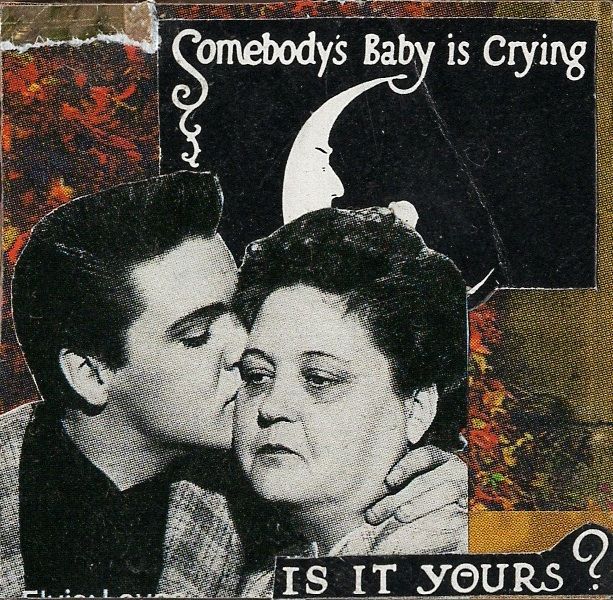
Collage – “That’s Alright Mama” – Michael Haeflinger
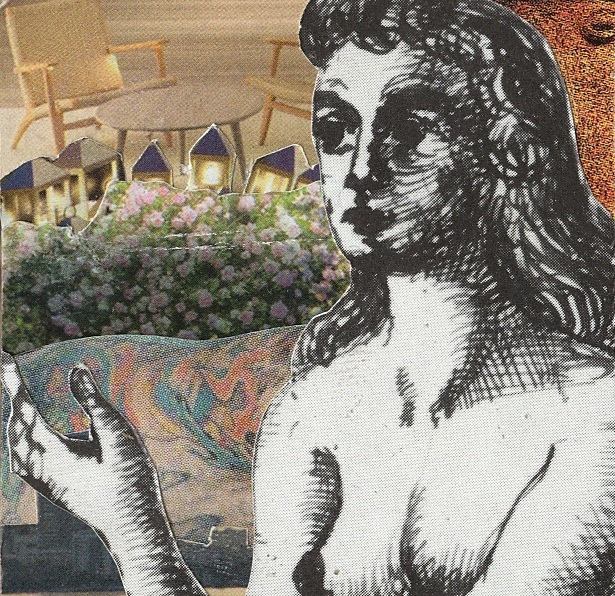
collage – Our Lady of Perpetual Maturation – Michael Haeflinger
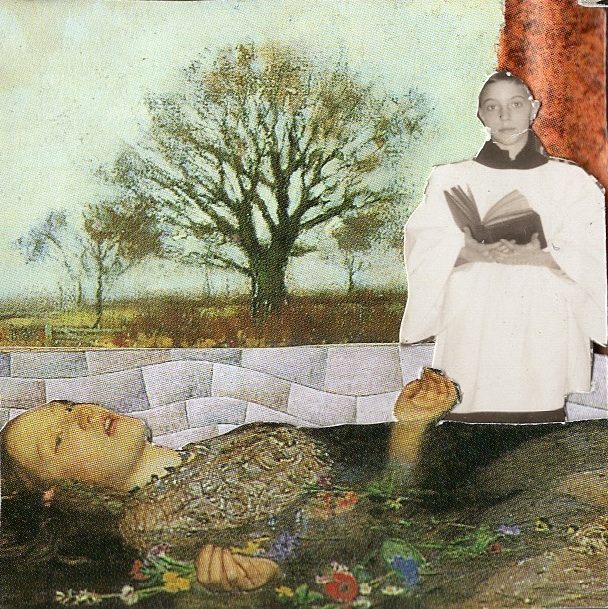
collage – Last Rites – Michael Haeflinger
Artist Biography
Michael Haeflinger lives in Philadelphia, PA. Recent collages will appear on the 22 Magazine blog and in the anthology Found Patrick. www.michaelhaeflinger.com
April 3rd, 2013 § § permalink
Dear Readers and Contributors,
Future calls from Unshod Quills will for submissions of poetry and photography only.
Send us letters at unshodquills@gmail.com.
Until the well runs dry,
UQ
April 3rd, 2013 § § permalink
On the themes of Your Very Flesh and Rivers
[I’m twenty-four years old & driving my father’s 1984 Ford F-150 down a highway that is whispering us to sleep.]
I’m twenty-four years old & driving my father’s 1984 Ford F-150 down a highway that is whispering us to sleep. The windows are down & the radio is cranked & we’re shouting at each other from a bench seat. We are trying to slice our very flesh into words, paste New Orleans to the Illinois loneliness with a trumpet & confetti. Embrace it. Sweat. He says, We could go all the way to South America, you know. This shouting, this foaming at the mouth, keeps me awake for days.
[I’m twenty-one years old & sitting in a canoe somewhere between Baton Rouge & New Orleans, Louisiana.]
I’m twenty-one years old & sitting in a canoe somewhere between Baton Rouge & New Orleans, Louisiana. Our backs are burnt & our hair is bleached & our teeth are all we’ve got. If we paddle 60 miles a day, he says, we’ll get to New Orleans on my birthday.
Day 1: 57 miles: we’re looking for a place to sleep while the crimson embers of last light descend on the bayou. A large boat pulls up to a landing: the perfect place for our bodies tonight. When we sea-leg onto the mowed grass, a man’s voice echoes through a loudspeaker: You can’t camp here & This is Angola State Penitentiary.
It’s dark & we don’t know what else to do. We float down about 100 feet & find a shrimp-shaped shit 4 feet above the rising water. I set up the tent & keep out of the boatlight shining like an actual eyeball for miles along the weeds. In 15 minute intervals we hit the deck, dodge the searchlight & rise again to the soupy wake crashing against our little island.
We eat in the tent with the noises in the water all around. I think of those alligator teeth coming through the thin fabric walls & sleep with a revolver under my head. One .22 caliber bird-shot cartridge that might just piss-off the larger varieties of night. In the calm darkness, we’re not dead. Instead, we wave the boat good-bye.
Day 2: 10 a.m.: we are stopped by a boatload of sheriffs wielding various weapons. They throw a rope to get a good look at our burnt backs & bleached hair & teeth. We tell them we’re from Wisconsin. We thought you were escapees, they say. Do you need anything, they say. & I thought it’s not often a man with a gun asks me that.
Day 4: 7 p.m.: 10 miles to New Orleans. We’re camped under a mile marker that gets trimmed once-a-year. There’s an anthill. We point at it & say don’t step on that, for heavensake! & then step on it anyway. We wake that birthday morning at 4 a.m. shouting about the ants that joined us. Could have been the duct-tape holding our lives together, that’s true. Could’ve been a lot of things. I shook like a bathtub when we got there & that’s how I remember it, Amen.
*”The phrase “shrimp-shaped shit” is a reference to Matthew Guenette’s collection AMERICAN BUSBOY.”
[I’m twenty-one years old & visiting a historic house in Lake Providence, Louisiana.]
I’m twenty-one years old & visiting a historic house in Lake Providence, Louisiana. We walk in & there’s a true Southern Bell apprehensive & elderly. We ask about bars in town & she says There aren’t any & looks at us a bit scared & I feel bad because we’re scary, I think. I’ve never been scary, I think. She points us to a gas station down the street & takes refuge in her office tending to the telephone. I find a piano & begin to play. Slow at first, there’s a tempest building in the trunks of Live Oak. It crescendos & a river flows from my fingertips. Water fills the house while the Southern Bell invites her friends for pictures with the talented young men & together they wash away that fool scary for good.
Author Biography
Michael Lambert lives in California. In 2012 his work received the Thomas Hickey Creative Writing award from the University of Wisconsin–Platteville and was nominated for the Carson Prize. His poetry has most recently appeared in Extract(s), Utter, and Mixed Fruit. He lives online here:
[michaelvaughnlambert.tumblr.com].
April 1st, 2013 § § permalink
On the theme of Gratitude
GOODBYE, BILL BUTLER
“I know not all that may be coming, but be it what it will, I’ll go to it laughing.”
― Herman Melville, Moby-Dick
Though we’re apart
You’re part of me still
For you were my thrill
On Blueberry Hill
— Fats Domino, Blueberry Hill
“Fuck you, cock sucker!”
— Bill Butler, My Grandfather
While I was somewhere between Shanghai and Shenzhen smoking between the carriages on the overnight train, a mini beer keg was being purchased from a Costco in Richmond, British Columbia. Its express purpose, to hold the remains of my recently deceased grandfather.
The living do strange things when grief is involved. It’s okay, feel free to laugh.
I did.
∞
My uncle has the habit of taking control of any family gathering regardless if anyone wants him to or not. A little thing like hating his father did little to detour my uncle from taking control of the funeral arrangements.
It was Disneyland all over again.
My uncle had said some pretty horrible things to his father before he passed and whether they were meant or not does nothing to lessen the fact that they were said and could not be taken back.
My uncle had forgotten his last words to his father,
“I hope you die, you miserable old fuck.”
He then left for a three day fishing trip. My grandfather died shortly after the fight.
Upon being notified of his fathers death my uncle returned from his trip and ignoring the wishes of the family and of his father my uncle had his father prepared at a funeral home in his best sweatpants and favorite L.A. Rams cap for a personal viewing. Then he took several pictures and videos of he and his father as if they were enjoying a Sunday barbecue. My uncle smiling and rocking the thumbs up for the camera. I don’t believe this was malicious on my uncle’s part. I think he felt rotten for saying what he did to a dying man and for the years he spent holding grudges against his father. I think he just didn’t know how to process it all, there were things he wished desperately to take back. That’s life and death, you can’t take anything back.
My uncle finally complied with the deceased’s wishes and had his father cremated.
It wasn’t that a conventional urn was too expensive. My uncle just felt that a mini beer keg would be more fitting and a suitably symbolic abode for his father’s earthly remains. It’s true my grandfather had always been a hard drinker so it was clearly the best and logical choice — for my uncle — at the time. What do I know? Maybe my grandfather didn’t mind.
Once I heard about all of this, the whole thing gave me strange dreams over the following weeks. I would dream that I was sitting in the keg with my grandfather, like Genie’s bottle abode in I Dream of Genie. Except my grandfather’s keg was more masculine in its decor and he was sitting in his reclining arm chair with his giant remote control (that he used due to his arthritis) and was flipping through channels, but every channel was a Magnum P.I. rerun. My grandfather loved Magnum P.I.
Sure the whole thing was more than a little strange but that wasn’t the end of it. My uncle drove around the city, grandpa in his keg riding shotgun. The father and son dinners, the one sided conversations at the dinner table. It’s no wonder everyone thought my uncle was losing his shit. He had. Yet no one said anything. When someone goes that far down the rabbit hole people tend to give them a wide berth. There was still hope that things would word themselves out. Maybe.
We all deal with grief in different ways. My uncle was reliving Weekend at Bernie’s whereas when I received the news of my grandfather’s passing. I found the nearest cafe open in Shanghai at 9AM and got drunk while listening to and singing my grandfather’s favorite song, Blueberry Hill, and cried like a baby.
My father on the other hand walked out of the hospital after my grandfather was pronounced, got in his rental SUV and drove across the Granville Street Bridge to the nearest crack den to do a shit ton of crack. I can’t specify what a shit ton of crack is but to give you an idea, my father is the man who dropped a burning rock on his dick while free basing and taking a piss. Instead of rushing to the hospital to — I don’t know — get a skin graft for the severe burns on his penis he fished around the bathroom floor for twenty minutes while his cock was on fire so as not to waste a perfectly good rock.
Across the bridge he found a local crack den, tossed his keys to some junkies on the street and told them,
“My father is dead. I’m going in there for a while to do some crack.”
In any instance it is never a good idea to hand over the keys to a high end and expensive automobile to dope fiends. “Hope you got insurance on that mother fucker.” Which my father did not, because that would cost extra and he doesn’t roll like that. He had some grief to kill and some crack cocaine to help him do it.
Three days had passed when my father finally dragged himself out of that crack house. I can’t know what state my father was when he came out. Not good. I don’t know. I never asked him. What I do know is that when he hit the sidewalk his SUV was waiting for him, washed, polished inside and out. Not a scratch on it.
The local junkies had cared for it and watched over it those three days. They gave their condolences to my father has they handed over the keys. My father got in and drove away. He may be a deviant but he wasn’t about to miss his father’s funeral.
∞
The whole family was huddled around tables at the Legion in Fort Macleod, the town where my grandfather was born and raised. We had just set up for the wake and were waiting to start the service. My grandfather had wanted to buy one last round for his friends and family, so the bar was open. My grandfather got off lucky, nobody was really in the mood to drink, which was strange because that’s usually all we ever did at every and any family function. I did steal a bottle of whiskey for later. It was owed to me from many Christmas’s passed.
I remember going upstairs to use the washroom. When I returned I found the bottle of scotch my aunt had bought me empty. I’d been gone for ten minutes. I looked at my grandfather and he just winked at me. Touche old man, touche. I couldn’t begrudge him that, nobody ever let the old guy drink scotch because it turned him into an even bigger asshole than he usually was.
It had been a lovely Christmas, one of my favorites and the last that would spend with my grandfather. I loved that man.
The family was terrified my uncle would lose it completely during the eulogy and we all waited for his final break with reality.
It never came. Instead my uncle gave an honest and heart felt eulogy for his father and he cried and felt better for it I think. The catharsis, the letting go of anger and hate, taking a few moments to remember a simple story about his father, was enough to set things right.
The story my uncle told was how he and my father and their friend went down to the river after being told not to go there due to dangerous flooding. They went down anyway. Nothing bad happened at the river, but when my grandparents found out about it, my grandmother ordered my grandfather beat them stupid.
My grandfather did what he was told but got half way though and discovered he didn’t have the stomach for it. He told my grandmother that if she wanted the boys punished, she’d have to do it herself from now on.
He was a boozer and a grumpy old bastard but he loved his kids and his family. Most of them just never realized it when he was alive.
∞
We went down to the graveyard and we dug a hole under the concrete cover where the remains of my grandfather’s baby girl and his sister lay. We placed the keg holding my grandfather ashes inside. My grandmother, who suffers from dementia and was constantly asking where her husband was, seemed to finally realize that he was dead, so she cried and we poured some airline-sized vodkas and whiskey down the hole for his last drink and said our goodbyes, while my cousin played taps on his trumpet.
It was a sunny, cloudless day. Hot. Everything was still so when one mighty gust of wind came from nowhere scattering the empty bottles, the dried flowers then the dust, only to disappear and leave silence and more stillness in its’ wake, all of us knew what my grandfather was grateful for.
Author Biography
W.M. Butler is a Candian writer living in Shanghai, China. He is editor-in-chief of Hal Publishing Shanghai and co-founder of Far Enough East.
April 1st, 2013 § § permalink
On the theme of Groceries
THE NATURAL HISTORY OF THE GROCERIES OF NICOLETTE WONG
I. Red Bean Bun
They call it flower shaped, the red bean paste spilling over your lips when you bite into a petal. I’m about six years old, looking for my favorite bun in the bags of groceries my grandma has just put on the dining table. The afternoon shadow that is my hand, fumbling white plastic, beneath a flimsy tear-off calendar with green letters. When I feel the familiar petal shape, I lean against the wall, as if the chill would wrap me up in a cloak of invisibility. I wish not to be seen.
My grandma emerges from the kitchen; she sits down at the table and shoots a glance at me. She’s dressed in one of her many nylon shirts and pants, the kind of shapeless, dull-colored outfits (sometimes adorned with gold buttons and wavy lines) that the old folks wear in Hong Kong in the 80s. On this day she’s a pale blue.
She starts eating a slice of bread. I shout.
“How can you feel hungry? How can you eat?”
“Why can’t I eat?”
“You’ve done wrong! You’re not supposed to eat!”
“I’ll eat because I eat.”
My grandma takes another bite of the bread, pours herself some tea. It’s up to me to hold back tears. There was a scene earlier in the day. I might have wanted to go to the library to read on my own, or to go to the stationary store to check out (i.e. steal) some cartoon stickers, and my grandma denied my request. Why can’t she—and everyone else in this crowded household—let me be free for a day? In an odd twist to the Chinese concept of guilt—the wrongdoer should feel no hunger as they repent—I decide my grandma has no right to eat this afternoon.
When she has retreated to our shared room, I consider my options. The red bean bun—or anything from the bags of groceries—is out of question. I can’t give in to our usual afternoon tea routine as if nothing had happened. No, I must not eat within my grandma’s sight; I must prove her guilt with the drama of my suffering. The lemon-cream sandwich cookies or sesame crackers might work, if I manage to eat them quietly when she gets back to cooking. To tear the plastic packet open at the label with my teeth, the crumbs dropping onto the floor…
Time simmers for an unhappy child. I starve until dinner is served.
II. Junk Food Days
I’m thirteen, or fifteen, or nineteen, living in a studio flat in a public housing estate. My father is only around when he borrows or steals, and I’m left to cope with creditor harassment every day. My extended family supports me. I model for quick cash after turning sixteen.
Grocery shopping becomes the orbit of my daily life, the thing I do to survive from one day to the next without looking into the abyss. I buy groceries for the evening and the next morning: instant noodles or cup noodles, bread, cheese crackers, an assortment of biscuits, microwave food. Some nights I eat a loaf of banana bread for dinner. Or a bag of chips if I want to be distracted by the savory taste.
I only get what would fulfill my immediate needs, partly because of the fear of running out of cash. There’s comfort in the routine of grocery shopping, the precarious act of tending to my wellbeing one day at a time. I could spend my money on fresh food and cook sometimes. But I refuse to take care of myself as my situation calls for it; I can only live by avoiding the truth of my loneliness and near poverty.
Whenever I go to school—which is about half of the time—I eat better food. My best friend H. lives in a household of mentally ill people, and she copes with life with a mix of passive acceptance and kindness towards others. On this day—I’m eighteen—H. and I feel like getting away from the other girls during lunchtime. H. has groceries at home, and we get some fruits.
She heats up some dumplings. The tiny flat smells of steam. I sit in front of a desk fan, my legs curled up in H.’s bed. It’s a bright day. Too bright for us to sit by the windows.
We eat from two white plates on fold-up chairs.
“It’s too much hassle to go out for lunch every day,” H. says. “I’d rather stay at home and have something simple…like this.”
I nod yes, munches on an apple. H. has frizzy hair and tired eyes, as she often does.
I’m happy when people give me food to eat.
III. PARKnSHOP
I’m twenty-two, still living in public housing, with plans to run off to Australia once I finish graduate school.
Tonight I wear a ponytail for a change, though my floral pattern shirt has a similar cut to the one I wore yesterday. It makes no difference to my trip. Between the grocery stores, supermarkets and fast food places in the hood, I’ve shown up in T-shirts and overcoats, straight hair and curly hair, sunglasses and no glasses, wobbling down the stairs at different times of the day, over the years… I’m still the girl who dines and shops alone.
With my studentship and part-time jobs, I can afford regular (i.e. takeaway) dinners. Once or twice a week I visit the PARKnSHOP for grocery shopping, and I get more or less the same junk food as I got in my teens: noodles, biscuits, chips and microwave food, of higher quality. Grapefruit juice becomes an addition: I drink up to 2 liters of it on most days. The sour taste calms me down, makes me feel alive amid the clutter in my flat.
I’m fascinated with the PARKnSHOP cashier who wears an 80s style perm and bright lipstick. I watch her whenever I wait in line. She looks at the customers in the eyes as she speaks, her voice burnt from years of smoking; then she smiles and takes the cash, or inserts a credit card into the card reader. I see her playing mahjong with three friends, a white cigarette between her red lips. Other cashiers look generic to me, just as I’m one of the numerous customers coming in and out of the supermarket.
When I come home from grocery shopping, there’s a note scribbled in childish handwriting in my mailbox:
“Dear Miss Room 422,
I’m bored. Will you be my friend?
Sometimes I see you smile. I think you’re always happy.
Call me. 9746 3804.
Wait for you!”
Is it someone who lives in the opposite building? Why would anyone spy on me? Follow my routine? I was probably crying, rocking in grief to post-rock music, when some creep mistook it for a happy dance.
What gives this stranger the right to judge and exploit me?
IV. 7-Eleven
I’m twenty-eight, living with my cat in a studio flat in a quaint neighborhood, where there’re many auto repair shops and sidewalk cafes. People walk their dogs in the hood. On the eve of Mid-Autumn Festival, the shop owners and their families throw barbecue parties on the sidewalk.
I work irregular hours. Most nights I get dinner at 10pm, write from midnight to around 4:30am, and go to sleep. When insomnia strikes I take long walks to the pier two train stations away, or to another district for breakfast at a 24-hour restaurant. There’s rarely any grocery in my home anymore: a box of instant cereal, a pack of sesame cracker, an orange. My fear is late-night binge eating. If there’s a packet of Chinese noodles in the kitchen, I’d cook it and gobble it with the soup, one hour before I hit the sack.
The anxiety sends me straight to 7-Eleven, where the cashier named Carol is sweeping the floor with a red broom. I pretend to get something light, a ham and cheese sandwich and two chocolate bars. A man with a graying crew cut brushes past me and snatches a dinner box from the fridge.
I hear him open the microwave oven. Then the smell of meat, of cooked food that has been sitting on the table for too long.
I scan the microwave dinner boxes; I’ve never had one before. Most are Cantonese dishes like chicken and mushroom rice, the kind of food we order at a Hong Kong styled teahouse. The pork ribs and green beans look gigantic in pictures; the colors are two shades darker than they are in real life. The set up looks like flaming flesh in motion, shaky and steady in a close-up grind.
I pay for my sandwich and chocolate. Carol offers me some cartoon stickers.
“Twenty-five stickers plus ten bucks for a Moomintroll mug,” she says.
I put them in my wallet.
The guy starts eating his late dinner. There are worlds inside those microwave dinner boxes, colors and textures that come to life in sizzling glory. But I won’t find out. I don’t have a microwave in my new home; and I won’t be the person who’s seen waiting for their food at 7-Eleven, lonely.
Author Biography
Nicolette Wong is a dancer, magician, and editor of A-Minor Magazine & Press. She blogs at Meditations in an Emergency.
April 1st, 2013 § § permalink
On the theme of Gratitude
THE TOPOGRAPHY OF HER CHEST
I found out later it was the superintendent who found the hard ugly lump glued into his wife’s small right breast, the same night she conceived their tenth child.
“Goyim,” my mother said. She shook her head when she heard that Estelle was pregnant again.
Most of the families in our neighborhood had a couple of kids. Then there were the outliers—the occasional childless couple, objects of pity. Or the superintendent and Estelle, doing their Catholic duty. My mother looked down her nose at them.
The superintendent didn’t tell his wife about the lump and she would not have been the kind of woman to look at her breasts in the mirror, let alone touch them. The superintendent wept in secret, swiped at his eyes as he pushed his wide broom or sloshing mop up and down the tile halls of the apartment building.
I imagined that each night, when his heavy body rested on top of Estelle, his wide rough hand would return to the breast with the lump, praying to god that he’d been mistaken or that it had miraculously disappeared. I imagined that his touch was gentle, his body balanced on his elbows. My belly tingled when I thought about it.
And then Estelle began to spot and cramp. When everything was said and done, Estelle miscarried and the doctor found the lump and things fell from there. Then everyone in the building learned the superintendent had found the lump first and not said a word. Out of guilt, or shame, he owned up to his secret.
My mother accused the superintendent of crimes against Estelle; it seemed she knew the story in ways I didn’t understand.
“They got it all,” the superintendent said. He beamed.
“That’s what the surgeons always say. They never get it all,” my mother said.
The superintendent told everyone the news, and cried each time, until all the tenants knew of Estelle’s surgery and he was out of tears.
My mother said he’d signed Estelle’s death warrant by keeping his mouth shut, that he wanted Estelle to die.. There was no point in asking my mother what she meant because she wouldn’t talk to me about it. My mother was superstitious and talking about things made them real. It would be bad luck. Secrets were big in our family, and this was a secret so big and real it scared me too.
My mother also believed rape got Estelle pregnant ten times, something I really couldn’t understand. When she didn’t want me to get it, she spoke in Yiddish.
We had lots of books, including the blue-leather-bound Encyclopedia Britannica and a Merck Manual, but no Yiddish dictionary. These had most everything I wanted to know. I turned to them when my mother wouldn’t answer my questions. The Merck Manual told me the kind of surgery Estelle had: a radical mastectomy.
They were poor, Estelle and the superintendent and their nine children. They lived in the basement apartment with all the clanging from the radiators and booms from the boilers. Estelle wore threadbare housedresses.
Her breasts seemed tiny sad little things, invisible in her loose garments after suckling nine infants. I pictured the breast they removed as a lump of coal in a wet sock. If they hadn’t gotten it all, what was there left to get? The surgeon had removed the offending breast, its armpit and the muscles in her chest and back.
Estelle seemed transparent after that, like I could see through her, like she was already a goner. But everyone wore a game face, and her fate, like cancer, was something my mother refused to discuss with me.
I had no problem creating my own horrific scenarios. I wanted to grow a beautiful large pair of my own, as soon and as quickly as possible. I spent hours in front of the bathroom mirror with the door locked. I ran my hands over the gentle rise of ribs into the shallow valleys between. I pressed and pushed my puny flesh into something resembling cleavage. I was convinced that anything I didn’t recognize from the day before was cancer. Pretty soon my chest was covered in bruises the size of my fingertips, which my mother discovered. She became hysterical and hauled me off to the doctor to reassure herself there was nothing wrong with me. The doctor suggested she talk to me and explain things.
Six months after they took off Estelle’s right breast, they took off the left, and while they were at it, they traveled south for her uterus and ovaries. My mother was right. They hadn’t gotten it all.
We rarely saw Estelle’s gorked face around the building anymore. When we did, it was the superintendent who pushed her around in a wheelchair. She was all teeth and skull draped in tight skin. Her cancer cells were the busiest part of her, reproducing themselves exponentially faster than any other cell in her body.
Meanwhile, my breasts began to grow, but they were still swimming in a double A training bra that I stuffed with toilet paper. No one at school seemed to notice them, except Joey, Estelle’s oldest son, who was one year older than me. I deliberately stuck my chest out when I saw him.
I knew Estelle’s kids, but they weren’t my friends. They kept to themselves, played together, helped their father around the building while Estelle dressed and fed them all. They avoided eye contact. They played hit-the-penny with a worn Spalding on the street in front of our building, or roller-skated down the five block hill to the park behind our building. I used the same hill, skated every day after school, after homework and piano practice, if it wasn’t raining or snowing.
I wanted to skate with Joey, race him down that hill, but didn’t have the nerve to ask. My best friend was already tongue-kissing her boyfriend and I had to force myself to talk to Joey. I was skinny, with dark hair in a pixie cut and didn’t think I was pretty at all.
I reasoned that Estelle’s kids needed someone to play with besides each other. I was curious and scared and I felt sorry for them and I thought I would be doing a good thing, that maybe I’d be guaranteed safe passage because of doing a good thing.
I finally screwed up the courage and asked Joey to skate with me. We challenged each other to a race down that hill to the park.
“Yeah,” he said. His voice squawked unexpectedly, from soprano to tenor. “I always wanted to skate with you,” he said. I smiled—at his voice and because I was a champion on that hill.
He looked a starving puppy, too happy that I’d asked him, hoping that maybe I liked him, and like all he had were brothers and sisters and a dying mother.
So we got to skating and talking.
“Do you like Elvis?” he asked.
I was ashamed to tell him I wasn’t allowed to listen to rock n roll, only classical. My mother was a concert pianist. Of course I listened to rock n roll when she wasn’t around and I could imitate Elvis’ velvet voice doing Love Me Tender. So I sang Joey a few bars. He was cute in a blond skinny way. He looked at me, at my face not my chest—me, so I sang the entire song.
He was impressed, all goofy smiles.
“My dad told me your mother played the piano really good and I was supposed to
respect her.”
Respect my mother? Weird. She was my mother.
“We should get ready,” I said.
We practiced, tightened our skates into the soles of our shoes, wore the keys around our necks, every day, skating down that hill, one block at a time. Finally we moved off the sidewalk and onto the street. I could see heat sparks flying from our skates. It seemed really steep and a long way down. I crouched. So did Joey. We were bombs and the world at the bottom of the hill was our target.
The day of the race arrived. All the kids in the building turned out. My mother was there.
“Don’t get hurt.” She wagged her pointer finger in my face. “You know I’m not happy about this, don’t you?”
I knew she was as unhappy with my new friendship as she was about the race.
As if to disprove my mother’s contention that the superintendent didn’t care about Estelle, maybe even wanted her dead, he brought Estelle to the event.
Joey and me started together, picking up speed, the thrill of it rushing up and through me. We both screamed and ended the race together, laughing, shaking, hugging—Joey hanging on to me too tight. Since my toilet paper breasts were dissolving in my sweat, I figured I should kiss him so he wouldn’t notice. I leaned my head toward his; his mouth was ready and his tongue tickled the inside of my lips. I would have stayed like that forever, but the superintendent raced by, pushing Estelle in her tipped-back wheelchair. Her head was thrown back and she laughed and laughed. This was the last dance on her dance card and all I saw was love.
Author Biography
Evelyn Sharenov’s fiction and essays have been featured in Glimmer Train, the New York Times, The People’s Apocalypse, Mediphors, Fugue and Etude and other journals and magazines. Her fiction has been a notable in Best American Short Stories. She’s written for Bitch magazine, Willamette Week and the Oregonian. A recipient of both OLA and OAC grants, she resides in Portland, OR.
