October 27th, 2012 § § permalink
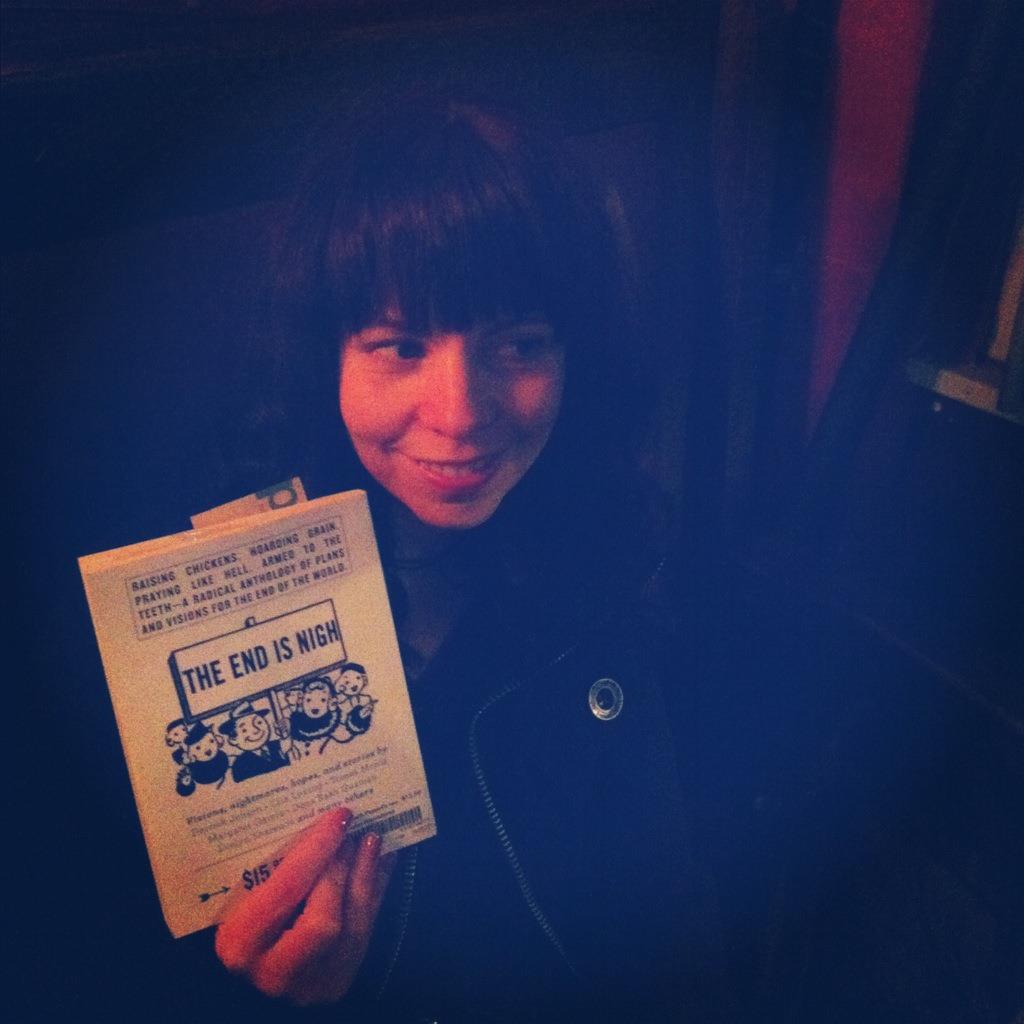
DRG with her copy of the People’s Apocalypse
Dear Readers,
It’s autumn now in the forest outside Portland, Oregon, which means it’s winter. Until July.
I’m cozying up with the great works in this issue of Unshod Quills. The sixth issue. That’s right. That’s how I will stay warm for the night, anyway, in my woodsy bed. Featured artists Evan B. Harris and Matthew Wong are in here, along with featured writer Miles Klee and featured poet Tammy Ho Lai-Ming. By in here, I mean in Unshod Quills, clearly. Not in my woodsy bed.
We are also happy to have a special feature: The People’s Apocalypse is an anthology edited by Ariel Gore and Jenny Forrester. Disclosure: I have a poem in the book. Disclosure: the special feature has some great writing sent by contributors to the project’s Kickstarter fund. Disclosure: I love the way UQ contributor and PA Kickstarter backer Golda Dwass writes.
Disclosure: if I ever unbecome an editor, I will miss making up words and writing like we have tapeworms. If you don’t get that, please make an appointment with Mark Twain.
Thank you for your patronage and for your participation. Thank you. Thank you.
Welcome back, and enjoy the show.
Yours,
Dena Rash Guzman
Founding Editor
Unshod Quills
October 27th, 2012 § § permalink
On the themes of milk, this whole time, and how we fall out of love
TO ANOTHER SWEETHEART WHO CURRENTLY LIVES IN AMERICA WHERE I CANNOT RIDE MY LONDON BIKE TO
Instead, I will write in jumbo-sized
hot air balloons of emails
gliding towards you
Or
one hundred folded
crane-like planes
flying headless your way
some of which land
nowhere, while the rest
get caught by eagles.
SIXTEENTH-CENTURY GADFLIES
You wrote to me yesterday
that you had sex
with a buxomly woman
ravenous for
sweet spicy pear slices.
My little head wondered
for a long while.
Did you not ‘make love’ first,
like in Shakespeare, Addison and Stern?
I hope you made love first.
And if you did
I hope you had
very, very, very, very,
very, very, very,
very, very,
very,
melancholy
orgasms.
NASTY GIRL
i.
When walking past a fat man
in a T-shirt that says
‘Treat yourself and take me home’,
she whispers no, and then, no.
ii.
Completely by chance,
she finds herself in
the Honda showroom.
She pops every red balloon
attached to every car.
Then she grins with the
brand new tyres.
iii.
Standing next to a busker
playing “Streets of London”, she says
to him: If I really want music,
I sing.
FORSAKEN DAYS
Finally, I ask him to make eye contact with me
from behind his glasses.
I know from a Victorian play
that the yellow lady of London will be wild.
I say to him: Let’s open up to silhouettes
tonight. Let’s feed champagne to the
line breaks. Let’s draw small moons
into smaller worlds. We can crack them
into a yes, no? – if yes, purr yes yes
He says: How the gutter doth shine so?
I don’t want to run into a bigger circle
to ride my luck or crane any longer.
What good is a fedora if there is none?
We leave them all out: the miles
and the sons. The zeitgeist just barrels in.
The leaves are louder now,
now quieter, now gone.
Together, we write abstract notes
about me, your tight-lipped lover –
tired, mired, very animal.
THAT WINTER
At the beginning there were eight buttons, each coated with glossy black veneer, on your sweater. Then there were seven, five, three, four, two. At the end of the season we did not know what happened to that cardigan. Perhaps it was left on the Bakerloo line. Or it was carried away in the wind when we buried a pair of old shoes like in that painting in the Moors. I should add that it was a sweater we picked up by a river during a canoe trip between Jasper and Hinton in the Rocky Mountains.
We sold small gold coins, mementos from the parents’ generation. Little coins stamped with austere men’s heads. So we could buy each other Christmas presents. I wanted a super-soft armchair that could harm one’s back. You wanted a silk parachute and a hoover. I said, ‘Forget about the parachute.’
There was enough for us to go to the theatre but at the intervals we were always empty-handed, watching others scoop, so very genteelly with their fat or creased or gloved fingers, ice-cream. I don’t remember everything you said that Winter but I remember this: one night, how little I knew, when all was still, you walked out of the bedroom and slammed the kitchen door closed. Coming back, you said, ‘I could hear the tap drip. Drip drip.’ Drip.
FROM GREENWICH TO THE MAUGHAN LIBRARY AND BACK
The Canon Street Station’s renovation
is complete and it looks hideous.
Red, green, blue lights
flash and flash.
All fallen leaves
on the pavements
have but one shape:
Yellow.
The photocopying room
in the Maughan Library is bonfire hot.
I want to take off
every item of clothing,
including the mechanical pencil
I wear in the hair
to make a small bun.
I am writing this on the back
of a letter the poet Koon Woon
of the Chrysanthemum
sent me last week.
I think he won’t mind.
Wherever he may see
this poem he’ll think:
Communion.
Five o’clock in the afternoon
and day is night.
Soon I will be walking on that street
with the smell of British beer and cat piss.
Soon I will be on a train home
hearing the newspapers
open and close and open again.
Author Biography
Tammy Ho Lai-Ming is a Hong Kong poet and editor. She edits Cha: An Asian Literary Journal and Fleeting Magazine. Her website is http://sighming.com/
October 27th, 2012 § § permalink
On the Theme of How We Fall out of Love
THE PAULA AND CLIFF FRAGMENTS
PAULA AND CLIFF DO NETFLIX
Paula says she doesn’t want Raging Bull. She doesn’t want horror or westerns, can’t stand noir. She reminds Cliff about the course in cinema she’d signed up for in college with her best friend, Mary Chris, how the course began with Hitchcock’s The Birds.
“The-fucking-Birds,” Paula says. “I looked at Mary Chris like, these people are speaking English!”
Paula wanted subtitles, she wanted ideas, she wanted Eisensteinian montage.
“I wanted films,” Paula says, “that questioned the existence of God.”
Cliff says, “Noir questions the existence of God.”
Paula says, “Then reaffirms it.”
“Ah,” Cliff says, “so John Ford.”
They settle on a documentary about figure skaters.
PAULA AND CLIFF AT RAY’S PIZZA
Paula is scraping the cheese from her slice of cheese pizza.
“What are you doing?” Cliff says.
Paula says, “What does it look like I’m doing?”
Cliff says, “It looks like you’re scraping the cheese off a slice of cheese pizza.”
“Bingo,” Paula says. She bites into the white dough wet with pink sauce.
Cliff says, “Why are you scraping the cheese off a slice of cheese pizza?”
Paula sings: “Because the world is round, it turns me on.”
“Ah,” Cliff says, “so something does.”
Paula stops mid-bite. “If you’re referring to what’s happened since I started Zoloft. . .”
Cliff says, “Something happened?”
“You’re an asshole,” Paula says.
Cliff burps, wipes his mouth, gets up.
“Another slice?” he says.
PAULA AND CLIFF IN BED
Paula says, “Open your eyes.”
She says, “Talk to me. Tell me what you want to do.”
“To me,” she says, “what you want to do to me.”
What Cliff wants to do to Paula, Paula doesn’t want to hear, Cliff is certain.
She says, “Say my name, say it in my ear, but with passion. Passion!”
“Spank me,” she says. “No, like you mean it. I’ve been a bad girl. A very bad girl.”
“I fucking love you,” she says, “you know that, don’t you? You should fucking know that.”
“Why do you love my cunt?” Paula says.
They’d had this discussion before. Cliff had given the wrong answer.
“Don’t say pussy, I hate that fucking word.”
“Don’t say cunt either,” Paula says, “unless it’s my cunt you’re fucking.”
“Is it my cunt you’re fucking,” Paula says. “Baby?”
“Tell me,” she says, “tell me in my ear. Tell me louder, tell me like you can hardly talk.”
PAULA AND CLIFF AT MARY CHRIS’S OPENING
Cliff stands in a corner where two blank walls meet. On the walls opposite, peculiar work hangs, work that makes Cliff feel vaguely uncomfortable.
Paula says, “You haven’t even looked at her work.”
Cliff tells her no, actually, he has. And he has on at least two occasions, one quite recent. He and Paula visited Mary Chris’s studio and Cliff had looked at her work and it made him uncomfortable.
“I mean tonight,” Paula says. “You haven’t looked at her work tonight.”
Cliff says, “Because it makes me uncomfortable.”
Paula says, “It’s supposed to make you uncomfortable.”
“Then I’m not doing anything wrong,” Cliff says.
“You could make an effort,” Paula says.
Cliff supposes that, yes, he could.
PAULA AND CLIFF AT COUPLES THERAPY
Paula isn’t talking.
“There’s nothing more to say,” she says. “There’s nothing more to add, I’ve said it all a thousand times. Nothing gets through. Nothing matters. I’d talk if it mattered, if it did any goddamn good.”
The counselor suggests that this kind of talk isn’t hopeful.
Cliff says Paula not talking is hopeful, it’s the most hopeful thing he’s heard since they started therapy, he’d never miss another session if he knew Paula wasn’t talking.
This, too, the counselor says is unhopeful. Perhaps, he says, they might consider “unhopefulness” as a bridge.
Paula is the first to snicker.
Cliff snickers, too.
Then they laugh. They laugh till they cry. They fill tissues.
Then they’re at time.
Author Biography
Tim Tomlinson is a co-founder of New York Writers Workshop, and co-author of its popular text, The Portable MFA in Creative Writing. He is the fiction editor of the webzine Ducts. Recent work online and in print in Asia Writes, The New Poet, the New York Quarterly, Pank, Prick of the Spindle, riverbabble, Salt River Review, among others. He was featured poet in Saxifrage Press (Dec 2011). “Blue Surge, with Prokoviev,” in Sea Stories, was nominated for Best of the Net 2011.
October 27th, 2012 § § permalink
On the theme of Gauntlet
THE HAPPY SUICIDE
Mr. Yearly, it must be admitted, enjoyed success in every aspect. His loving marriage had resulted in healthy, intelligent children. Wealthy from his innovations in photographic software, he gave to African charities and was devout in his Christian faith. He owned a rambling, modern house on a vast property given to beautiful pine forest that—so we have heard—he ventured into to die, by what method we have not been informed. We know it took eight days to find his body.
His wife, when one of us mentioned how happy and, more to the point, how satisfied he seemed in life, said that “still waters run deep.” Rather an odious cliché given the circumstances, there being deep rock pools in the woods. Although sensitive to his quiet anguish, she continued to envy, or almost resent, as did we all, how easily things came to him, extinction now included.
“How could Mr. Yearly—with all he had—have done it to his family?” we asked, thereby evading the question of how he could have done it to himself. But once our astonishment had eased, there came the sense that this type of gesture is entirely familiar.
Author Biography
Miles Klee has written for Vanity Fair, Lapham’s Quarterly and many others. He is the author of the novel Ivyland (OR Books 2012) and lives in Manhattan with the screenwriter C.F. Lederer, his wife.
October 27th, 2012 § § permalink
On the themes of Godzilla and How We Fall Out of Love
LIT BY FUJIAN MOONLIGHT
I’m building a green dragon
in my moonlit bedroom.
I hope she brings me luck.
It takes two mature dragons to breed.
I can break eggs without making an omelet
and the last dragon I claimed escaped.
I’ll ignite my dragon one morning
between river and bluegreen hills.
When she walks to the water, she’ll rattle
like shackles. Thirsty, she’ll fill
her stomach with sludge and Tsingtao cans.
Little Princes will chase her tail till
she dives and rests on river bottom,
and prays she’ll soon rust to measly pieces.
Maybe then, my verdigrisinous beloved
will miss our once happy home.
When the river prince abused a daughter
of Dong Ting Lake, it took an honest man
to bring news to her family. Her uncle,
diamond clawed, broke his chains,
ate the errant husband–two gulps–and flew
to heaven to request clemency.
Those dragons deserved respect,
their red hearts huge with hate
and love wider than their mouths.
They could teach a man to breath underwater.
WOMAN WITH A MAN’S HEART
Clytemnestra speaks
Red hand prints on a whitewashed wall
and a bay-leafed procession
down the cliff road to the sea.
Why should this sign inspire dread?
Think of summer strawberries
broken in your fingers.
Think of revelers drinking wine,
patting the friendly walls as they passed.
Think of the women who dyed your cloak crimson.
Think of strong hands lifting a newborn baby.
Red hand prints on a whitewashed walls
A wife is the best thing to have.
A wife smells sweeter than a good conscience.
She cuts cleaner than any brazen knife in Troy.
Yes, the ships came into the harbor with full tide.
Yes, the captains wear armor of gold
and carry sweet captives back to their homes.
Think of strong hands lifting a newborn girl.
Measure the palm print; measure my hand.
I would have pulled down stars,
and fed them, purpleskinned,
into the maw of my husband.
There are ships to Egypt but I will not worship cats.
Shall we look for flowers at the feet of strange gods,
or the floors of the sea?
The trickster asks for her I love best.
Such a foolish god to knock
when my purse is empty.
Red hand prints on whitewashed walls.
Think of your strong hands
lifting a newborn daughter
out of my bloody womb.
Author Biography
Reid Mitchell grew up in New Orleans and is a teacher in Beijing. He has an MFA from Warren Wilson and has published the novel ‘A Man Under Authority’ and some short stories. His poems have appeared in CHA, Asia Literary Review, Pedestal, and elsewhere. He collaborates with poet Tammy Ho and their dialogues have appeared in Barrow Street, ADMIT2, and Canopic Jar among others.
October 27th, 2012 § § permalink
On the theme of Gauntlet
A Primer for Imaginary Theft
For starters, smuggle sunset in through the fingernails; keep in a straightjacket in your throat.
Speak soft as liturgy with glint-spindled tongue. Elbows are for ghosts, who crave corners, so prey
cautious sparing the angles shaved off in your sleep. Discordant melody may ascend the hip without
a winged invitation. Swallowing harmonies through the bellybutton is best. Concoct heirlooms for
safe circumnavigation of shame, taking lantern breaths for each darkly hiss of dust-bile. Form
invisible bridges on your molars to pass a stolen sky through the system. Clouds are made malleable
in the language of rain & makeshift rafts. Remember that laughter dissolves chalk-like in an
eardrum, ferreting through the impossibly pink ductwork of memory, which is a giant mollusk. Faith
catches fairly fast in the toes but not without the inherent risk of infecting footfalls, stammering a
well-timed step with God’s grisly sunspots. Rig eyelids with heavy nets to intercept affection’s glass
architecture. Beauty builds its nest on the nipples, for doves to teethe & dig out & bury their
rage. Apocalypse rests along the ribcage in tiny teepees, anarchy somewhere in the spine. The lot of
wrath rots in the nape of the necks of dead lovers everywhere. For enders, to embezzle forever requires the cleanest choreography; to swindle infinity, one sharp-enough knife
Author Biography
Matthew Burnside is managing editor of Mixed Fruit, an online literary magazine (http://mixedfruitmagazine.com/), and an MFA fiction candidate at the Iowa Writers’ Workshop. His work has appeared or is forthcoming in > kill author, Gargoyle, PANK, Juked, elimae, Contrary, Pear Noir!, decomP, NAP, and Danse Macabre, among others.
October 27th, 2012 § § permalink
On the theme of Milk
THE HOARDER’S BASEMENT
Even from the sidewalk we could glimpse
through tiny basement windows
the glint of water
almost lapping the jambs.
The trash boats lolling
with their rat captains,
tails dipped like pink rudders
into the dead pond.
One day it rained
two inches in an hour.
We heard glass shatter,
looked to see
the hoarder’s cellar
dump from every side
its black ballast
into the yard,
the drive,
the street.
A fleet of empty milk jugs merged
into the river
that was road.
Trash bags swirled
toward the grate.
Mice scrambled
up the peaks
of those tumbling islands.
In the torrent
tomcats hunched
along the bank
to dip their quick paws
into the rush
like bears
to snatch the passing fish.
Author Biography
Raised in South Florida, Paul David Adkins lives in New York.
October 27th, 2012 § § permalink
On the theme of How We Fall Out of Love
SOME THINGS YOU MIGHT NOT HAVE REALIZED
There’s a dress you can wear that will cover up the deep scratch marks he brought to life on your back. Or there’s a sweater. There are even t-shirts you can wear with jeans. It’s better than nothing but that, as it turns out is actually something.
There’s also that thing about the court date for “Lewd and Indecent Activity.” Please consider pleading out that charge because court will cause more embarrassment than the normal embarrassment your affair is causing me. The questions from the judge about how you gave your new lover a hand job while he was driving with no seat belt, his hips hoisted up so the flagman could see it all through the windshield will have people on the edge of their seats. Also, the minor fact that you never stopped will be placed in your permanent record.
Eight months ago, when you suggested he and his wife should come over for dinner, which was, upon further calculation: You and he started cheating ten months ago. Subtract from that eight. Carry a one from the tens column. That made dinner, in hindsight, a bad idea. You made crusted mahi-mahi with lime. You admire dolphins, in fact, when you see them on television you say that you love them.
I ask you, why someone from your office? I’ve met all your co-workers, not for dinner, but during company events. Even if their eyes said it, I’ll never be “poor Doug” as I’ve never ever put myself in that position in the past. Allow me to decline the invitation to the company’s Holiday Party this year and before you off-handedly ask, I do mind if you go.
We can talk over dinner at our favorite restaurant. Pick something out: There’s that dress, or the sweater; maybe jeans and a t-shirt, since everything is different. I’ll still want to peel them off but not in a way we used to when we wanted each other. Now it’s only something I need to do. Right now, I need to see.
Author Biography
Timothy Gager is the author of nine books of poetry and fiction. He lives on www.timothygager.com.
October 27th, 2012 § § permalink
On the theme of How We Fall Out of Love
The History Architect
twilight lanterns fragile light
a will to feel sown
swallow ash
plant a seed make the bed
the steam whistles warmth as she gathers her sword
the look of love eyes in-shined
as evening shifts we wonder
what we left back at the start
all the demons decided to cook for you
exposing heart’s weakest moments
gathering nest
as something in the dirt rises towards you
clings to the sky
reaches high with direction
different sizes dragged across the floor
with answers chewing in their mouths
her eyes and her broken
flood become a hungry man’s river
fishing out lavender ghosts
saddling the dragon knowing she was the one
soft gathering fool
her rock is filling up pages
canyons swollen in offered affections
secrets kept buried deep in the rift
never once smoked damages
torn the risk of a worthless heart
or refracted from the aching damn
the smallest parallels of wilderness
burn the old shame from the legacy
where bone begins it’s task
of waiting for the huntsman
the history architect
hands have never
given out forgiveness
smitten fields are man loved
sky grows to yawn
beds whisper birth
force passing
ears as breathless lobs
touch between sly paths
where ghosts have moored rain
flag on a broken arrow
adorns body’s grief hill
Author Biography
John Barrios is a writer and stay-at-home father living in Portland, Oregon. He currently writes for Small Doggies Online Journal where he enjoys talking to writers about their process.
October 27th, 2012 § § permalink
On all themes of Issue Six
Editor’s Note: I asked Mr. Wong to allow me to select photos for publication from his galleries, and to be allowed to assign themes myself. To that end, the artist has given the editor a lot of freedom, for which I am grateful, but any associations between the art in this feature and the actual meaning behind them is pure and joyful editorial conjecture. It’s of note that none of the photos that follow were posed. Mr. Wong took them all candidly, on the streets of Hong Kong. For more on his work, see his interview with me. – DRG, Founding Editor, UQ
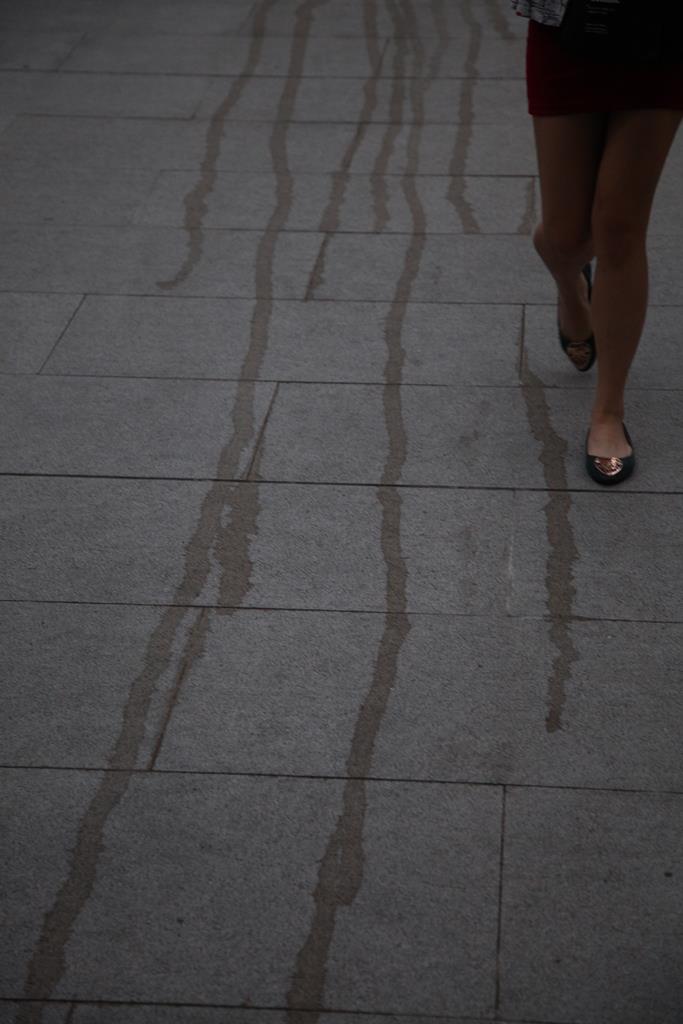
Matthew Wong – on the theme of Godzilla –

Matthew Wong – on the theme of Other Lovers

Matthew Wong – on the theme of Gauntlet
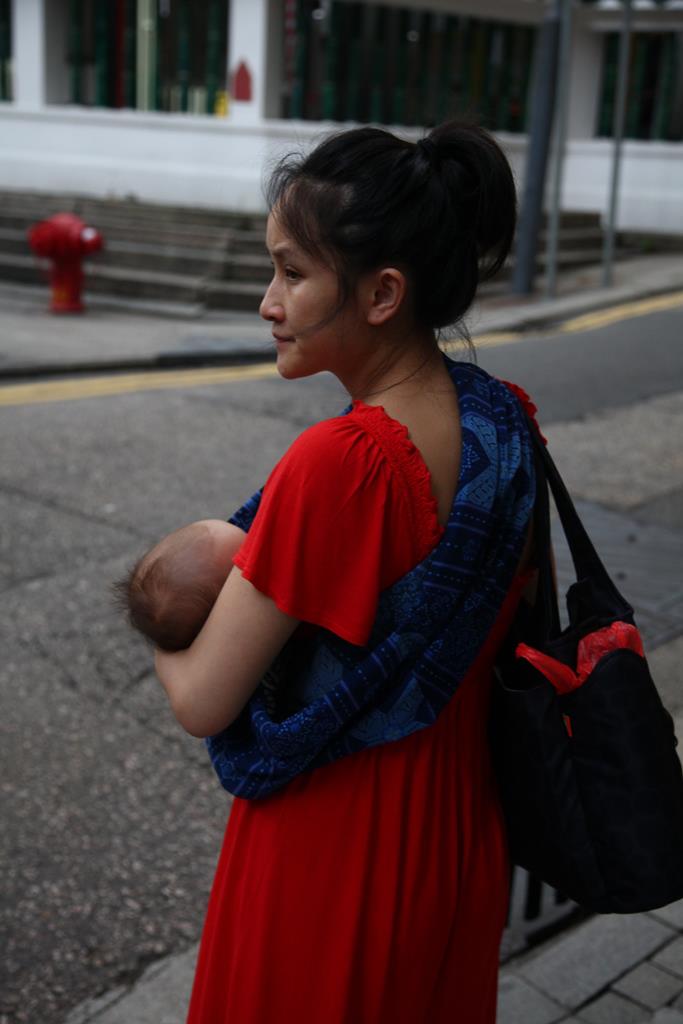
Matthew Wong – on the theme of Milk

Matthew Wong – on the theme of Milk
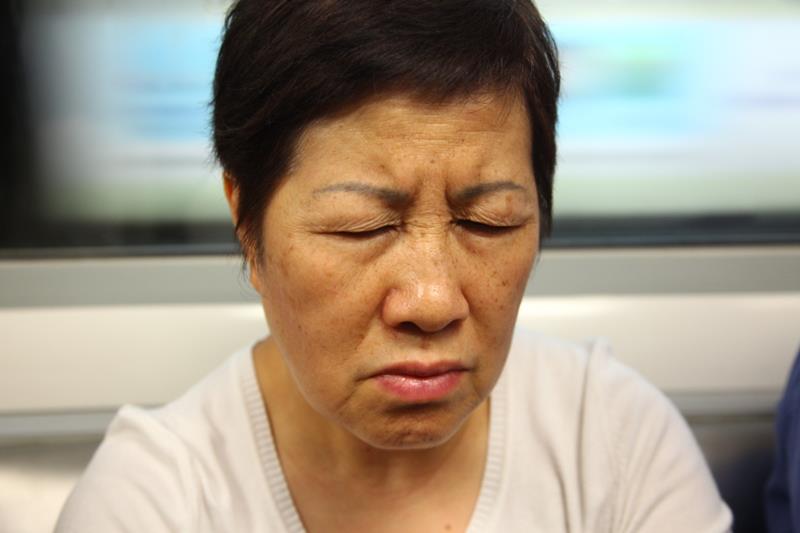
Matthew Wong – on the theme How We Fall Out of Love

Matthew Wong – on the theme of How We Fall Out of Love

Matthew Wong – on the theme This Whole Time
Author Biography
Matthew Wong is an artist currently based in Hong Kong, working in photography, painting, and poetry, in addition to the occasional foray into art criticism. “Everything is going according to plan; there is no plan.” www.matthewhk.tumblr.com
