September 19th, 2012 § § permalink
Vision in Black Water: Holly Hinkle Interview With Portland Artist Evan B. Harris
In the flesh, Evan B. Harris is a self-portrait of the old world maritime aesthetic that has become signature in his paintings and murals. As he settles into the darkened, quiet corridor of the shop where I first met him and takes a seat in a solid, antique chair across from me, I feel a spirit-tempest enter the room, and imagine the faint sounds of shipboards creaking and mermaids singing. The artist’s beige knit cap is pulled askew and his chest piece crests along the open neck of a striped boater shirt. He’s wearing cowboy boots. “My style comes from my granddad,” says Harris, “He was a cowboy-sailor.”
Every artist comes from somewhere, and from that somewhere a story unfolds. Harris’s own narrative originates off the grid, where, in the backwoods of small towns across Southern Oregon, he journeyed with his mother through the wonders, loneliness, and hardships of a keyless life. Harris picked up drawing early on and, like any natural born artist, filled his school notebooks with sketches. Encouraged by his teachers and fellow students, he continued to draw and hone his skills throughout his youth. When I ask Harris about the crux of his work, his answer is simple.“I paint my family—” Mother, Father, and Grandfather are recurring Muses—often painted into the “mythology that circles in my head” says Harris.
Looking at an Evan B. Harris painting, it’s apparent that the artist is a master at translating the delicate braid of real life and a folkloric menagerie of symbolisms onto the canvas. One feels a natural gravitation towards the narrative textures, subdued color palette, and invitation to interpret the work through a full spectrum of emotion; above all, the artist’s gift of metaphor holds the viewer’s gaze until they realize they are looking, not at a painting, but in to one. In a world where wolves and moths are protectors that “elevate everything out of darkness,” roots are like arteries carrying blood into the center of things, foxes and horses are cut-in-half vessels for the dead and the living, and black water is a universal evil, the desire to pause and take it all in is not surprising.
Toward the end of our conversation, Harris throws up his hands and says, “Holly, I want the world to be overrun with artists.” I have to agree. The room is darkened, and my imagination is set on fire. I smell wood smoke and saltwater, a pelican flies overhead, and the floor rocks and creaks like an old ship at sea. This is the story of an artist spoken, painted, fully unfolded.
On the themes of Milk, Other Lovers, Gauntlet, and How We Fall Out of Love
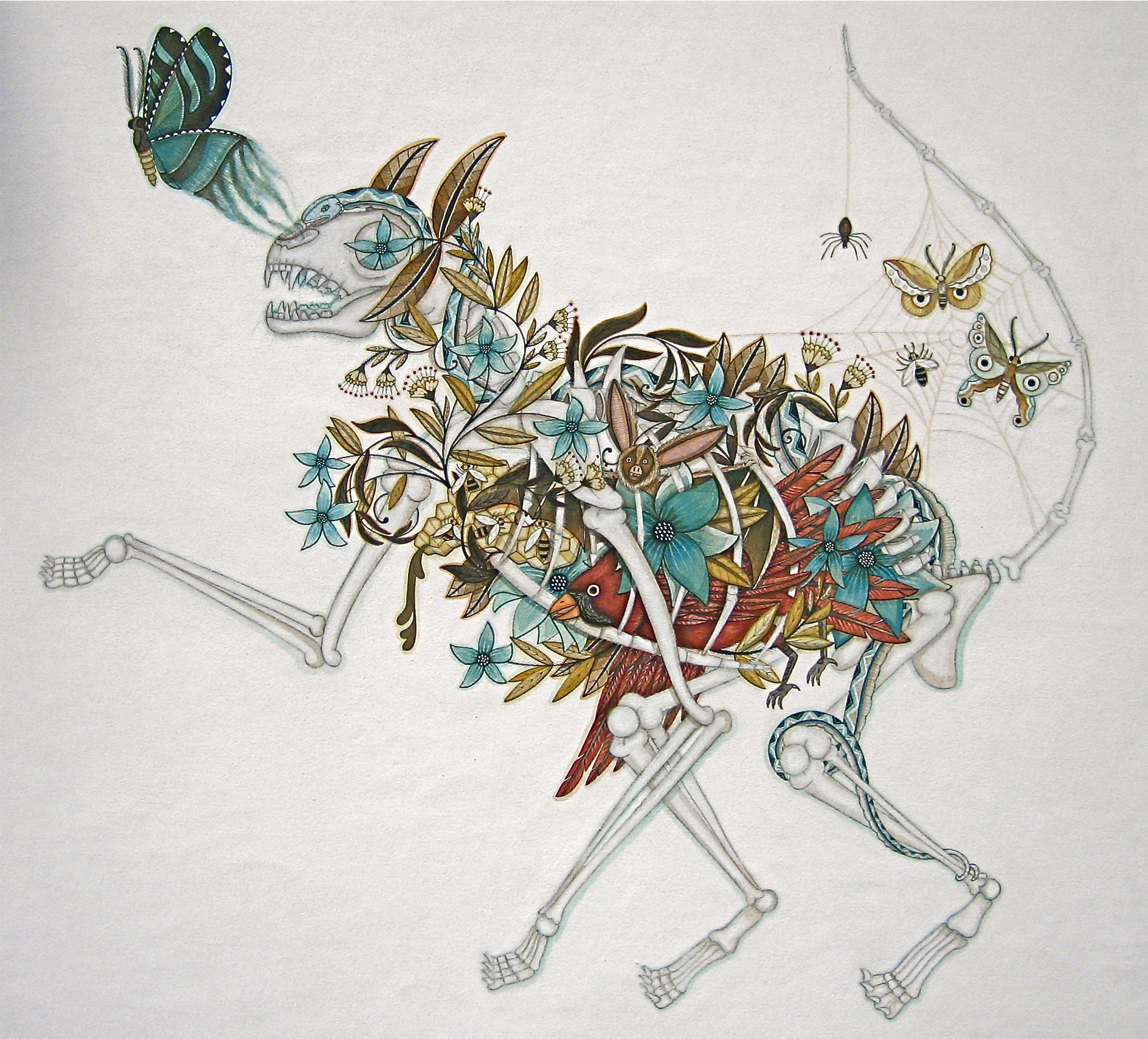
Evan B. Harris – 9 Lives
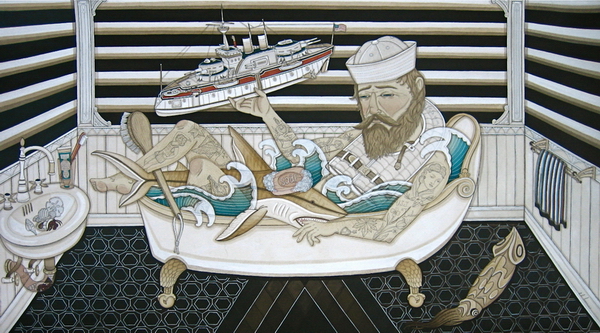
Evan B. Harris – Shark Soap
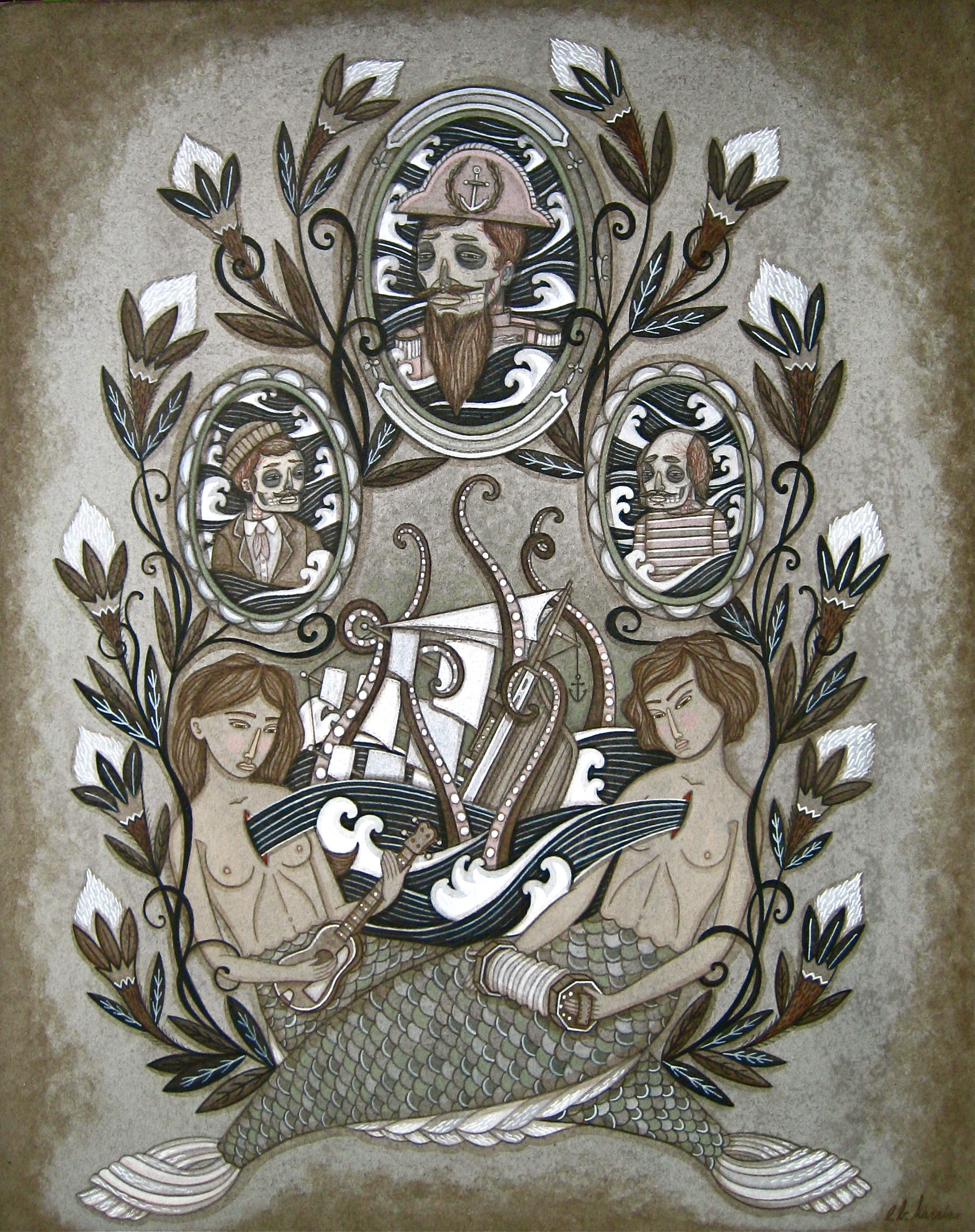
Evan B. Harris – Black Water
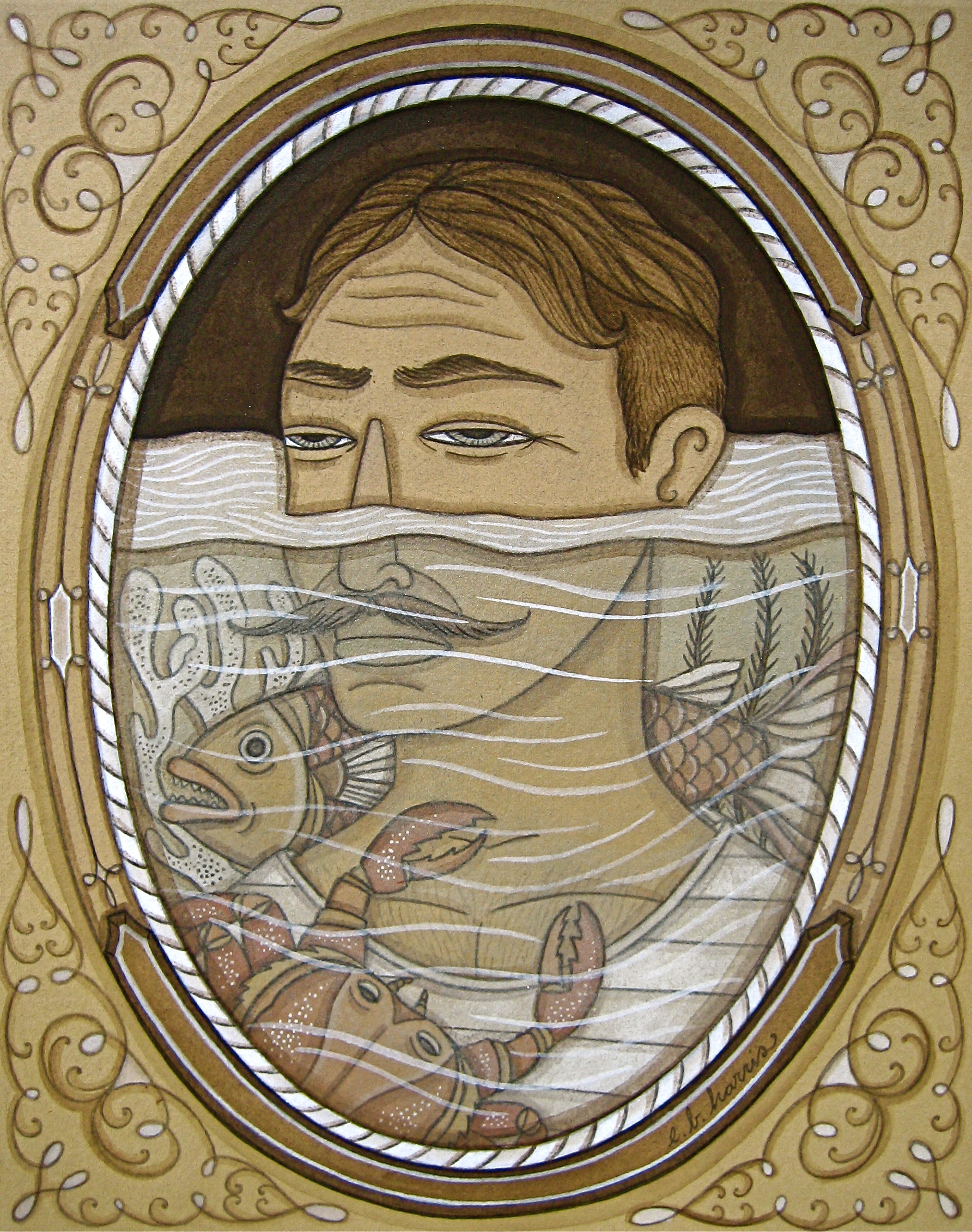
Evan B. Harris – Nose Under
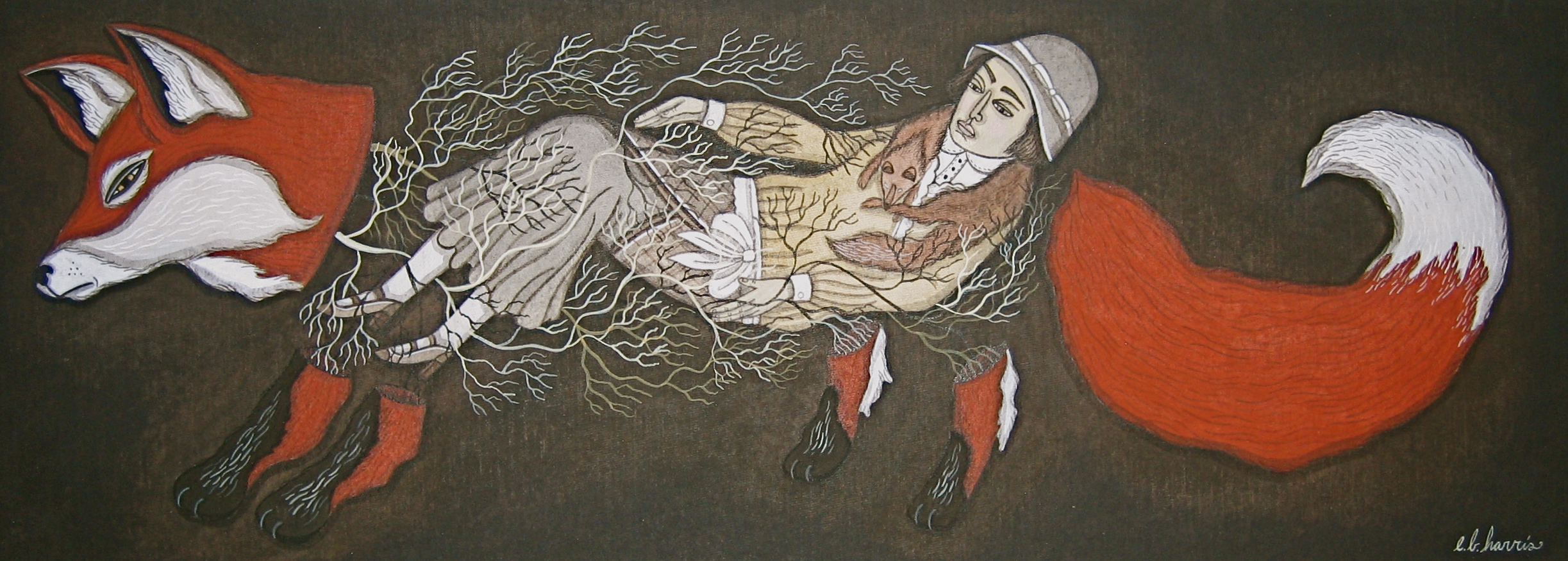
Evan B. Harris – Red Fox
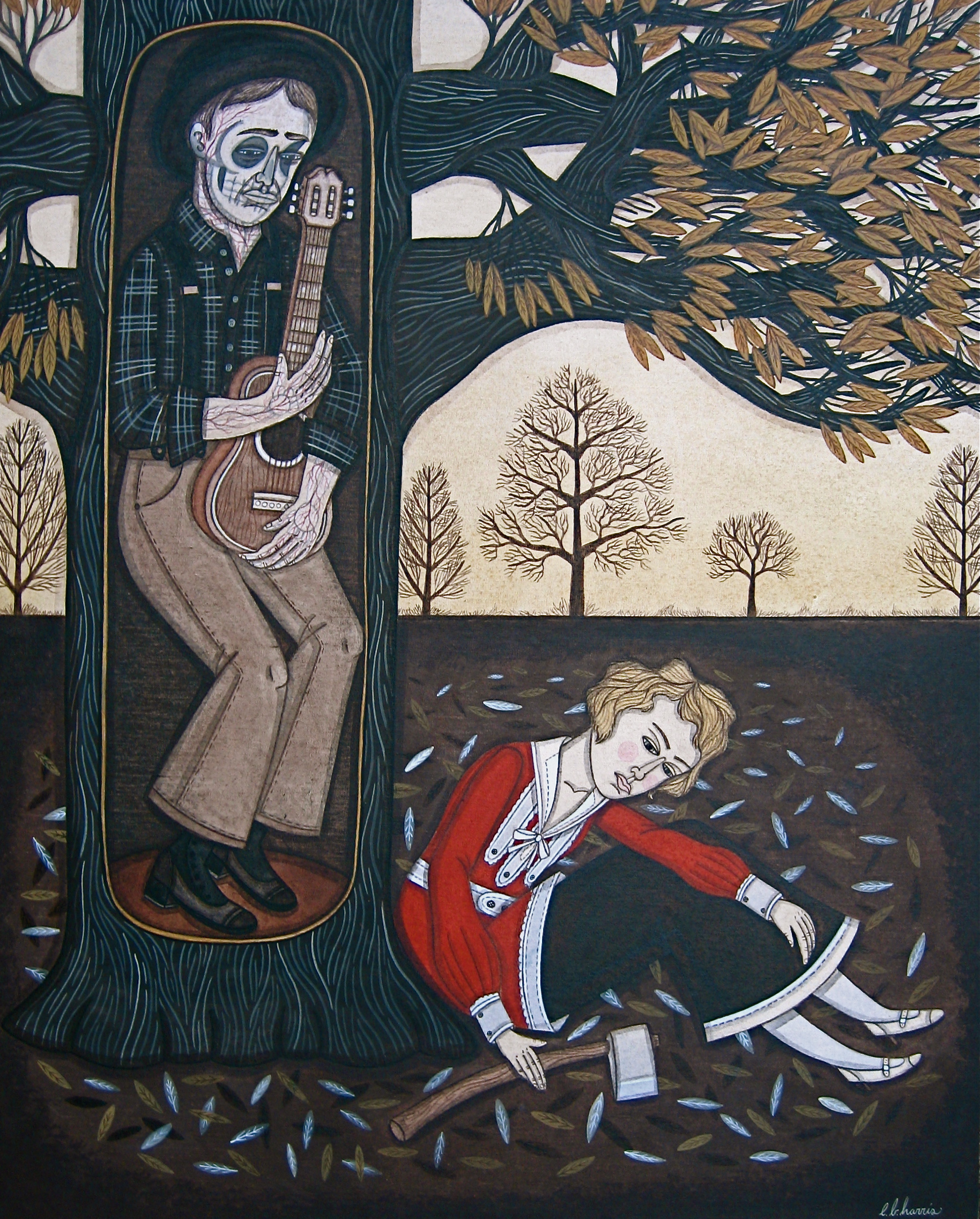
Evan B. Harris – Hidden in the Hollow of the Pine
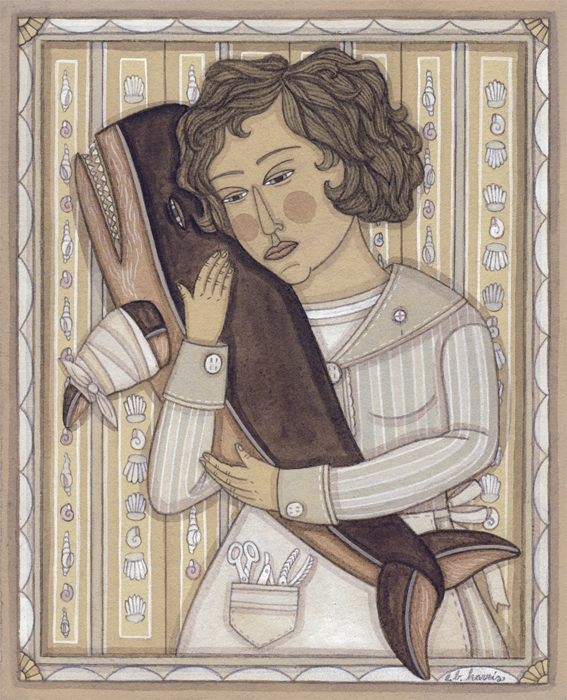
- Evan B. Harris – Wounded Fin
Artist Biography
Evan B. Harris grew up in Medford and Newburg, Oregon, and lived in Hawaii and Seattle before settling in Portland to become a working artist. This winter he will be exhibiting new work in New Orleans, New York, and at Art Basel in Miami Beach, Flordia.
September 9th, 2012 § § permalink
On the theme of How We Fall Out of Love
Landlocked
it’s like choking in June
orchards and snowfall:
I want to speak
of your clavicles, how
sharp and jutted
they seem at skin, or
speak to them and ask
if or if once they
cinched ’round your throat
to pin down words
so they never fell on
my never-deaf ears.
Author Biography
A longtime desert dweller, Sina Evans is a poet and photographer who spends the bulk of her time exploring the intersection where the visual and language arts collide.
September 9th, 2012 § § permalink
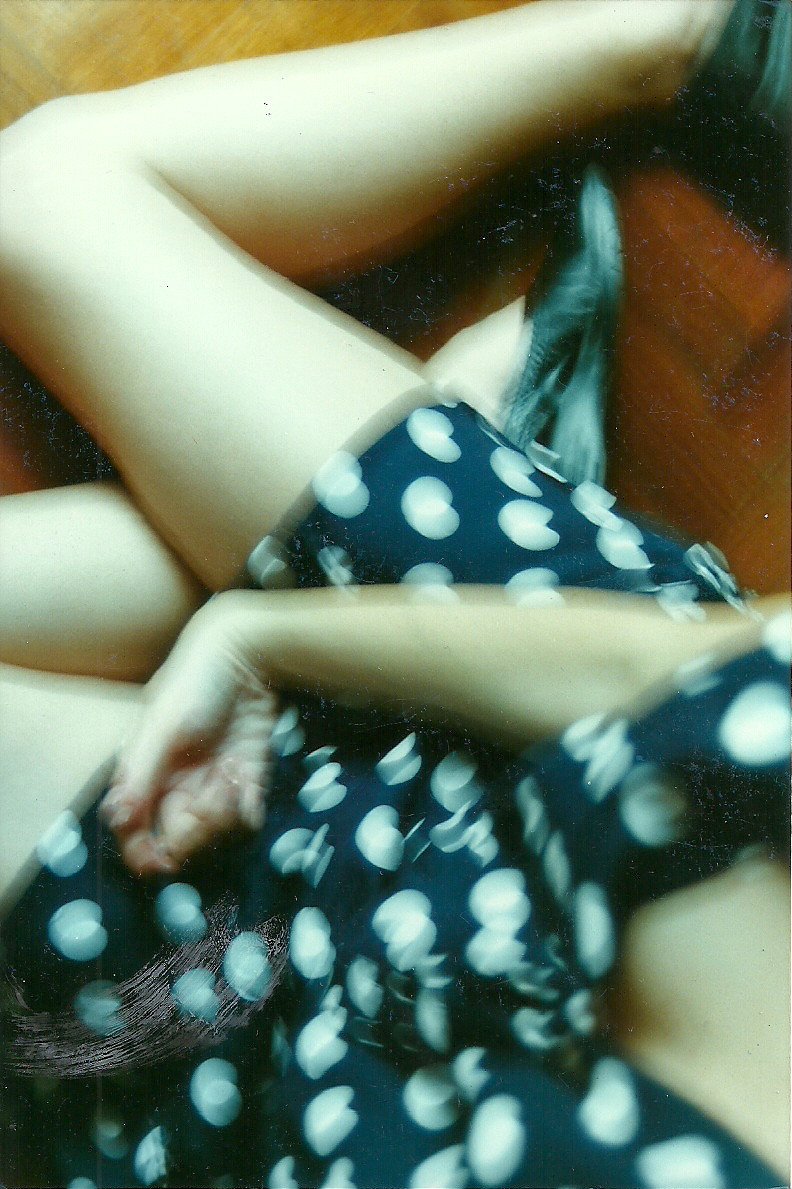
On the Themes of Other Lovers and This Whole Time

Artist Biography
Yolanda Mora was born and studied fine arts in Madrid, Spain. Her work can be found in Unshod Quills, Up the Staircase Quarterly and on the cover of “WATCHING IT BURN” by Mike Meraz (Dog on a Chain Press).
September 9th, 2012 § § permalink
On the theme of How We Fall Out of Love
from Cephalopeda
you are octopus to me—
i grant you three wishes,
and they must be figurative.
you say, giant squid race
through the sky and hang
puffs of ink everywhere
so it rains on your tomatoes
after a week
of hot days
you say, this tentacle
covered with hungry
kisses
and we make love near a graveyard
even though the ground is wet.
you say, within me
is a vestigal shell
a reminder
that there are snails
in the distant past,
which reminds me
of the last time
i glimpsed your breast:
just before you pulled
your sweatshirt on
and locked the door.
Author Biography
Chris Cottrell is a two-time Shelly Reece award-winning poet and one of the first Portland State MFA poetry graduates. His work has appeared in The Scene, Willamette Week, Portland Review, Clackamas Literary Review, Oregon Literary Review, Nervy Girl!, Poor Claudia, Grove Review, THEthe Poetry,and Haggard & Halloo. Cottrell’s chapbooks are [luvthrong] and Normal Park & Paradise (12th Street).
September 9th, 2012 § § permalink
On the theme of This Whole Time
Sun and Butterfly Create Elephant
Not long ago, Butterfly became curious about a solar storm and flew very close to the Sun for a better view. He withstood the intense heat of the Sun because, remember: Butterfly is not a butterfly. Not one of the Sun’s raging solar eddies could catch him, so he didn’t burn.
It so happened that the Sun noticed, although it didn’t see Butterfly as a butterfly. It saw artifacts—undulating imprints where its white-hot blasts were deflected.
Fascinated, the Sun turned more and more of its attention to Butterfly, who hovered and fluttered in awe and admiration.
With so much attention focused on them, the undulating artifacts began to act as a single lens. The billowing inferno aligned itself, converged to a point just beyond the center of the lens, and radiated outward again to the surface of the world.
Perfectly inverted, the storm was transformed, and Elephant alighted like a great, wingless bird onto the spring savanna.

Characters: Butterfly
Butterfly is not actually a butterfly, but was once what one might call a caterpillar.
Both Butterfly and Caterpillar exist at the same time.
Butterfly loves wooded ravines and busy traffic on the Las Vegas Strip on hot summer days.
Insatiably curious, Butterfly once followed a winding stair for days. Drawn in turns by its mysterious shadows and then by faint streams of sunlight along its twists and turns, the quest yielded one new friend and a set of deep footprints that led to a shear drop.
Butterfly is only vaguely aware of Caterpillar, and often wonders about the Sun, especially because there seems to be a possibility that the Sun harbors clues about a certain mysterious stone.
My world is quite near yours, so close that we overlap a bit.
 We have a sun, too, you know—a little different than yours and a little bit the same. It gives light and warmth, just like yours, but its color is more vibrant. It gets a little hotter than yours, but we are used to it.
I think that it’s because of our more vibrant sun that the colors here in our world are a bit more vibrant, too. And our wishes. Our wishes and our mysteries, too, are all turned up a notch.
I am not actually a butterfly. I came here to probe one of those mysteries. I can tell you this about it:
There is a little, new-moon-colored stone I first encountered by a pool in the woods. Our woods. Yes, we have woods. We have quite a lot in common.
This stone shines with a light so pure that if you close your eyes, you can hear a single, soft, exquisite note. Otherwise, it’s really ordinary—small, translucent white and tumbled smooth—unless you touch it.
If you touch it, you will see the ocean. Your ocean, not ours.
It’s as if you are looking through someone else’s eyes at a cold, dark turquoise ocean on another world.
Whose eyes?
The Hidden Side of the Little Stone
Elephant wandered in the late-afternoon woods and stopped at a little shaded pool for a drink of water. Later, he foraged some and found the very stone that Butterfly was exploring and Caterpillar was guarding.
He pried it from the soil and lifted it right up to his eye for a closer look, turning it in the fingers of his trunk. He carried it to the edge of the woods, where the sun was brighter and the grass was turning gold. There, he turned it and turned it, then held it up to his eye again. A line, very slightly bowed, was cut into the side that had been laying face down, for how long, he couldn’t guess.
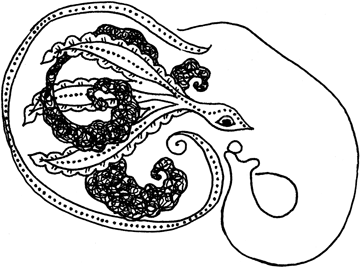
It was well worn, but still looked as though it was part of something bigger. Just a cut, mind you, but one your eye followed to the memory of a line that was much longer—perhaps curving into a shape and then arcing around again to complete itself. Tiny ridges suggested a simple carving tool.
Elephant glanced out at the open plain and lowered the stone, turning it a few more times. He noticed an elephant-foot-sized bit of granite just starting to sprout from the ground, and he put it down there. It might be a good place to come and find the little stone again, if he felt inclined to look for it.
Vague movements and a cloud of dust near the low, dry hills in the distance had caught his attention. Elephant went to investigate.
Characters: Caterpillar
Caterpillar is technically not any older than Butterfly.
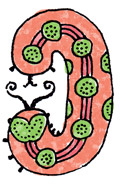
She believes she is the guardian of a mysterious stone, but can’t remember why.
Caterpillar will go out of her way to keep a promise. Vaguely aware that she is incredibly vulnerable to danger, she does everything—everything—as if it may be her last moment alive.
Caterpillar has a cautious fascination with the Sun. She is afraid of it, but she also waits and watches for it to rise (from behind a leaf) in the early morning. She will turn and watch again, no matter what she’s doing, when it’s time for it to set.
Butterfly in Las Vegas
There are rules in Las Vegas:
1. Assume that every situation is governed by rules, especially when there appear to be none.
2. You are required to establish your own rules.
3. You must decide when and how to abide by your rules.
4. If someone else demands that you abide by their rules, you are required to determine whether they conflict with yours and to choose accordingly.
Whenever I visit Las Vegas, I spend a good deal of time flitting around the wider sidewalks on the northern (and older) end of the Strip. Later in the afternoon, the Sun is lower but the heat is still unnerving. There are fewer people about, but it’s just as dusty. Passersby have occasionally noticed me, and generally seem to dislike me. This is a good time and place to practice indifference.
The last time I went, though, I met someone I am still thinking about. He had stepped abruptly out of the black glass doors of a rundown casino, taking me by surprise. I wasn’t quick enough to avoid him, and we bumped heads. There’s a considerable difference in size between our two heads so I was badly knocked, and fell to the ground.
I appear to be quite a small butterfly so I was surprised that he noticed and carefully lifted me up into the palm of his hand. I’m not sure if he thought he had killed me. He ran his finger along the edge of my wings. He gently lifted the tips of my antennas.
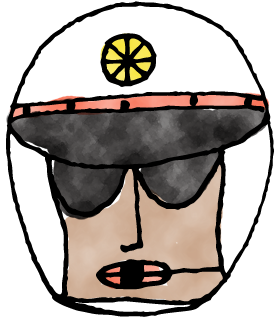
Recovering, I began to squirm so he pulled his finger away and watched. At least, I think he watched because I couldn’t see his eyes. He was wearing shiny, black sunglasses, and a motorcycle helmet, too.
Under his vague gaze, I struggled to my feet and tried out my wings. They seemed fine so I left his palm and fluttered just a little away to see him better. He did turn his head to follow my movements, and I could see now he was a motorcycle policeman. But suddenly, as if he was remembering something, he glanced at his watch and hurried off.
I believe he is, or he has, a piece of the puzzle. I must find him again.

Characters: The Policeman
The Policeman lives and works in Las Vegas. He rides a motorcycle and has never, ever been seen without his helmet.
He has a brother and a sister who live in another city, and he has three really good friends. Two of his friends are blackjack dealers. The third, his closest friend, is vice president of a multinational corporation.
He loves to play stick games, and has a collection of beautiful sticks he’s collected over many years. When he comes home at the end of a long day, he makes himself something to eat and then spreads his beautiful sticks out on the table. He picks up one or the other of them, remembering where he found it, or the person who gave it to him. Then he decides what stick game he’ll play. He can get so absorbed in his game, he won’t hear the door or the phone and will play until the quietest, coolest hours just before sunrise.
Still, no matter how late he goes to bed, he is always up and showered and eating breakfast well before he has to be at work. He takes his job very, very seriously.
At the Sea
It was late in the afternoon, and cold. The mist was so thick I could barely see the looming granite outcrops that stood in a miles-long, irregular row. They were hunched against the waves, and one was just twenty feet from me, mostly shrouded. Thousands of tiny, smooth pebbles, normally a rainbow of glinting specks, were now a thousand sparkling shades of gray, fading quickly to white.
On days like this, I’m moody and yearn for the dark. I’ll dive right into the seething waves, swim clear of the jagged pillars and drop myself like a stone. I don’t need the sun anymore. Its rays were fed to me so perfectly when I was a child that it’s now a part of me, and I take it everywhere I go.
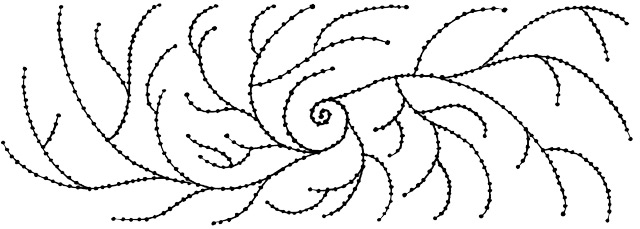
But on this day, a massive whorl of seaweed caught in the underwater squall netted and held me. Shells, fish, pebbles and sand whipped and cut me. I couldn’t fall and I couldn’t rise. Pulled along the relentless coiling swirl, the only thing to do was fold myself like a sleeping leaf and close my eyes.
As soon as I did, I saw the sun.
I was in the woods. I was warm and dry.
I was looking into the eye of an elephant.
I opened my eyes and seaweed whipped my face, flurries of shell and sand cut my flesh.
I closed them and I was alone by a pool.
I was encircled by a weeping caterpillar.
I opened my eyes again, and I lay on the pale and quiet beach, tangled in a slippery mountain of black seaweed.
Author Biography
Penina Finger makes artwork, poems, stories, and collaborations. www.iamnotactuallyabutterfly.wordpress.com/
September 9th, 2012 § § permalink
On the theme of How We Fall Out of Love
Shamrock Motel, Route 17, Outside Corning, New York
You agreed to meet Tuesday
for a lark, ever the wavering
vamp vying for her wanderlust
sharpshooter, tough-guy blue.
Predictable as blaze, you were certain
this time you would conquer
his misbehaving heart,
scale inconstancy’s cloud.
One more corner room—
silty with lust, the mattress
molding and sumped, light years
of love notes fallen flat.
It never works like that.
You, tailed by a slagheap.
His trysting rules in media res,
glacial pebbles a nibble at the pane.
How many years
and you still don’t get
why the window could not break.
You swallowed your tongue,
complicit poet of the gimcrack
walls. Yet another afternoon brewed
hot then cold then hot, molten
blown to glass, mere miles
down that road. Swaying
to the lyric, crystal sips
from a Cole Porter tune.
Swinging its inevitable
fists of ruin.
Their Cheating Hearts
All that’s left in the living room is a rug made in Turkey,
the wool diagrammed from vegetable and root.
She sits by the fireplace, waiting for an omen
in a smoldering wedge of wood.
Hoping for Mary who’ll remind her—
it was only about dancing seams
down a leather skirt
and a poetry that urged,
Pick me.
She scraped plates and scrubbed,
contraband dawns and the smell of Dawn,
those honey-glazed, log-cabin nights.
After their late-late meals
of garden zucchini, potatoes,
and the most royal of Silver Queens.
Now she pours a kettle
over the grounds, slow drip
into a mug that celebrates
the ambidextrous,
above and below the belt.
He’s in the doorway, shirtless,
pointing out a shred of nest
beyond their heads.
She is supposed to be
swimming laps at the Y
then overnight at a friend’s.
They are packing,
his music, his books,
folding his quilt,
each with two corners,
walking to meet.
One last night
to sail their adulterous seas.
In the morning,
he’ll screw hose,
start the siphon
down from the loft
to deflate their watery bed.
Where she was his starlet,
harlot, the frolicking (but married) girl
he begged to talk bawdy-blues dirty,
hurry up and put that dog between my legs
barely the half of it,
slap of skin, snap of shutter,
the salt on an ear of corn,
his addictive sweat.
After he’s gone?
She’ll claw the piney planks.
Supplicant for splinter,
far too willing to trade the wreckage
for that first song,
Irma Thomas on his stereo—you can have
my husband but please don’t mess with my man-—
and the solstice floor grown cold
so they adjourned, seconds on the stairs,
their two-timing turned two-step
marathon in a roadhouse honky-tonk.
Not unlike the Crooked Board Saloon
where he once took her to strut her stuff.
Watched from a stool while she fooled
with a guy down the bar. Watched them
heading out back. Waited inside the door.
Watched as she stretched long down the picnic
table’s bench. Waited for her to catch his eye.
Watched for her knees, opening wide.
Waited for her to lose her open-toed shoes.
Watched.
Author Biography
Nancy Flynn grew up on the Susquehanna River in northeastern Pennsylvania, spent many years on a creek in Ithaca, New York, and now lives near the mighty Columbia in Portland, Oregon. Recent poems have appeared in Blood Orange Review, PANK, qarrtsiluni, and Sugar Mule; her second poetry chapbook, Eternity a Coal’s Throw, will be published in November 2012. More at www.nancyflynn.com.
September 9th, 2012 § § permalink
On the theme of Godzilla
Issei Sagawa
You said it tastes like tuna fish
to the newspapers.
I tend to wear my jeans too long
between washes.
I don’t tell people this.
I tell people
fishermen call tuna
the $50,000 fish.
Washing machines aren’t free.
75 cents per cycle got
my pockets feeling light.
You ever wonder how others do laundry?
My neighbor strings his sheets like filets to drip dry.
His cat pissed in his shoes
so he traded her for a Harley.
Our cat pisses blood sometimes
but we still love him.
I can always expect him at my ankles
when I crack open a can of fish.
I eat tuna when I’m alone and don’t want to cook.
Tuna is easy to prepare
and never disappoints me.
I always know what to expect
inside every tin of the stuff,
not like washing clothes
where I never know if my shirts will shrink
or if proud reds will dull to orange.
Did you swear off seafood?
Does it surprise you that I haven’t?
I wonder what book you are reading right now.
Your tabby is lazily stroking your calves with the brush of her tail.
It’s noon and you still haven’t made breakfast.
Author Biography
Tayler Geiger is a writer and slam poet at Washington University in St. Louis. As a freshman, he competed at the National Poetry Slam in Charlotte, performing as a showcase poet in the finals. His work has also appeared in In Parenthesis. For more: taylergeiger.tumblr.com
September 9th, 2012 § § permalink
On the theme of Milk
Perishable
Milk is for sidewalks,
clear, hard plastic gallons
are ripped open
by overzealous workers
with chubby fingers
and spilled across
stepped-on
sunflowers and
bodega-bought
gum that darkens
the ground.
Milk is for Manhattan,
which runs parallel
to Bovine Avenue
and Moo District
where shoppers with
size two waist lines
drink 2% milk and
mingle in bars.
Milk is for schools,
the grave danger
is the lactose-intolerant
students who drink
chocolate milk under
the guise that it’s
made from illegally
harvested soy, while
eating their
medium-well
done hamburgers
during lunch knowing
that this combination
isn’t very kosher.
Author Biography
Yevgeniy Levitskiy has a B.A. in English-Education from Brooklyn College. His writing has been published in Hot Summer Nights (Inner Child Press), The Fiction Shelf, Green Briar Review, and elsewhere. His forthcoming publications include The Books They Gave Me (Free Press/Simon & Schuster) and Everyday Other Things. He is currently at work on a middle-grade novel.
September 9th, 2012 § § permalink
On the theme of Godzilla
RUBBLE
The skyscraper collapses to one side, a cloud of dust and tumbling letters overtaking the families and financiers on the streets below. Run, they cry, turning, shielding their eyes. They scramble past sports cars and climb over tanks. The ground rumbles beneath their feet. A cereal box topples and crushes three of them before they can scream.
“Not today,” says an old woman, “not now.”
“He needs you,” says her son.
“He needs his father.”
“I’m trying.”
“You’re not.”
A roar echoes down the cardboard canyons and the monster appears, towering over the steel and concrete horizon. Swarms of plastic people begin to spill from the city’s buildings, necks craned and legs churning, eyes wide with disbelief and terror.
“It can’t be,” they mutter, “how is this possible?”
“It’ll only be for an hour,” says the young man.
“It’s never just an hour,” says his mother. “Not for the rest of us. You’re gone for days, and then you stagger back hollow-eyed and covered in filth.”
The old woman looks toward her grandson in the other room, the mop-topped six-year-old slamming a toy lizard against the carpet, bouncing it towards a city of building blocks and empty cardboard. The grandmother sighs.
“You can’t keep doing this,” she says. “You know that.”
“You think I should take him with me?” he says.
“You can stop.”
“You know I can’t.”
Skyscrapers glow orange as the monster belches an endless column of radioactive fire, building after building nothing but ashes at its clawed and scaly feet. The monster crashes through the walls of City Hall. The mayor scrambles through the burning cardboard raining down around him and climbs aboard his triceratops. Together, they race down the avenue.
Two pirates press against a slab of upturned sidewalk as the mayor and his dinosaur pass, smiles painted on their terrified faces. Behind them their ship lies scattered in tiny, plastic piles.
“What do we do now?” says the girl pirate.
“We run,” says the boy pirate.
“Where? Where do we go?”
“Calm down,” says the boy.
“You’re better than this,” says the woman.
“I’m not,” says the man.
“I can’t,” says the girl.
A massive explosion rocks the living room, a tower of blocks crumbling down and burying Action Man. The pirate girl watches in dismay, then falls to her knees.
“He was our only hope,” she says.
“We can do this,” says the boy.
The monster’s giant foot crashes down into the rubble atop the superhero.
“Goddamn it,” the woman says, “you can’t just give up.”
“You don’t understand. Not using is worse than using. Do you really want me here, huddled in the corner, scratching at myself? Is that what you want?”
“I never said it was going to be easy.”
The mother and son stare at one another across the table. The young man slumps, his head down.
“I need help,” he says.
“We need help,” says the girl.
“We don’t,” says the boy.
“You do,” says the woman. “But not mine. Not anymore.”
Buildings tumble into the carpet, concrete and dust filling the air. The pirates bury their faces in their arms. The sidewalk shakes as Godzilla nears.
“We have to go, now,” says the boy pirate.
The old woman leans back into her chair.
The pirate girl trips, her knees hit the cracked pavement. The boy takes her hand.
“You’re my mother,” says the man.
“You’re an addict,” says the woman.
“I’m your son.”
“We can do this,” says the boy.
“I can’t trust you,” says the woman.
“Trust me,” says the boy.
“An hour?” says the woman.
“You promise?” she says.
The alphabet rains down around them. The last of the cereal boxes is in ruins, the street is nothing but rubble. A construction worker crawls toward his truck, only to be trampled by the rampaging monster.
“I promise,” he says.
Author Biography
Eirik Gumeny is the author of the Exponential Apocalypse series and has a chapbook of short fiction forthcoming from Kattywompus Press. His work has been published online a lot, in print occasionally, and has been nominated for the Pushcart Prize at least once. His website is egumeny.com.
September 9th, 2012 § § permalink
On the theme of Milk.
on breaking away
“and calcium
is important too,” the doctor
reminded a mooncaptured,
starshattered child
(played at being
a woman; made
belief.) but curled
like a newborn shedding
its skin, soft-boned, in the
corner of any room surely, lit
by a solitary ray of sinking
sun shifting
through dust shining
no sparkling in your
wide mirror-
enervated eyes surely, a
future here – you always
wanted
to –
“could you just not
put milk in my tea?”
mother’s eyes orbit
deliberately away from
mine.
“i’d rather be able to
taste it
properly,” a comet
in me finds it
necessary to add;
sweetsourshriveldrown but
so what, so what if this is
harsh, so what if this is
cold – frost seeps like
snowflakes into sewer-flooded
lungs, swamp you, encase your
bones; and so what if this is
not
what i wanted – little girl
plans to grow
away from
home
in any room, any
space i ever
please – or no room
at all, out
on your own
as evening sky
swathes trunks and nettle
in reassuring regularity,
leaving
) you
carving sticks and
whittling bones
“see, without
calcium, your bones
will not be strong
enough; you are not yet
grown”
so one day, the moonshattered,
starscattered child
asked, “may
i have some
milk, please? i’d rather be
able to enjoy it
properly –”
sure-boned, venus-
fingered, learning to be
a woman: galaxy-vast and
white-thread-woven
into amatory skies.
ligaments
so here is milk in a
glass, tangible yet
impalpable – clouds
i hiked through in the
italian alps, once upon a
summer;
land obscured
and thoughts
anchored firmly
somewhere, beyond
the mist;
so
milk in this glass,
crystal-frail
but sound
enough
to bear a mother’s
nurturing love
(albeit unintentional, automatic; our bodies are merely
functional)
and sound, enough
[we fly]
there is a
ripple, somewhere
in my air
Author Biography
Camille Thigpen has lived in France, Pennsylvania, and Sweden. She is currently undertaking two new activities: adult life at Bard College, and commissions. More of her poems are included in Taft College Literary Magazine’s May 2012 issue. Contact: thigpen.camille@gmail.com.